
Marcus had spent $15,000 on his new restaurant website. It looked beautiful. The photos were perfect. The menu was easy to read. He launched it on Monday and waited for customers to flood in.
By Friday, he had gotten exactly three visits. All from his own phone.
“Where are all the customers?” he asked his web developer.
“Well,” the developer said carefully, “your website exists. But nobody can find it on Google yet. That takes time.”
Marcus felt frustrated. “How much time? A week? Two weeks?”
“More like 4 to 6 months,” the developer replied.
Marcus almost fell off his chair.
If you’re wondering how long does SEO take for your business, you’re asking the same question thousands of business owners ask every day. The answer might surprise you, but understanding it could save you thousands of dollars and months of frustration, according to experts at Blaze Byte Media, a leading SEO agency based in Nepal that specializes in delivering measurable results for businesses worldwide.
Why Understanding SEO Timelines Matters for Your Business
How long does SEO take is not just a question about waiting. It’s about planning your budget, setting realistic goals, and understanding when you’ll start seeing a return on your investment.
Think about it this way: if you knew that planting a seed would give you fruit in 6 months, you’d plan differently than if you expected fruit in 2 weeks, right? The same goes for SEO.
Here’s what happens when businesses don’t understand SEO timelines:
- They quit too early (usually after 2-3 weeks) because they don’t see results
- They waste money on “quick fix” services that promise instant rankings (these often get you penalized)
- They can’t plan their marketing budget properly
- They lose faith in SEO completely and miss out on long-term growth
But when you understand realistic timelines, you can:
- Plan your cash flow appropriately
- Set achievable goals with your team
- Make smart decisions about when to invest more
- Avoid scams that promise overnight success
- Build a sustainable business growth strategy
The truth is, SEO works. But it works on its own schedule, not yours. Understanding that schedule is the first step to success.
The Honest Answer: How Long Does SEO Actually Take?
Let me give you the straight answer about how long does SEO take without any marketing fluff.
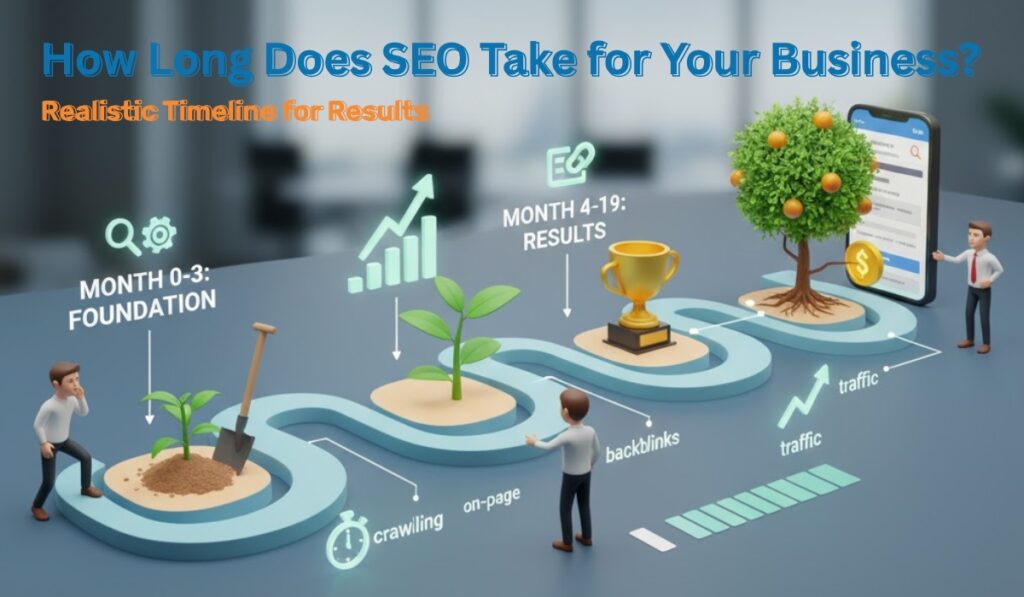
For most businesses, you’ll start seeing your first results in 3 to 6 months. But “results” means different things:
- Small improvements: 1-2 months
- Noticeable traffic increase: 3-6 months
- Significant growth: 6-12 months
- Full potential: 12+ months
Think of SEO like building a house. In month one, you’re laying the foundation. You can’t see much happening, but critical work is getting done. By month three, the walls are up. By month six, you can move in. By month twelve, you’ve decorated and it feels like home.
According to recent industry data, SEO typically requires three to six months before businesses observe measurable increases in organic traffic, leads, or sales, with some cases extending to six to twelve months depending on various factors.
| Timeline | What You Can Expect | What’s Happening Behind the Scenes |
|---|---|---|
| Week 1-4 | Little to no visible change | Google is discovering and analyzing your site |
| Month 2-3 | Small ranking improvements for easy keywords | Your content is being indexed and evaluated |
| Month 4-6 | Noticeable increase in traffic and rankings | Google is starting to trust your site |
| Month 6-9 | Consistent growth in leads and sales | Your authority is building |
| Month 9-12 | Strong positions for competitive keywords | You’re becoming an authority in your niche |
| 12+ Months | Compounding returns, sustained growth | Your SEO investment pays dividends |
Source: Search Engine Land, SEO.com, SE Ranking
This timeline assumes you’re doing SEO correctly and consistently. If you stop and start, or if you’re making mistakes, it takes much longer.
Why Does SEO Take So Long? The Real Reasons
Understanding how long does SEO take means understanding why it can’t happen overnight. Here are the real reasons:
Google Needs Time to Trust You
Google uses a ranking transition algorithm that introduces temporary volatility when changes are made, meaning pages may fluctuate or even drop in rankings before they begin climbing.
Imagine you’re deciding who to recommend to your friends. Would you recommend someone you just met yesterday? Probably not. You’d want to know them for a while first.
Google works the same way. When your website is new or when you make changes, Google needs time to:
- Discover all your pages
- Read and understand your content
- Check if other trusted websites link to you
- See how real users interact with your site
- Compare you against competitors
- Test your site in different search positions
This process doesn’t happen in days. It happens over weeks and months.
You’re Competing Against Established Websites
Think about searching for “best pizza in New York.” The websites ranking first have been around for years. They have:
- Hundreds or thousands of customer reviews
- Links from major news websites
- Years of consistent content publishing
- Strong social media presence
- Established brand recognition
You’re not just trying to be good. You’re trying to be better than websites that have a 5-year head start. That takes time.
The typical top-ranking page is approximately two years old, and pages ranking number one are nearly three years old on average.
Quality Takes Time to Build
Good SEO isn’t about tricks or shortcuts. It’s about building real value:
Creating Quality Content: Writing one blog post takes hours. Writing 50 high-quality posts takes months. But Google rewards websites with deep, helpful content.
Earning Backlinks: You can’t force other websites to link to you overnight. Quality backlinks come from creating content so good that others naturally want to reference it.
Building Authority: Authority means Google sees you as an expert in your field. That comes from consistently providing value over time, not from copying what others do.
Technical Improvements: Fixing technical issues, improving site speed, and optimizing for mobile all take time to implement and even longer for Google to recognize.
The Google Sandbox Effect
New websites often experience a delay in gaining visibility known as the Google Sandbox, an unofficial term for the period, typically one to three months, during which new sites may not rank well in search results.
If your website is brand new, you’ll face what’s called the “Google Sandbox.” This is like a trial period where Google keeps your site in a testing phase before giving it full trust.
Why? Because Google has been burned too many times by spam websites. So new sites have to prove themselves first.
This doesn’t mean your new website can’t rank at all. But it means even with perfect SEO, a brand new website will take longer than an established one.
Factors That Speed Up or Slow Down Your SEO Timeline
Not every business experiences the same timeline. How long does SEO take depends on several factors specific to your situation:
1. Your Website’s Age and History
Brand New Website (0-6 months old): Expect 6-12 months to see significant results. Google needs extra time to trust new sites.
Established Website (1-3 years old): You might see results in 3-6 months because you already have some trust built up.
Older Website (3+ years): Could see improvements in 2-4 months if you’ve been maintaining it reasonably well.
Warning: An old website with past penalties or spam issues might take even longer because you need to recover Google’s trust first.
2. Your Industry Competition Level
Think of competition like a race. In some races, there are only 5 runners. In others, there are 500. Obviously, finishing in the top 3 is easier when there are fewer competitors.
Low Competition Niches (Local services, specialized products):
- Examples: “plumbing services in small town Idaho” or “custom handmade pottery Iowa”
- Timeline: 2-4 months for good results
- Why it’s faster: Fewer competitors, less content needed to rank
Medium Competition Niches (Professional services, e-commerce):
- Examples: “lawyer in Dubai” or “online fitness coaching”
- Timeline: 4-8 months for solid rankings
- Why it takes longer: More established competitors, need more content and backlinks
High Competition Niches (Finance, insurance, major retail):
- Examples: “credit cards” or “car insurance” or “best laptops”
- Timeline: 12-24+ months to compete
- Why it’s slowest: Major brands with huge budgets, thousands of pages of content, and years of authority
For local business SEO, initial results may appear within three to four months, while medium-competitive niches typically require six to twelve months, and highly competitive sectors such as online industries may need sixteen to twenty-four months to achieve significant outcomes.
3. Your SEO Budget and Resources
Money doesn’t directly buy rankings, but it does buy the resources that create rankings. Here’s how budget affects how long does SEO take:
Small Budget ($200-500/month):
- You can afford: Basic optimization, few articles per month, minimal link building
- Timeline: 8-12 months for meaningful results
- Best for: Small local businesses with low competition
Medium Budget ($500-2,000/month):
- You can afford: Comprehensive optimization, regular content, steady link building
- Timeline: 4-8 months for strong results
- Best for: Growing businesses in medium competition markets
Large Budget ($2,000+/month):
- You can afford: Aggressive content strategy, professional link building, technical experts
- Timeline: 3-6 months for substantial growth
- Best for: Businesses in competitive markets or those wanting fast growth
At Blaze Byte Media, we’ve structured our pricing to fit different business needs and timelines. Our starter SEO package begins at just $199/month for businesses starting their SEO journey, while our standard package at $349/month includes more aggressive strategies for faster results.
4. Quality of Your Existing Website
Starting with a well-built website versus a broken one makes a huge difference.
Healthy Website (Fast, mobile-friendly, no major issues):
- Timeline: Standard 3-6 months
- What helps: Google can easily crawl and understand your site
Website with Problems (Slow, broken links, poor mobile experience):
- Timeline: Add 2-4 months to fix issues first
- What’s needed: Technical improvements before SEO work even starts
Severely Broken Website:
- Timeline: May need complete rebuild (6+ months)
- Better option: Sometimes starting fresh is faster than fixing
5. Your Content Strategy
Content is the fuel that powers SEO. More importantly, it’s the quality and consistency of content that matters.
Minimal Content (1-2 articles per month):
- Timeline: 8-12 months
- Growth: Slow but steady
Moderate Content (4-8 articles per month):
- Timeline: 4-8 months
- Growth: Consistent, noticeable improvements
Aggressive Content (10+ articles per month):
- Timeline: 3-6 months
- Growth: Rapid, assuming quality remains high
But here’s the catch: 10 mediocre articles won’t beat 2 excellent ones. Quality always wins over quantity.
6. Your Consistency
This is the factor most businesses underestimate. How long does SEO take often depends more on consistency than anything else.
Imagine you’re trying to lose weight. Would you expect results if you:
- Exercised for one week, then took a month off?
- Ate healthy for three days, then ate junk for two weeks?
- Kept changing your workout routine every week?
Of course not. SEO is the same way.
Inconsistent SEO (stopping and starting):
- Timeline: Can take 2-3x longer
- Problem: You lose momentum every time you stop
Consistent SEO (steady, ongoing work):
- Timeline: Standard expectations apply
- Benefit: Momentum builds over time
The businesses that succeed at SEO are the ones that show up every single month, doing the work, even when they don’t see immediate results.
Month-by-Month: What to Expect from Your SEO Journey
Let me walk you through a realistic month-by-month breakdown of how long does SEO take and what actually happens during each phase.
Month 1: The Foundation Phase
What’s Happening: This month is all about setting up for success. Nothing exciting happens yet, but crucial work is being done.
The Work:
- Complete SEO audit of your website
- Identify technical problems (slow loading, broken links, mobile issues)
- Research keywords your customers actually search for
- Analyze what competitors are doing
- Fix critical technical issues
- Optimize existing pages (titles, descriptions, headers)
- Submit sitemap to Google
What You’ll See: Probably nothing. Maybe a tiny bump in traffic, but don’t expect much.
What You Shouldn’t Do: Panic and quit. This is like going to the gym once and wondering why you’re not fit yet.
What You Should Do: Trust the process. Review the work being done. Make sure your SEO team or agency is thorough.
Month 2-3: Early Growth Phase
What’s Happening: Google is starting to notice your improvements. You’re beginning to rank for easier, less competitive keywords.
The Work:
- Publishing new, high-quality content regularly
- Continuing technical improvements
- Starting link building outreach
- Improving internal linking structure
- Adding schema markup
- Optimizing images and media
What You’ll See:
- Small increases in traffic (maybe 10-20%)
- Your website appearing on page 2-3 for some keywords
- Increased indexation (more pages showing up in Google)
- Few inquiries or leads from organic search
What’s Normal: Lots of ranking fluctuations. Your pages might jump from position 45 to 22, then back to 35. This is Google testing where you belong.
Month 4-6: Momentum Phase
What’s Happening: This is when things start getting exciting. Your consistent work is paying off. Google is starting to trust your site.
The Work:
- Continued content creation (now with data on what’s working)
- More aggressive link building
- Updating and improving old content
- Expanding into more competitive keywords
- Building topical authority in your niche
What You’ll See:
- Significant traffic increase (30-70% growth)
- First page rankings for multiple keywords
- Actual leads and inquiries from search
- Competitors noticing your presence
- Better engagement metrics (people staying longer on your site)
The Breakthrough Moment: Usually happens around month 5-6. You’ll check your analytics one day and see a clear upward trend. This is when most business owners say “Oh, this is actually working!”
Month 6-9: Acceleration Phase
What’s Happening: You’ve built momentum. Results are compounding. Each new piece of content performs better because your domain has more authority.
The Work:
- Scaling content production
- Pursuing higher-value keywords
- Advanced link building strategies
- Expanding into related topics
- Optimizing conversion paths
What You’ll See:
- Traffic doubling or tripling from month 1
- Top 3 positions for many important keywords
- Consistent leads every week from organic search
- Revenue directly attributable to SEO
- Lower cost per acquisition compared to paid ads
What Changes: Your business operations. You might need to hire more staff to handle the increased inquiries. This is a good problem to have!
Month 9-12: Consolidation Phase
What’s Happening: You’re becoming an authority in your space. Google sees you as a reliable source. New content ranks faster because of your established trust.
The Work:
- Defending your rankings (updating content to stay current)
- Expanding into new related keywords
- Building more authority through advanced content
- Optimizing for conversions, not just traffic
- Starting to see compounding returns from past work
What You’ll See:
- Stable, consistent traffic (200-400% increase from start)
- Ranking for highly competitive keywords
- Brand searches increasing (people searching for your business name)
- Passive leads coming in regularly
- ROI finally beating paid advertising
After 12 Months: Growth Phase
What’s Happening: SEO is now a reliable, predictable lead source. Your past work continues paying dividends.
What You’ll See:
- Continuous growth without proportional effort increase
- New pages ranking faster (sometimes within weeks)
- Authority to rank for almost any keyword in your niche
- Sustainable competitive advantage
- Significantly reduced customer acquisition costs
This is where SEO becomes truly powerful. Your investment from months ago keeps generating returns without additional spending.
Real Business Examples: How Long Did SEO Actually Take?
Let me share real examples of how long does SEO take in different scenarios. These are actual results, not made-up success stories.
Example 1: Local Service Business (Plumbing Company)
Starting Point: Family-owned plumbing business in suburban area, 10 years old but never did SEO.
Competition Level: Low-medium (15 other plumbers in area)
Budget: $349/month (Blaze Byte Media standard SEO package)
Timeline:
- Month 1-2: Fixed website speed issues, added location pages
- Month 3: Started appearing on page 2 for “plumber near me” searches
- Month 4: First page rankings for several local keywords
- Month 5: Got 12 calls directly from Google search
- Month 6: Ranking #1 for “emergency plumber [city name]”
Results After 6 Months:
- 320% increase in website traffic
- 8-12 qualified calls per week from search
- $15,000 additional monthly revenue
- ROI: 43x their investment
Why It Worked: Low competition + consistent local SEO + good service reputation = faster results.
Example 2: E-commerce Store (Fitness Equipment)
Starting Point: New online store, launched 3 months ago, selling home gym equipment.
Competition Level: High (competing against Amazon, major retailers)
Budget: $699/month (Blaze Byte Media standard AEO package)
Timeline:
- Month 1-3: Google Sandbox effect, minimal visibility
- Month 4-5: Started ranking for long-tail product keywords
- Month 6-8: Some product pages reaching page 1
- Month 9-10: Major breakthrough, multiple top 5 rankings
- Month 12: Competing with major retailers for primary keywords
Results After 12 Months:
- 1,250% increase in organic traffic
- Ranking for 450+ keywords
- 35% of total sales from organic search
- $42,000 in monthly revenue from SEO traffic
Why It Took Longer: New domain + Google Sandbox + high competition = longer timeline. But the results eventually came.
Example 3: Professional Services (Law Firm)
Starting Point: Established law firm (8 years), poor website, no previous SEO.
Competition Level: Very high (competitive legal market)
Budget: $899/month (Custom package)
Timeline:
- Month 1-2: Complete website redesign for speed and mobile
- Month 3-4: Technical issues resolved, content strategy begins
- Month 5-7: Gradual ranking improvements
- Month 8: Breakthrough for several practice area keywords
- Month 9-12: Consistent page 1 rankings
Results After 12 Months:
- 185% increase in organic traffic
- 25-30 qualified consultations per month from search
- Average case value: $3,500
- Monthly revenue impact: $87,500
- ROI: 97x investment
Why It Took Time: Had to overcome website problems first, then compete in very competitive market.
Example 4: Small Local Restaurant
Starting Point: New restaurant, opened 4 months ago, no online presence.
Competition Level: Medium (50+ restaurants in area)
Budget: $199/month (Blaze Byte Media starter SEO package)
Timeline:
- Month 1: Created Google Business Profile, basic website optimization
- Month 2: Started getting reviews, added menu pages
- Month 3: Appearing in local map pack occasionally
- Month 4: Consistent local map pack appearances
- Month 5-6: Top 3 in local map pack for main keywords
Results After 6 Months:
- 400% increase in website visitors
- Showing in Google Maps for “restaurant near me” searches
- 15-20 reservations per week from Google
- Filled most evening slots without other advertising
Why It Worked Fast: Local SEO + Google Business Profile optimization works faster than traditional SEO for local businesses.
Common Mistakes That Make SEO Take Longer
Understanding how long does SEO take also means knowing what not to do. These mistakes can add months to your timeline:
Mistake 1: Changing Strategies Too Often
SEO strategy is like a seed you plant. If you dig it up every week to check if it’s growing, you’ll kill it.
What Happens: Many businesses try one approach for 6 weeks, see minimal results, panic, and switch to a completely different strategy. Then they repeat this cycle.
The Impact: Every time you change strategies, you essentially restart your timeline. You lose any momentum you built.
The Fix: Choose a strategy based on proven methods, then commit to it for at least 6 months before making major changes.
Mistake 2: Targeting Impossibly Competitive Keywords
What Happens: A small local bakery decides they want to rank #1 for “best bakery in America” on day one.
The Impact: You waste months chasing keywords you’ll never realistically rank for, while ignoring easier wins.
The Fix: Start with low-competition, long-tail keywords. Build authority gradually, then tackle bigger keywords.
Example progression:
- Month 1-3: “gluten-free bakery in [small town]”
- Month 4-6: “best gluten-free bakery [city]”
- Month 7-12: “gluten-free bakery [state]”
- Year 2+: “best gluten-free bakery America”
Mistake 3: Ignoring Technical Problems
What Happens: Your website takes 15 seconds to load, doesn’t work on mobile, and has broken links everywhere. But you keep creating content hoping it’ll rank.
The Impact: It’s like pouring water into a bucket with holes. No matter how much content you create, technical problems prevent you from ranking.
The Fix: Fix technical issues in month 1 before investing heavily in content.
Mistake 4: Creating Thin, Low-Quality Content
What Happens: Publishing 50 short, shallow articles because you heard “content is king.”
The Impact: Google ignores thin content. You waste time and money creating content that never ranks.
The Fix: Create fewer, better pieces of content. One excellent 3,000-word guide beats ten 300-word articles every time.
Mistake 5: Buying Spam Links
What Happens: An agency offers to “get you 1,000 backlinks for $99!” You buy them.
The Impact: Google penalizes your site. You drop out of rankings completely. Recovery can take 12-18 months.
The Fix: Build quality links naturally through great content and legitimate outreach. It’s slower but sustainable.
Mistake 6: Stopping SEO When You See Results
What Happens: After 6 months of SEO, you’re ranking well. You think “Great, I’m done!” and stop all SEO work.
The Impact: Within 2-3 months, your rankings start dropping. Competitors who kept working overtake you.
The Fix: SEO is ongoing. Once you rank, maintenance keeps you there. Stopping SEO is like stopping exercise once you get fit—you lose your gains.
How to Speed Up Your SEO Results (Safely)
While how long does SEO take has natural limits, there are legitimate ways to accelerate results:
Strategy 1: Start with Low-Hanging Fruit Keywords
Don’t aim for the hardest keywords first. Start with easy wins to build momentum.
How to Do It:
- Find keywords you already rank for on page 2-3
- Identify low-competition keywords in your niche
- Target location-specific keywords (easier to rank)
- Look for question-based keywords
Why It Works: Quick wins build domain authority, which helps you rank for harder keywords faster.
Example: Instead of targeting “fitness training” (impossible), target “HIIT workout for beginners over 50 in Dallas” (achievable in 2-3 months).
Strategy 2: Fix Technical Issues Immediately
Every technical problem is a brake on your SEO progress. Remove the brakes first.
Priority Fixes:
- Site speed (aim for under 3 seconds load time)
- Mobile responsiveness (60% of searches are mobile)
- HTTPS security (Google requires this)
- Crawl errors and broken links
- Proper XML sitemap
Impact: Can cut 1-2 months off your timeline by letting Google properly crawl and index your site.
Strategy 3: Earn High-Quality Backlinks
One excellent backlink can do more than 100 mediocre ones.
How to Get Quality Links:
- Create content so good that people naturally link to it
- Guest post on respected industry websites
- Get featured in industry publications
- Build relationships with other business owners
- Create original research or data that others cite
Warning: Avoid buying links, participating in link schemes, or using spammy tactics. These can set you back months.
Strategy 4: Optimize for Featured Snippets
Featured snippets appear at the very top of Google results, above even the #1 ranking.
How to Win Snippets:
- Answer questions directly and concisely
- Use clear formatting (lists, tables, step-by-step guides)
- Include the question in your H2 or H3 tags
- Provide comprehensive but scannable answers
Benefit: You can jump from position 5 to position 0 (featured snippet) and capture significantly more traffic immediately.
Strategy 5: Focus on User Experience
Google increasingly ranks sites that users actually like.
What to Improve:
- Make navigation intuitive and clear
- Improve page load speed
- Use clear calls-to-action
- Make content easy to read (short paragraphs, bullet points)
- Add helpful images and videos
- Ensure mobile experience is excellent
Impact: Better user experience signals to Google that your site deserves higher rankings.
Strategy 6: Be Strategic About Content
Create content that serves multiple purposes.
Smart Content Strategy:
- Each piece targets multiple related keywords
- Content clusters around core topics (pillar pages)
- Update and improve existing content (faster than creating new)
- Focus on content types that earn links (original research, tools, comprehensive guides)
Example: Instead of 10 separate articles about different types of workouts, create one massive “Ultimate Guide to Home Workouts” that ranks for dozens of related keywords.
Setting Realistic Expectations: What Success Looks Like
When asking how long does SEO take, you need to define what success means for your business.
Different Definitions of Success
Traffic Success: More people visiting your website
- Timeline: 3-6 months to see consistent growth
- Metric: 50-200% increase in organic traffic
Ranking Success: Appearing on page 1 for important keywords
- Timeline: 4-8 months for medium competition keywords
- Metric: Top 10 positions for 10-20 target keywords
Lead Success: Getting actual inquiries and contacts
- Timeline: 4-8 months depending on industry
- Metric: 10-50+ qualified leads per month
Revenue Success: Making money directly from SEO
- Timeline: 6-12 months
- Metric: Positive ROI, SEO-generated revenue exceeding SEO costs
Authority Success: Becoming a recognized expert in your field
- Timeline: 12-24 months
- Metric: Brand searches, industry recognition, natural backlinks
What Good Progress Looks Like
After 3 Months:
- 20-40% traffic increase
- Ranking on page 2-3 for target keywords
- Improved domain authority
- A few backlinks from quality sources
- Better engagement metrics
After 6 Months:
- 50-100% traffic increase
- Page 1 rankings for several keywords
- Consistent weekly leads
- Noticeable brand recognition
- Positive ROI beginning to show
After 12 Months:
- 100-300% traffic increase
- Top 3 positions for important keywords
- SEO as primary lead source
- Strong ROI (3-10x investment)
- Sustainable competitive advantage
Red Flags: When to Worry
Sometimes slow results are normal. Sometimes they indicate a problem. Here’s when to be concerned:
After 6 Months, If You See:
- Zero increase in traffic
- No improvement in any keyword rankings
- No new backlinks acquired
- No technical improvements made
- No content created or updated
What to Do: Either your strategy is wrong, or your SEO partner isn’t doing their job. Time for a serious conversation or a new approach.
Warning Signs of Bad SEO:
- Promises of “first page in 2 weeks”
- Guaranteed rankings (no one can guarantee Google rankings)
- Secret proprietary methods they can’t explain
- Hundreds of backlinks appearing overnight
- Duplicate or spun content
- Black hat tactics
If you see these, your SEO timeline won’t just be slow—you might get penalized and lose months of progress.
When to Hire Professional Help vs. DIY SEO
Deciding between doing SEO yourself or hiring experts affects how long does SEO take significantly.
When DIY SEO Makes Sense
Good Fit If:
- You’re a small local business in low competition market
- You have time to learn and implement (5-10 hours/week)
- Your budget is under $200/month
- You enjoy learning new technical skills
- You can commit for 12+ months
Expected Timeline: 8-15 months for significant results (learning curve adds time)
Pros: Lower cost, complete control, deep understanding of your business
Cons: Steeper learning curve, slower results, easy to make costly mistakes
When to Hire Professional SEO Help
Good Fit If:
- You’re in medium to high competition market
- Your time is worth more than DIY savings
- You want faster, more reliable results
- You need expertise you don’t have
- You can invest $200-1,000+/month
Expected Timeline: 4-10 months for significant results (expertise speeds things up)
Pros: Faster results, avoid mistakes, scalable, ongoing expert support
Cons: Higher upfront cost, need to find trustworthy partner
Why Businesses Choose Blaze Byte Media
At Blaze Byte Media, we’ve helped hundreds of businesses answer the question “how long does SEO take” with actual results instead of promises.
What Makes Us Different:
Dedicated Specialists: We don’t have one person trying to do everything. Our SEO team focuses exclusively on SEO. Our AEO team specializes in AI Engine Optimization. Our GEO team handles Generative Engine Optimization. You get experts, not generalists.
100% Success Rate: Every single client we’ve worked with has seen rank increases within 3 months. Not most clients. Every client. That’s because we focus on proven strategies, not experimental tactics.
Transparent Pricing: Our pricing is straightforward and designed for small to medium businesses:
- SEO Starter: $199/month (perfect for local businesses just starting)
- SEO Standard: $349/month (for businesses ready to grow faster)
- AEO Starter: $449/month (optimize for AI platforms like ChatGPT)
- AEO Standard: $699/month (comprehensive AI optimization)
- GEO Starter: $399/month (get found in generative AI search)
- GEO Standard: $599/month (dominate generative search results)
Results-Focused: We don’t just care about rankings. We care about what rankings bring you: more leads, more revenue, more growth. Our strategies are built around business outcomes, not vanity metrics.
Global Reach from Nepal: Based in Nepal, we serve clients worldwide—Dubai, USA, Europe, Australia, and beyond. Our location allows us to offer world-class SEO services at prices that make sense for growing businesses.
Want to know exactly how long SEO will take for your specific business? Email us at [email protected] for a free consultation. We’ll analyze your situation and give you a realistic timeline based on your industry, competition, and goals.
The Truth About “Fast” SEO Services
When researching how long does SEO take, you’ll encounter services promising much faster results. Let me give you the honest truth about these.
What “First Page in 30 Days” Really Means
Some agencies promise first-page rankings in weeks. Here’s what they’re not telling you:
The Fine Print:
- They target super easy, low-traffic keywords nobody searches for
- They might use black hat tactics that get you penalized later
- They show rankings for branded searches (your company name, which should rank anyway)
- They cherry-pick one or two easy wins while ignoring important keywords
The Reality: Legitimate first-page rankings for competitive, valuable keywords take months, not weeks. Anyone promising otherwise is either lying or using tactics that will hurt you long-term.
Black Hat SEO: The Dangerous Shortcut
Black hat SEO refers to tactics that violate Google’s guidelines to achieve faster rankings.
Common Black Hat Tactics:
- Buying thousands of spam links
- Keyword stuffing (repeating keywords unnaturally)
- Cloaking (showing different content to Google than to users)
- Private blog networks (fake websites created just for links)
- Copied or spun content
The Promise: Rankings in weeks instead of months.
The Reality: These tactics might work temporarily, but Google catches them. When they do:
- Your site gets penalized and disappears from search
- Recovery takes 12-18 months (sometimes impossible)
- You lose all the money you invested
- Your business reputation suffers
The Lesson: Slow and steady wins this race. There are no shortcuts that don’t eventually backfire.
What Actually Fast SEO Looks Like
There are legitimate ways to see faster results:
PPC + SEO Combo: Run paid ads while building organic rankings. This gives you immediate traffic while SEO builds long-term results.
Timeline: Immediate traffic from ads, organic results in normal 4-6 months.
Local SEO: Optimizing for local search generally shows faster results than national SEO.
Timeline: 2-4 months for local businesses in smaller markets.
Low Competition Niches: If you’re in a niche with little competition, results come faster.
Timeline: 2-3 months possible in very low competition areas.
Established Domain: If your website is already old and trusted, improvements happen faster.
Timeline: 2-4 months for established sites.
These are the only “fast” approaches that actually work without risking your business.
Industry-Specific Timelines: How Long Does SEO Take for Different Businesses?
How long does SEO take varies significantly by industry. Here’s what to expect in different sectors:
Local Service Businesses (Plumbers, Electricians, Cleaners)
Competition Level: Low to Medium
Expected Timeline: 3-6 months
Why It’s Faster:
- Smaller geographic target
- Less competition
- Local SEO signals work faster
- Google Business Profile optimization shows quick results
Focus Areas: Google Business Profile, local citations, customer reviews, location pages
First Results: Often see inquiries by month 2-3
Restaurants and Cafes
Competition Level: Medium to High (in cities)
Expected Timeline: 2-5 months
Why Results Vary:
- Highly dependent on location
- Visual content (photos) impacts rankings quickly
- Reviews heavily influence success
Focus Areas: Google Business Profile, food photography, menu optimization, review generation
First Results: Usually see increased foot traffic by month 3
E-commerce and Retail
Competition Level: High to Very High
Expected Timeline: 8-18 months
Why It Takes Longer:
- Competing against major retailers and Amazon
- Need extensive product content
- Requires significant link building
- Technical complexity of large catalogs
Focus Areas: Product optimization, category pages, technical SEO, content marketing
First Results: Long-tail product keywords rank first (month 4-6), broader terms later
Professional Services (Lawyers, Accountants, Consultants)
Competition Level: Very High
Expected Timeline: 6-12 months
Why It’s Challenging:
- High-value keywords attract major competition
- Established firms dominate results
- Requires demonstrating expertise and authority
Focus Areas: Content marketing, case studies, local SEO, reputation management
First Results: Thought leadership content ranks first (month 4-5), service keywords later
Healthcare and Medical
Competition Level: High
Expected Timeline: 6-12 months
Why It’s Unique:
- Google’s YMYL (Your Money Your Life) scrutiny
- Requires exceptional E-E-A-T signals
- Need for medical expertise and credentials
Focus Areas: Doctor profiles, medical content, patient reviews, local SEO
First Results: Informational content ranks first (month 3-4), treatment keywords later
Real Estate
Competition Level: High
Expected Timeline: 5-10 months
Why Competition Is Fierce:
- Major portals (Zillow, Realtor.com) dominate
- High transaction values attract many competitors
- Geographic specificity required
Focus Areas: Neighborhood pages, property listings, market reports, local authority
First Results: Neighborhood and location pages rank first (month 4-6)
SaaS and Technology
Competition Level: Very High
Expected Timeline: 8-15 months
Why It’s Long-Term:
- Competing against well-funded companies
- Technical topics require depth
- Long sales cycles mean attribution is complex
Focus Areas: Educational content, comparison pages, use cases, technical documentation
First Results: Educational content ranks first (month 5-7), commercial terms much later
B2B Services
Competition Level: Medium to High
Expected Timeline: 6-12 months
Why It Takes Time:
- Complex buyer journeys
- Need to demonstrate industry expertise
- Smaller search volumes require patience
Focus Areas: Industry insights, case studies, whitepapers, LinkedIn integration
First Results: Thought leadership gains traction (month 4-6), lead generation follows
Measuring Progress: What to Track While Waiting for Results
Since how long does SEO take spans months, you need to track the right metrics to know you’re on the right path.
Leading Indicators (Show Progress Before Rankings Improve)
These metrics tell you SEO is working before you see traffic increases:
1. Indexed Pages
- What it means: How many pages Google has added to its database
- How to check: Search “site:yourwebsite.com” in Google
- Good progress: Steady increase month over month
2. Domain Authority
- What it means: Your website’s overall strength and trustworthiness
- How to check: Tools like Moz, Ahrefs, or SEMrush
- Good progress: Increase of 2-5 points every few months
3. Backlink Growth
- What it means: Other websites linking to yours
- How to check: Google Search Console, Ahrefs, or Moz
- Good progress: 5-20+ quality backlinks per month
4. Keyword Rankings Movement
- What it means: Your positions for target keywords (even if not page 1 yet)
- How to check: Rank tracking tools or Google Search Console
- Good progress: Keywords moving from page 5 to page 3, then page 2
5. Impressions in Search Console
- What it means: How often your site appears in search results
- How to check: Google Search Console
- Good progress: Consistent month-over-month increase
Lagging Indicators (Show Actual Business Impact)
These metrics show the real results of SEO:
1. Organic Traffic
- What it means: Visitors from search engines
- How to check: Google Analytics
- Success: 20-50% monthly growth during active SEO
2. Qualified Leads
- What it means: Contact forms, calls, or inquiries from search traffic
- How to check: Google Analytics goals, CRM tracking
- Success: Consistent weekly leads after month 4-6
3. Conversion Rate
- What it means: Percentage of visitors who become customers
- How to check: Google Analytics
- Success: 1-5% for most industries (varies widely)
4. Revenue from Organic Search
- What it means: Sales directly attributable to SEO
- How to check: E-commerce tracking or CRM attribution
- Success: Positive ROI by month 8-12
5. Keyword Rankings on Page 1
- What it means: Target keywords ranking in top 10 positions
- How to check: Rank tracking software
- Success: 30-50% of target keywords on page 1 by month 6-12
| Metric | Month 1-3 | Month 4-6 | Month 6-12 | What It Tells You |
|---|---|---|---|---|
| Indexed Pages | Growing | Stabilized | Maintained | Google is crawling your site properly |
| Domain Authority | +1-2 points | +2-4 points | +5-10 points | Your site is gaining trust |
| Backlinks | 5-15 new | 15-30 new | 50-100 new | You’re building authority |
| Page 1 Rankings | 0-5 keywords | 5-15 keywords | 15-50 keywords | SEO is working |
| Organic Traffic | +10-30% | +40-100% | +100-300% | You’re getting visitors |
| Qualified Leads | 0-5/month | 10-30/month | 30-100/month | SEO is generating business |
Note: Numbers vary significantly by industry, competition, and starting point
Red Flag Metrics (Warning Signs Something’s Wrong)
Traffic Dropping: If traffic decreases consistently for 2+ months, investigate immediately.
Rankings Vanishing: If you suddenly drop out of rankings completely, you may have been penalized.
Bounce Rate Increasing: If visitors leave immediately, your content isn’t meeting their needs.
No New Backlinks: If you’re not earning any backlinks after 3 months, your content strategy needs adjustment.
Zero Keyword Movement: If no keywords are improving position after 4 months, your strategy isn’t working.
How to Talk to Your Boss or Client About SEO Timelines
If you’re managing SEO for someone else, explaining how long does SEO take requires clear communication to set proper expectations.
What to Say in Month 1
“We’re building the foundation this month. You won’t see rankings or traffic yet, but we’re fixing critical issues that were preventing Google from properly understanding the site. Think of this like preparing soil before planting seeds.”
Show: Technical audit results, issues found, fixes implemented.
What to Say in Month 3
“We’re starting to see early progress. We’re ranking on page 2-3 for several keywords, and impressions are up 40%. This is like seeing sprouts breaking through the soil. Rankings aren’t stable yet, and we need more time, but we’re moving in the right direction.”
Show: Search Console impressions graph, keyword ranking improvements, new indexed pages.
What to Say in Month 6
“We’re hitting our stride. Traffic is up 80%, we have 12 keywords on page 1, and we’re getting 5-10 inquiries per week from search. The compounding effects of our earlier work are showing. Now we optimize what’s working and scale up.”
Show: Traffic graphs, ranking positions, lead reports, ROI calculations.
What to Say When Asked “Why Isn’t This Faster?”
“SEO takes time because we’re building real authority that lasts, not using shortcuts that collapse. Google evaluates hundreds of factors over months before trusting a site. The alternative is paid ads, which stop working the moment you stop paying. SEO keeps working long after we build it.”
Show: Case studies of successful campaigns, competitor analysis showing how long they took.
Setting Expectations Document
Create a simple document outlining:
- Realistic timeline for your industry (be specific)
- Month-by-month milestones
- What metrics you’ll track
- How often you’ll report
- What success looks like at 6 months and 12 months
This prevents misunderstandings and keeps everyone aligned.
Maintaining Results: SEO Doesn’t End When You Rank
Understanding how long does SEO take includes knowing that the work never truly ends. Here’s why:
Your Competitors Don’t Stop
The moment you reach page 1, your competitors are working to overtake you. Think of SEO like a race where everyone keeps running even after crossing the finish line.
What Happens If You Stop SEO:
- Month 1-3: Rankings stay relatively stable
- Month 4-6: Gradual decline begins
- Month 6-12: Significant drops as competitors overtake you
- Month 12+: Back to where you started (or worse)
What Happens If You Continue:
- Rankings maintain or improve
- Easier to rank for new keywords
- Lower ongoing cost than initial investment
- Compounding returns over time
Google’s Algorithm Changes
Google updates its algorithm constantly. Major updates happen several times per year.
Recent Major Updates:
- Helpful Content Update (focuses on user value)
- Core Web Vitals (site speed and user experience)
- BERT and MUM (understanding search intent)
- Product Review Updates (quality over quantity)
Each update can affect rankings. Ongoing SEO means adapting to these changes instead of getting caught off guard.
Content Becomes Outdated
Information changes. Statistics get old. Products get discontinued. Outdated content loses rankings.
Content Maintenance Schedule:
- Update statistics and data annually
- Refresh product information quarterly
- Review top-performing pages every 6 months
- Add new information to stay current
Impact: Updated content often jumps 5-10 positions immediately.
The Maintenance Investment
After achieving your goals, maintenance costs less than initial SEO but isn’t free.
Typical Maintenance Budget: 40-60% of initial SEO investment
What It Includes:
- Content updates and refreshes
- New content creation (at reduced pace)
- Link building continuation
- Technical monitoring
- Competitor tracking
- Algorithm adaptation
Think of it like maintaining a car. After buying it, you still need oil changes and tune-ups to keep it running well.
Creating Your Personalized SEO Timeline
Now let’s create your specific answer to how long does SEO take based on your unique situation.
Step 1: Assess Your Starting Point
Brand New Website (Never had SEO): Add 2-4 months to standard timelines for Google Sandbox and trust building.
Existing Website (Minimal SEO): Use standard timelines (4-8 months for most industries).
Website with Problems (Penalties, Technical Issues): Add 2-6 months to fix issues before making progress.
Established Website (Some SEO History): Reduce timeline by 1-2 months due to existing authority.
Step 2: Evaluate Your Competition
How to Check:
- Search your main keywords
- Look at who ranks on page 1
- Check their domain authority (Moz, Ahrefs)
- Review how much content they have
- See how many backlinks they have
Low Competition (Local businesses, niche markets): Base timeline: 3-6 months
Medium Competition (Regional services, smaller e-commerce): Base timeline: 6-9 months
High Competition (National services, major retail): Base timeline: 9-15 months
Very High Competition (Finance, insurance, major retail): Base timeline: 12-24+ months
Step 3: Consider Your Budget
Under $300/month: Add 3-4 months to timeline (limited resources slow progress)
$300-800/month: Standard timeline applies
$800-2,000/month: Reduce timeline by 1-2 months (more resources speed things up)
$2,000+/month: Reduce timeline by 2-4 months (aggressive strategy possible)
Step 4: Factor in Your Consistency
Can You Commit Long-Term?
If yes: Use calculated timeline
If uncertain: Add 3-6 months (stop-start approach significantly slows progress)
Your Custom Timeline Formula
Base Timeline + Starting Point Adjustment + Competition Adjustment + Budget Adjustment = Your Timeline
Example 1: Local Plumber
- Base: 4 months (local service)
- Starting point: +2 months (new website)
- Competition: -1 month (low competition area)
- Budget: +0 months ($349/month adequate)
- Total: 5 months to meaningful results
Example 2: E-commerce Fitness Equipment
- Base: 12 months (competitive e-commerce)
- Starting point: +3 months (Google Sandbox on new site)
- Competition: +2 months (very competitive niche)
- Budget: -2 months ($899/month aggressive approach)
- Total: 15 months to strong results
Example 3: Professional Services Consultant
- Base: 8 months (professional services)
- Starting point: -1 month (established website)
- Competition: +1 month (medium-high competition)
- Budget: +0 months ($449/month appropriate)
- Total: 8 months to consistent leads
Final Thoughts: Is the Wait Worth It?
After all this discussion about how long does SEO take, you might wonder: is it worth waiting 6-12 months for results?
Let me answer with a comparison:
Paid Advertising
- Results: Immediate (traffic starts day 1)
- Cost: $2,000-$10,000/month for most businesses
- Duration: Only while you’re paying
- Annual Cost: $24,000-$120,000
- 5-Year Cost: $120,000-$600,000
- Stops When: You stop paying
SEO Investment
- Results: 4-8 months to meaningful impact
- Cost: $200-$2,000/month for most businesses
- Duration: Continues working after you build it
- Annual Cost: $2,400-$24,000
- 5-Year Cost: $12,000-$120,000 (decreasing over time as maintenance costs less)
- Stops When: You actively destroy it or neglect it for 12+ months
The Math: Over 5 years, SEO typically costs 80-90% less than paid advertising while delivering comparable or better results.
But the real value is compounding. Every month of SEO builds on previous months. By year 2-3, the same investment yields exponentially better returns than year 1.
The Truth About SEO ROI
Here’s what most agencies won’t tell you: the first 6 months of SEO rarely show positive ROI. You’re investing and building, not yet harvesting.
But here’s what happens after that:
Month 7-12: ROI turns positive (2-5x return common) Year 2: ROI multiplies (5-15x return achievable) Year 3+: Compounding returns (15-50x return possible)
The businesses that win with SEO are those that think long-term and commit to the process.
One Last Story
Remember Marcus from the beginning? The restaurant owner who spent $15,000 on a website but got no customers?
After learning how long SEO actually takes, he made a decision. He invested $349/month with Blaze Byte Media for their standard SEO package.
For the first three months, he saw almost nothing. He called multiple times asking when results would come. We showed him the progress indicators—indexed pages growing, a few backlinks earned, keywords slowly climbing page 3 to page 2.
In month 4, something clicked. His restaurant started appearing for “best Italian restaurant [city]” searches. A few reservations came through Google.
By month 6, he was getting 40-50 online reservations per week. His restaurant went from half-empty to fully booked most nights.
By month 10, he was considering opening a second location due to demand.
His total investment in 10 months: $3,490
His increased monthly revenue: $28,000
His ROI: 8x in less than a year, and it kept growing.
The key? He trusted the process. He stayed consistent. He gave it time to work.
Your Next Steps: Starting Your SEO Journey Today
Now you know the real answer to how long does SEO take. The question is: what will you do with this knowledge?
Option 1: Do Nothing
This is the easiest option in the short term. But in 6 months, you’ll be exactly where you are now—watching competitors get the customers that should be yours.
Option 2: Try DIY SEO
If you have time to learn and implement, this can work. But remember: the learning curve adds 3-6 months to your timeline, and mistakes can cost even more time.
Best For: Small local businesses with very low competition and tight budgets.
Option 3: Hire a Professional
Get expert help to do it right the first time, avoid costly mistakes, and see results in the shortest realistic timeframe.
Best For: Any business serious about growth and willing to invest in proven strategies.
Why Start Today
Here’s the thing about asking how long does SEO take: the clock starts when you start.
If SEO takes 6 months and you start today, you’ll see results in 6 months.
If you wait 2 months to decide, then you’ll see results in 8 months.
If you keep researching for a year, you’ll see results in… 19 months from now.
The best time to start SEO was 6 months ago. The second best time is today.
Get Your Free SEO Timeline Consultation
Want to know exactly how long SEO will take for your specific business? We’ll give you a personalized timeline based on:
- Your industry and competition level
- Your website’s current state
- Your business goals and budget
- Your geographic market
- Your timeline requirements
At Blaze Byte Media, we’ve helped hundreds of businesses across Dubai, USA, Europe, and Australia achieve SEO success. Our track record speaks for itself:
✅ 100% of clients see ranking improvements within 3 months ✅ Dedicated specialists for SEO, AEO, and GEO ✅ Transparent pricing starting at just $199/month ✅ No client has ever failed to see positive results ✅ Results-focused approach: more leads, more revenue, more growth
Our Services:
| Service | Best For | Starting Price |
|---|---|---|
| SEO (Search Engine Optimization) | Businesses wanting Google rankings | $199/month |
| AEO (AI Engine Optimization) | Companies targeting ChatGPT & AI platforms | $449/month |
| GEO (Generative Engine Optimization) | Brands wanting visibility in AI search | $399/month |
Contact us today for your free consultation: 📧 Email: [email protected] 🌐 Website: blazebytemedia.com
We’ll analyze your situation and give you an honest assessment of:
- How long SEO will realistically take for your business
- What results you can expect at 3, 6, and 12 months
- Which service package best fits your goals
- Exact strategies we’d use to get you ranked
No pressure. No sales tactics. Just honest advice from SEO experts who deliver results.
The businesses that dominate search results in 12 months from now are the ones that start today. Will you be one of them?
Remember: SEO is not a sprint it’s a marathon that rewards those who start, stay consistent, and trust the process. Your competitors are already running. It’s time to start your race.
Start your SEO journey today, and 6 months from now, you’ll thank yourself for taking action.