
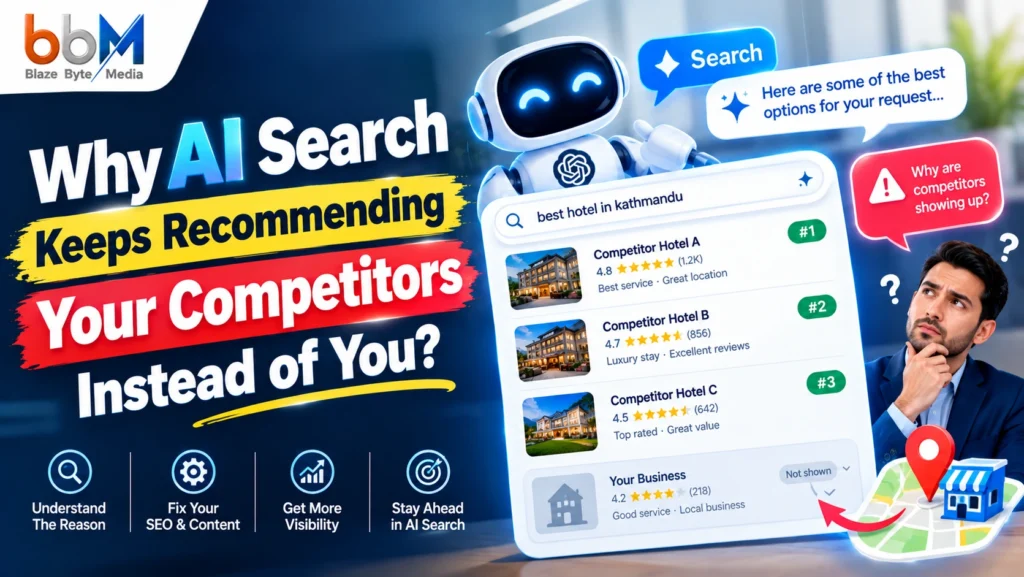
You ask ChatGPT the exact question your business answers every single day, and it names three competitors. You search that same query in Google and the AI Overview cites someone else’s page, someone whose content you genuinely believe is thinner than yours. It stings in a specific way that a low search ranking never quite did, because this isn’t a list you’re missing from. This is a direct recommendation, and it’s going to someone else.
This is becoming one of the most common frustrations brands bring to SEO and AEO teams. It is also one of the most fixable, once you understand what is actually happening behind the scenes. AI systems are not choosing your competitors because they dislike you. They are choosing based on a specific set of signals, trust, extractability, and topical depth, and in most cases, a brand losing this battle is simply weaker on one or two of those signals without realizing it.
This guide breaks down the real reasons AI search tools recommend competitors instead of you, how to diagnose which one applies to your situation, and a practical framework for closing the gap. It’s written for business owners and marketers who already show up somewhere in search but are getting passed over at the exact moment it matters most: when an AI system is deciding who to name.
What’s Actually Happening When AI Search Picks a Competitor
AI search tools recommend a competitor instead of you when their content scores higher on a combination of trust, structural clarity, and topical depth for the specific question being asked, not because of brand loyalty or bias toward bigger names. Every time someone asks ChatGPT, Perplexity, Copilot, or Google’s AI Overview a question, the system is running a version of the same process: find relevant candidates, evaluate which ones are credible and useful, extract the clearest answer, and decide who to name.
Your competitor isn’t necessarily a better business. They are, for that specific query, a more convincing source in the eyes of a model trained to be cautious about who it recommends. That is genuinely good news, because it means this is a solvable content and trust problem, not a permanent verdict on your brand.
There are five recurring reasons this happens, and most brands are dealing with one or two of them, not all five at once.
Reason One: You’re Not Being Crawled or Indexed Deeply Enough
If your site has technical issues, thin crawl coverage, or slow load times, your content may never even reach the pool of candidates an AI system considers, regardless of how good it is once someone actually reads it. This is the most invisible reason, because from your side everything looks fine. The page exists. It’s live. It just never gets pulled into consideration.
Common culprits:
- Pages blocked from crawling by robots.txt or noindex tags left over from a redesign
- Slow load times or poor Core Web Vitals that push crawlers to deprioritize your site
- Orphaned pages with no internal links pointing to them
- A sitemap that’s outdated or missing key pages
- New content that simply hasn’t been crawled and indexed yet
If your competitor’s page was crawled last week and yours hasn’t been touched in months, the AI system is working with an incomplete picture of your site, through no fault of your content’s quality.
Reason Two: Your Competitors Have Stronger Authority Signals
AI systems favor sources they have learned to associate with credibility, and if your competitors have more reviews, more third-party mentions, stronger backlink profiles, or clearer author expertise, the model will lean toward naming them even when your content covers the same ground. This is the Authority problem, and it’s frequently the real reason behind competitor visibility, even when a brand assumes the issue is purely about content quality.
Signals that build this kind of trust over time:
- A consistent volume of genuine customer reviews across Google, industry platforms, and social channels
- Backlinks and mentions from sites already considered credible in your niche
- Named authors with visible credentials, rather than anonymous or generic bylines
- Consistent business information (name, description, services) across your website, directories, and social profiles
- A track record of being cited, quoted, or referenced by other publishers
None of this happens overnight, but it compounds. A competitor who has spent a year building this kind of footprint has an advantage that a single well-written article won’t immediately overcome.
Reason Three: Your Content Isn’t Structured to Be Extracted
Even accurate, well-researched content can lose out to a competitor’s page if the answer is buried in long paragraphs instead of stated clearly near the top, because AI systems favor content they can lift cleanly without needing to interpret or reorganize it. This is often the fastest reason to fix, because it’s entirely within your control.
Signs your content has this problem:
- Sections that build up to an answer instead of stating it in the first two or three sentences
- Long, unbroken paragraphs with no bullets, tables, or bolded key terms
- No FAQ section, or an FAQ section with vague, incomplete answers
- Missing or incomplete schema markup
- No single passage that reads as a clean, standalone answer to the question being asked
A competitor whose page opens with “X is defined as…” in plain, direct language will consistently out-extract a page that opens with three sentences of context before getting to the point.
Reason Four: Competitors Are More Topically Thorough
If a competitor’s content answers not just the main question but the follow-up questions a reader would naturally have next, an AI system is more likely to view their page as the more complete, authoritative source on the topic. This is the topical depth problem. It’s not about writing more words for the sake of length. It’s about covering the full territory of a topic instead of one narrow slice of it.
A page that answers “what is AEO” in three sentences and stops loses to a page that also covers how AEO differs from SEO, what it costs, how long it takes to see results, and what mistakes to avoid, because the second page satisfies more of the actual questions a reader, and a model generating an answer, might have.
Reason Five: The AI Model Doesn’t Clearly Understand What You Do
Vague positioning, inconsistent naming, or unclear descriptions of your products and services can prevent an AI system from confidently connecting your brand to the query being asked, even if your content technically covers the topic. This is an entity clarity problem. If your homepage says you offer “innovative solutions for modern businesses” instead of naming exactly what you do and who you serve, both search engines and AI models struggle to categorize you correctly.
Common versions of this problem:
- Service names that change from page to page instead of staying consistent
- Heavy use of vague, brand-voice language instead of plain descriptions
- A business description that reads differently across your website, Google Business Profile, and social channels
- No clear statement of who the business serves or what problem it solves
How to Diagnose Which Reason Applies to You
Diagnosing why AI search favors a competitor starts with comparing your content against theirs across the same five categories, rather than guessing at a single cause. Use this checklist against the actual query where you’re losing visibility.
| Check | Where to Look | What You’re Looking For |
|---|---|---|
| Crawl and index health | Google Search Console | Indexing errors, missing pages, slow crawl activity |
| Authority signals | Your site vs. competitor’s reviews, backlinks, bylines | Volume and consistency gap |
| Content structure | The actual page competing for the query | Is the answer stated in the first few sentences? |
| Topical depth | Your page vs. competitor’s page, side by side | Which one answers more of the likely follow-up questions? |
| Entity clarity | Your homepage, About page, Google Business Profile | Is your description specific and consistent everywhere? |
Run the actual query through ChatGPT, Perplexity, and Google, then open both your page and the cited competitor’s page side by side. In most cases, the gap becomes obvious within a few minutes of direct comparison.
A Fix-It Framework: Closing the Gap Step by Step
Closing the visibility gap with a competitor requires fixing the weakest of the five areas first, then reworking the specific page competing for that query with a clearer, more extractable, more thorough answer. A practical sequence:
- Confirm the page is fully crawlable and indexed. Check Search Console for errors, confirm the page isn’t blocked, and check load speed.
- Rewrite the opening of the relevant section with a direct answer. Two to three sentences, no scene-setting, stated plainly.
- Add the missing depth. List out every follow-up question a reader would reasonably ask next, and answer each one in its own clearly headed section.
- Add or strengthen author attribution. A named author with real credentials outperforms an anonymous byline.
- Add schema markup. FAQPage, Article, and HowTo schema where relevant, so the structure is machine-readable, not just visually clear.
- Tighten entity consistency. Make sure your service descriptions match, word for word where possible, across your website, Google Business Profile, and any directories.
- Build genuine authority signals over time. Encourage real reviews, pursue mentions from credible sites in your niche, and keep content updated.
- Re-test the query regularly. Ask the same question in the same AI tools every few weeks and track whether the citation shifts.
What to Do When a Competitor Is Simply Better Right Now
Sometimes the honest answer is that a competitor’s content is genuinely stronger on a given query today, and the right response is to acknowledge that clearly and outbuild them rather than looking for a shortcut. There is no plugin, prompt injection, or technical trick that reliably forces an AI system to cite a weaker source over a stronger one, and chasing one wastes time better spent on the fix-it framework above.
The brands that close this gap fastest tend to pick one or two specific queries where they’re losing ground, rather than trying to fix their entire site at once, and rebuild those pages properly before moving to the next set.
How to Monitor This Going Forward
Ongoing monitoring means regularly re-running your key queries through AI search tools and tracking whether your brand starts appearing, rather than treating this as a one-time fix. A simple monthly routine:
- Manually test your five to ten most important questions across ChatGPT, Perplexity, and Google AI Overviews
- Check analytics for referral traffic from AI platform domains
- Set up brand mention alerts to catch unlinked references building your entity recognition
- Note which competitor is being cited instead, and revisit their page periodically to see what’s changed
FAQ
Why does ChatGPT recommend my competitor instead of my business?
Usually because the competitor’s content scores higher on trust signals, structural clarity, or topical depth for that specific question, not because of brand size or popularity alone.
Can I fix this without rewriting my whole website?
Yes. Most brands only need to fix one or two specific pages competing for the queries where they’re losing visibility, rather than overhauling the entire site.
How long does it take to start appearing in AI search results after making changes?
It varies, and there’s no fixed timeline, but re-crawling, re-indexing, and rebuilding trust signals typically take weeks rather than days. Regular re-testing is the best way to track progress.
Does having more backlinks guarantee AI citation?
No. Backlinks contribute to authority, but structure and clarity matter just as much. A page with strong backlinks but a buried, vague answer can still lose to a better-structured competitor page.
What is entity clarity and why does it matter?
Entity clarity means clearly and consistently describing what your business does and who it serves, across your website and other platforms, so AI systems can confidently categorize and recommend you.
Should I mention my competitors in my own content?
Generally no, unless you’re writing a genuine, balanced comparison piece. Focus on making your own answer clearer and more complete rather than referencing competitors directly.
Is it possible to force an AI tool to cite my site instead of a competitor’s?
No reliable method exists to force this outcome. The sustainable approach is improving the underlying trust, structure, and depth signals the model actually evaluates.
How do I know which AI search tools matter most for my business?
Check your analytics for existing referral traffic from AI platforms, and test your key queries manually across the tools your target audience is most likely to use.
Does schema markup really influence AI citations?
It helps by giving crawlers an explicit, machine-readable structure, which supports extraction, though it works alongside content quality and authority rather than replacing them.
What if my competitor has fabricated statistics that make their content look more authoritative?
Focus on your own credibility rather than trying to match unverifiable claims. Cite real, checkable sources, since AI systems are increasingly cross-referencing claims for accuracy.
Can a small or new business ever outrank an established competitor in AI search?
Yes, particularly on specific, narrow questions where a smaller business can demonstrate direct, clear expertise, since AI systems reward clarity and depth over brand size alone.
How often should I re-check whether I’m being recommended over competitors?
Monthly is a reasonable baseline for important queries, with more frequent checks after you’ve made specific changes to a page.
What’s the fastest fix among the five reasons covered here?
Content structure is usually the fastest to fix, since rewriting an opening to state the answer directly and adding schema markup can often be done within days.
What’s the slowest issue to fix?
Authority signals typically take the longest, since reviews, backlinks, and reputation build up over months, not days.
Does updating the publish date on old content help with AI visibility?
Only if the content itself is genuinely updated. Changing a date without improving accuracy, depth, or structure does not meaningfully help and can appear misleading.
Should every page on my site be optimized for AI search?
No. Prioritize the pages tied to your most important, highest-intent questions first, then expand from there.
Can inconsistent business descriptions across platforms really hurt my AI visibility?
Yes. Inconsistent naming or descriptions make it harder for AI systems to confidently connect your brand to a query, which can lead them to favor a competitor with clearer, more consistent signals.
What role do customer reviews play in AI search recommendations?
Reviews contribute to the authority signals AI systems use to judge credibility, and review language is sometimes directly reflected in AI-generated summaries about a brand.
Is losing to a competitor in AI search the same as losing a Google ranking?
Related but not identical. A page can rank reasonably well in traditional search while still losing the AI citation to a competitor with clearer structure or stronger trust signals.
Where should I start if I’m not sure why a specific competitor keeps getting recommended?
Run the exact query through the AI tool in question, open your page and the cited competitor’s page side by side, and compare them against the five reasons covered in this guide.
Stop Losing Ground to Competitors in AI Search
Getting passed over by an AI system in favor of a competitor is frustrating, but it’s rarely permanent. In almost every case, it comes down to a specific, fixable gap in trust, structure, or depth, not a verdict on your business.
Blaze Byte Media diagnoses exactly where you’re losing ground in AI search and builds the AEO and GEO strategy to close it. Get a free AI search visibility audit and find out why competitors are being named instead of you.