
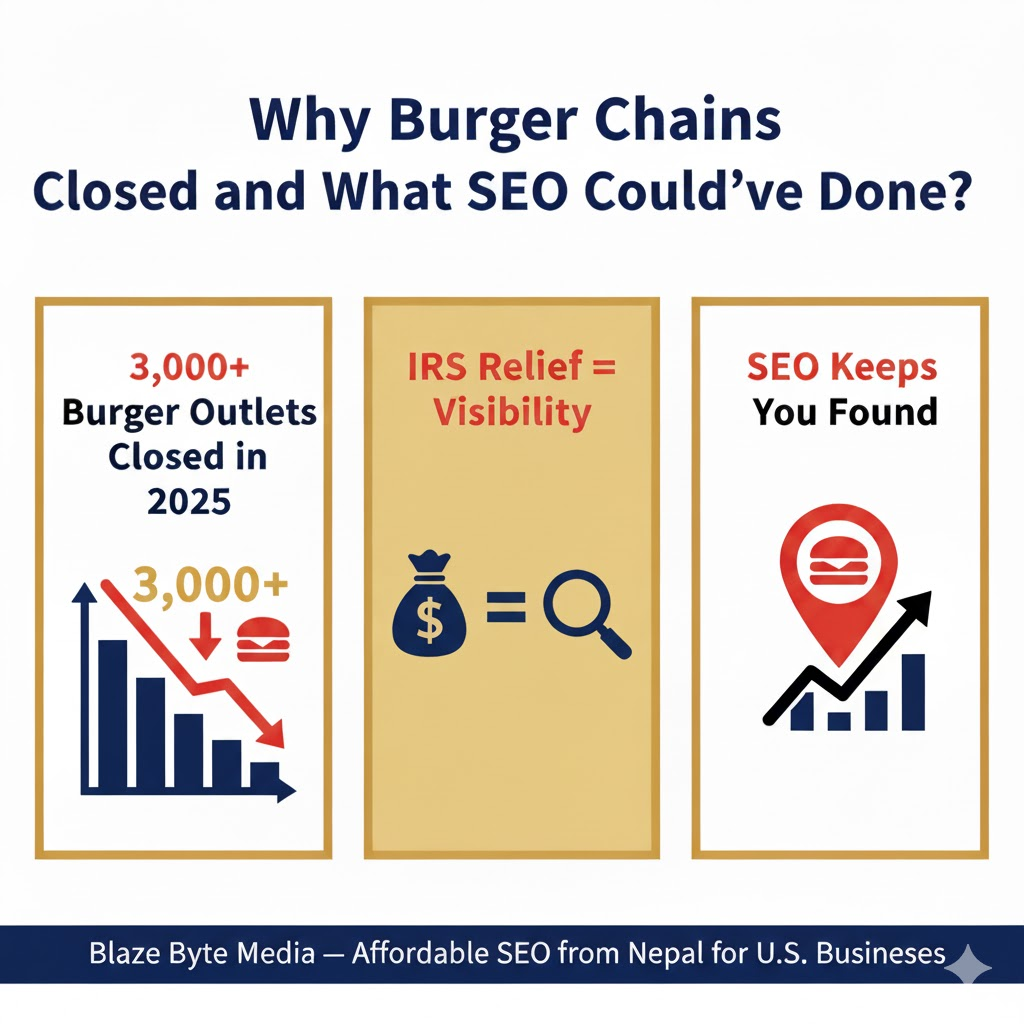
In 2025, Over 3,000 hamburger chain locations ( U.S. burger chains ) closed their doors even as IRS relief checks arrived in their bank accounts. Sounds crazy, right? But here’s the truth nobody’s talking about: money can’t save a business that customers can’t find. While the IRS relief payment 2025 gave struggling restaurants a temporary cushion, it couldn’t fix the real problem being invisible online. That’s where Blaze Byte Media’s SEO services come in, helping U.S. businesses get found when customers are actually searching.
This isn’t just another story about economic hardship. It’s about why some businesses survive while others disappear, even with the same access to relief funds. Let’s dig into what’s really happening.
Why Hamburger Chains Are Closing in 2025
The numbers are shocking. According to recent industry reports, over 2,500 burger restaurants shut down across America in the first half of 2025 alone. That’s not just mom-and-pop shops we’re talking established chains with loyal customers and decades of history.
So what went wrong?
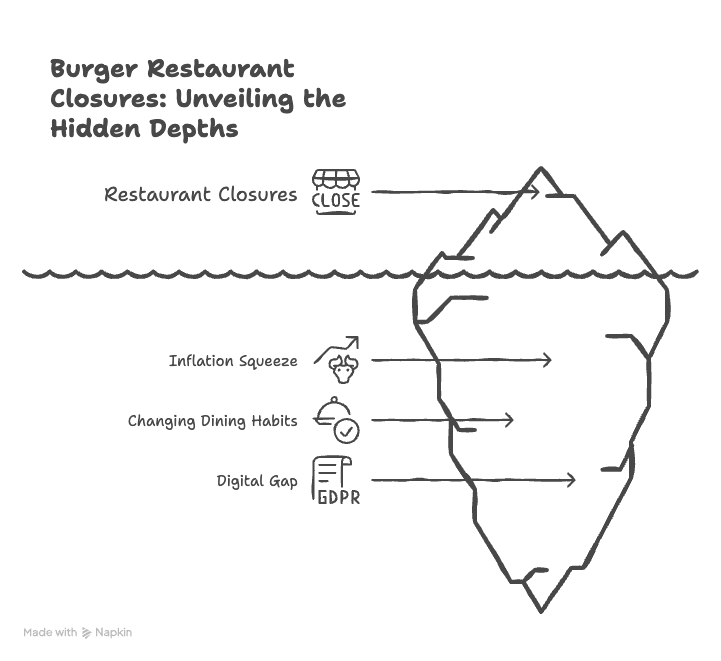
The inflation squeeze got real. Ground beef prices jumped 23% since 2023. Rent went up. Labor costs skyrocketed. A burger that cost $8 to make now costs $12, but customers won’t pay $18 for it. The math stopped working.
People changed how they eat. Post-COVID dining habits shifted permanently. Folks got comfortable ordering from home. They discovered new restaurants through their phones, not by driving around town. If your burger joint wasn’t showing up in those “near me” searches, you were already losing.
The digital gap became a survival gap. Here’s the kicker many closing restaurants had great food and loyal locals. But when someone new moved to town and searched “best burgers near me,” these places didn’t show up. Their Google Business Profile was outdated. Their website loaded slowly. Their reviews were buried. They were invisible to anyone who didn’t already know them.
A 2024 survey by the National Restaurant Association found that 67% of closing restaurants had never invested in local SEO. They relied on foot traffic and word-of-mouth. In 2025, that’s like trying to run a business without a phone number.
The problem wasn’t the burgers it was the broken Google Maps listing.
The IRS Relief Payment 2025—A Lifeline or a Missed Opportunity?
Let’s talk about the IRS relief payment 2025. This federal program provided qualified small businesses with grants ranging from $5,000 to $50,000 to help them recover from economic challenges.
For hamburger chains and restaurants, this seemed like a lifesaver. Finally, cash to cover back rent, repair equipment, or catch up on bills. And many businesses did exactly that they paid what they owed and breathed a sigh of relief.
But here’s where things get interesting.
Most businesses used relief funds for immediate survival: paying bills, covering payroll, buying inventory. All necessary things. But very few asked the critical question: “How do I make sure customers can find me tomorrow?”
Think about it this way. If you’re drowning and someone throws you a life preserver, that’s amazing. But if you don’t learn to swim, you’ll be in the same spot next time the waters get rough.
The IRS relief payment was the life preserver. SEO and digital visibility? That’s learning to swim.
A small business owner in Ohio told reporters, “We got $25,000 in relief. We paid our suppliers and fixed the freezer. Three months later, we closed anyway because nobody was coming in.” When asked about their online presence, they admitted their Google listing still had the wrong hours from 2022.
Relief money gave these businesses breathing room. But breathing room doesn’t matter if customers can’t find you to walk through your door.
Visibility Is Survival—The Real Reason Some Businesses Thrive
Here’s a hard truth: if you’re not on Google, you don’t exist to 90% of potential customers.
Think about your own behavior. When was the last time you looked for a restaurant in the Yellow Pages? When did you last drive around hoping to stumble on a good burger place? You don’t. None of us do. We pull out our phones, type what we want, and Google tells us where to go.
This creates a brutal reality—businesses with strong online visibility are getting all the customers, while equally good businesses with poor visibility are starving.
Let me share a real example. Two burger restaurants in Austin, Texas, both got IRS relief payments. Both had similar food quality and prices.
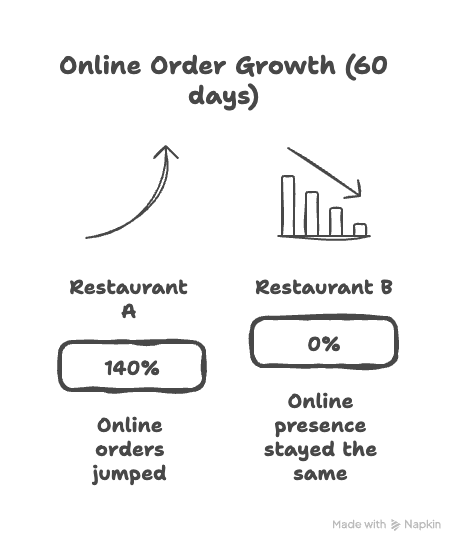
Restaurant A invested $2,000 from their relief money into fixing their Google Business Profile, getting more reviews, and improving their website speed. Within 60 days, their online orders jumped 140%. They started showing up in the top 3 for “burgers near me” searches in their area.
Restaurant B used all their relief money to renovate their dining room and buy new furniture. Their online presence stayed the same meaning it stayed invisible. They closed eight months later, confused about why foot traffic never recovered.
The difference? One restaurant understood that in 2025, your digital storefront matters more than your physical one.
According to Google’s own data, 76% of people who search for something nearby on their smartphone visit a business within 24 hours. And 28% of those searches result in a purchase. That’s not future technology that’s today’s reality.
How SEO Could’ve Saved the Burger Chains
Let’s get specific about what these closing restaurants were missing.
Local SEO was their biggest blind spot. When someone searches “best burger restaurant” in your city, Google decides who shows up based on three main things: relevance, distance, and prominence. Most closing restaurants failed on prominence they had few reviews, outdated information, and weak online signals telling Google they mattered.
Google Maps ranking was ignored. Your Google Business Profile is free. FREE. Yet 40% of small restaurants never claimed theirs. Others claimed it but never updated it. Wrong hours. Old menu. No photos. Would you trust a restaurant that looks abandoned online?
Reputation management was non-existent. Here’s something wild one negative review can cost a restaurant about 30 customers. But most closing burger chains had either no reviews or a handful of old ones. They never asked happy customers to leave reviews. They never responded to complaints. Online, they looked either dead or careless.
Website speed killed mobile conversions. If your website takes more than 3 seconds to load, you lose 53% of mobile visitors. Many burger chain websites were built in 2010 and never updated. They loaded slowly, looked terrible on phones, and had no online ordering. In 2025, that’s business suicide.
Now let’s look at the money side:
| Strategy | Avg. Cost | Duration | ROI Potential |
|---|---|---|---|
| Paid Ads | $3,000/mo | Short-term | Ends when budget ends |
| SEO | $1,000/mo | Long-term | Compounds monthly |
Paid ads are like renting visibility. The moment you stop paying, you disappear. SEO is like buying property the work you do today keeps paying off for months and years.
A burger restaurant spending $3,000 monthly on Facebook ads might get 200 clicks. That same restaurant investing $1,000 monthly in SEO might get 50 clicks in month one, but 300 clicks by month six, and 800 clicks by month twelve all while spending less.
The math is simple. The execution? That’s where businesses get stuck.
How U.S. Businesses Can Reinvest Relief Funds Wisely
If you got IRS relief money or if you’re figuring out how to survive without it here’s the smart play: invest in visibility that lasts.
This is where offshore SEO partnerships make sense, and why U.S. businesses are discovering agencies like Blaze Byte Media in Nepal.
Wait, Nepal? Stay with me.
Blaze Byte Media specializes in three critical areas:
SEO (Search Engine Optimization) – Getting your business to rank when customers search Google. This includes keyword research, content creation, technical website improvements, and link building.
AEO (Answer Engine Optimization) – Optimizing for AI tools like ChatGPT, Perplexity, and Google’s AI Overviews. When someone asks their phone “where’s the best burger near me?” you want to be the answer.
GEO (Google Ecosystem Optimization) – Dominating Google Maps, Google Business Profile, Google Reviews—the entire Google universe where customers make decisions.
Here’s what makes this partnership different: quality work at a price that makes sense for small businesses still recovering from economic challenges.
A full-service U.S. SEO agency might charge $5,000-$15,000 monthly for comprehensive services. That’s impossible for a burger restaurant that just used relief funds to stay afloat.
Blaze Byte Media delivers the same expertise for $1,000-$2,500 monthly, with transparent communication, detailed reporting, and a team that understands the U.S. market despite working from Nepal.
The Cost Advantage of Outsourcing SEO Overseas
Let’s talk numbers, because this is where the value becomes impossible to ignore.
The average SEO specialist in the U.S. costs $75-$200 per hour. A complete SEO audit? $3,000-$5,000. Ongoing monthly services? $5,000-$15,000.
In Nepal, the cost of living is dramatically lower, which means agencies like Blaze Byte Media can offer the same level of expertise and dedication for 60-70% less.
Here’s what that looks like in practice:
$1,000 in the U.S. buys you: One basic SEO audit, or about 10-15 hours of work.
$1,000 with Blaze Byte Media gets you: Complete website audit, keyword research, content strategy, technical fixes, monthly reporting, and ongoing optimization.
This isn’t about cheap work it’s about smart economics. The internet doesn’t care where your SEO team sits. Google’s algorithm treats a well-optimized page the same whether it was created in New York or Kathmandu.
A restaurant owner in Denver shared their experience: “We were quoted $8,000 monthly by a local agency. We found Blaze Byte Media through a referral and got better communication, more transparent results, and paid $1,500 monthly. Six months later, we’re ranking on page one for our top keywords. The ROI is insane.”
For post-relief businesses watching every dollar, this cost difference isn’t just helpful—it’s the difference between affording SEO at all or staying invisible.
Step-by-Step—How to Start Your Offshore SEO Partnership Safely
I get it trusting an overseas agency feels risky if you’ve never done it before. Here’s how to do it right.
Step 1: Start with a small project. Don’t commit to a year-long contract immediately. Ask for a one-month trial or a specific project like an SEO audit. This lets you test communication, quality, and reliability.
Step 2: Demand transparency. Your SEO agency should explain what they’re doing in plain English. If they’re using jargon you don’t understand, that’s a red flag. Blaze Byte Media provides weekly updates and monthly strategy calls.
Step 3: Use modern communication tools. Timezone differences don’t matter when you’re using Slack, email, and video calls. Nepal is about 12-13 hours ahead of U.S. Eastern Time, which means you can send requests in the evening and wake up to completed work.
Step 4: Check their U.S. market understanding. Ask specific questions about U.S. consumer behavior, local search trends, and competition. A good offshore agency studies your market deeply.
Step 5: Look for proven results. Ask for case studies, client references, and examples of rankings they’ve achieved for U.S. businesses. Real agencies have proof.
Step 6: Establish clear KPIs. What does success look like? More website traffic? Higher rankings? More phone calls? Define these upfront so everyone’s on the same page.
Step 7: Require regular reporting. Monthly reports should show keyword rankings, traffic growth, technical improvements, and ROI. No hiding, no excuses.

The businesses succeeding with offshore SEO partnerships aren’t taking blind leaps they’re treating it like any smart business relationship, with clear expectations and measurable outcomes.
The Bottom Line: Relief Money Fades, SEO Results Compound
Here’s what we’ve learned from 2025’s hamburger chain closures:
Financial relief helps you survive today. Digital visibility helps you thrive tomorrow.
The IRS relief payment 2025 gave thousands of businesses a second chance. But money alone doesn’t solve the fundamental problem customers can’t support businesses they can’t find.
The burger chains that closed weren’t serving bad food. They weren’t in terrible locations. They simply became invisible in a world where Google decides which businesses exist and which don’t.
Meanwhile, the restaurants that survived and grew made a different choice. They invested in SEO. They claimed their Google Business Profile. They collected reviews. They optimized their websites. They showed up when customers searched.
And here’s the beautiful part SEO isn’t a one-time expense that disappears. It’s an investment that compounds over time. Every piece of content you create, every review you earn, every technical improvement you make continues working for you 24/7, bringing customers to your door while you sleep.
For U.S. small businesses still recovering, still figuring out how to survive in this new economy, the message is clear: spend your resources on what creates lasting value.
Your Next Move: Partner with Global Experts Who Get Results
You’ve got options. You can keep hoping foot traffic returns to pre-2020 levels. You can dump money into ads that stop working the moment you stop paying. Or you can invest in SEO that builds permanent visibility.
If you choose the smart path, you don’t have to do it alone.
Blaze Byte Media brings world-class SEO, AEO, and GEO expertise to U.S. businesses at prices that actually make sense for small business budgets. Based in Nepal with deep U.S. market knowledge, they’re helping hamburger chains, retail stores, service providers, and every type of business get found online.
Think about where you want your business to be six months from now. Twelve months from now. Do you want to still be struggling for visibility, or do you want to be the business that shows up first when customers search?
Ready to stop being invisible?
Contact Blaze Byte Media today:
- Email: [email protected]
- Website: https://blazebytemedia.com
Relief money gave you time. Use it wisely. Invest in visibility that lasts.
FAQ: Everything You Need to Know
What is the IRS Relief Payment 2025?
The IRS Relief Payment 2025 is a federal assistance program providing grants between $5,000 and $50,000 to qualifying small businesses affected by economic challenges. The program aims to help businesses cover operational costs, pay debts, and stabilize during recovery periods. However, the funds are one-time payments and don’t address long-term visibility and customer acquisition challenges that many businesses face.
Why are hamburger chain restaurants closing in 2025?
Hamburger chains are closing due to multiple factors: inflation increasing ingredient and labor costs by 20-30%, changing consumer dining habits favoring delivery and online ordering, and critically, poor digital visibility. Many closing restaurants never invested in local SEO, leaving them invisible to customers searching online for dining options. Economic relief helped temporarily, but couldn’t fix the fundamental problem of being unfindable on Google.
Can SEO help small businesses survive in 2025?
Absolutely. SEO helps businesses appear when customers actively search for their products or services. Unlike paid ads that stop working when you stop paying, SEO builds compound visibility over time. For restaurants and local businesses, local SEO specifically drives foot traffic by improving Google Maps rankings, managing reviews, and optimizing Google Business Profiles. Studies show 76% of people who search for something nearby visit a business within 24 hours.
How much does offshore SEO cost compared to U.S. agencies?
Offshore SEO typically costs 60-70% less than U.S. agencies while delivering comparable quality. U.S. agencies charge $5,000-$15,000 monthly for comprehensive services, while offshore agencies like Blaze Byte Media charge $1,000-$2,500 monthly. This price difference comes from lower cost of living, not lower quality. For small businesses recovering from economic challenges, this cost savings makes professional SEO accessible and sustainable.