
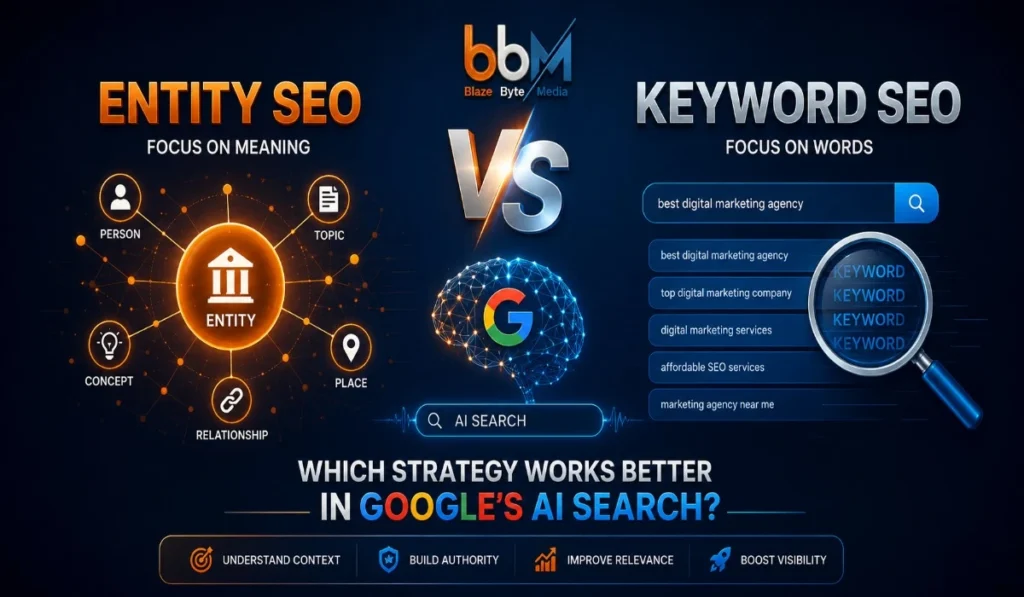
Search is changing fast. A few years ago, ranking on Google was mostly about finding the right keywords and using them the right number of times. Today, Google doesn’t just read your words, it tries to understand what your content actually means. This shift is why two terms keep coming up in every SEO conversation: Entity SEO and Keyword SEO.
If you’ve been writing content, running a website, or managing a business online, you’ve probably asked yourself: Should I still focus on keywords? Or is entity SEO the new king now that Google shows AI Overviews at the top of search results?
This blog breaks it all down in simple words, no jargon, no confusion. We’ll explain what each strategy means, how they work, which one performs better in Google’s AI-driven search world, and how you can use both together to get real results.
What Is Keyword SEO? (The Old Way of Doing Things)
Keyword SEO is the classic, well-known method of search engine optimization. It means finding the exact words and phrases that people type into Google, and then using those words in your content, in your titles, headings, body text, and meta descriptions.
For example, if someone runs a bakery, keyword SEO would involve targeting phrases like:
- “best bakery near me”
- “chocolate cake delivery”
- “birthday cakes online”
The idea is simple: match the words in your content to the words people search for, and Google will show your page when someone types that phrase.
For almost two decades, this approach worked well. Google’s older systems were built around matching text strings. If your page had the right keyword in the right place, with the right frequency, it had a good shot at ranking.
But keyword SEO has a weakness. It treats search as a matching game, not an understanding game. It doesn’t care whether your content is actually helpful, it cares whether the right words appear in the right spots. That gap is exactly what led to spammy, keyword-stuffed pages that technically “matched” a search but gave users a poor experience.
What Is Entity SEO? (The New Way Google Understands Content)
Entity SEO is a newer, smarter approach. Instead of asking “what keywords should this page rank for?”, entity SEO asks a different question: “What is this page actually about, and how does it connect to other real things Google already knows about?”
An “entity” is any real, distinct thing, a person, a place, a brand, a product, an organization, or even an idea. Google stores information about entities in something called the Knowledge Graph, which is a massive database connecting billions of real-world things and the relationships between them.
Google’s Knowledge Graph now handles more than 800 billion facts about 8 billion entities. That’s an enormous web of connected information, and it’s the backbone of how modern Google, and AI tools like Gemini, actually “understand” the world.
So instead of just repeating the phrase “best bakery near me” fifty times, entity SEO would focus on clearly establishing:
- Who you are (the bakery, as a business entity)
- Where you’re located (a place entity)
- What you offer (products like cakes, pastries, custom orders)
- How you connect to related concepts (wedding cakes, local delivery, gluten-free baking)
Entity SEO optimizes content around those entities and the relationships between them, rather than around exact-match phrases. This helps Google (and AI search tools) place your business accurately inside a bigger picture of “who’s who” and “what’s what” in your industry.
The Real Difference Between Entity SEO and Keyword SEO
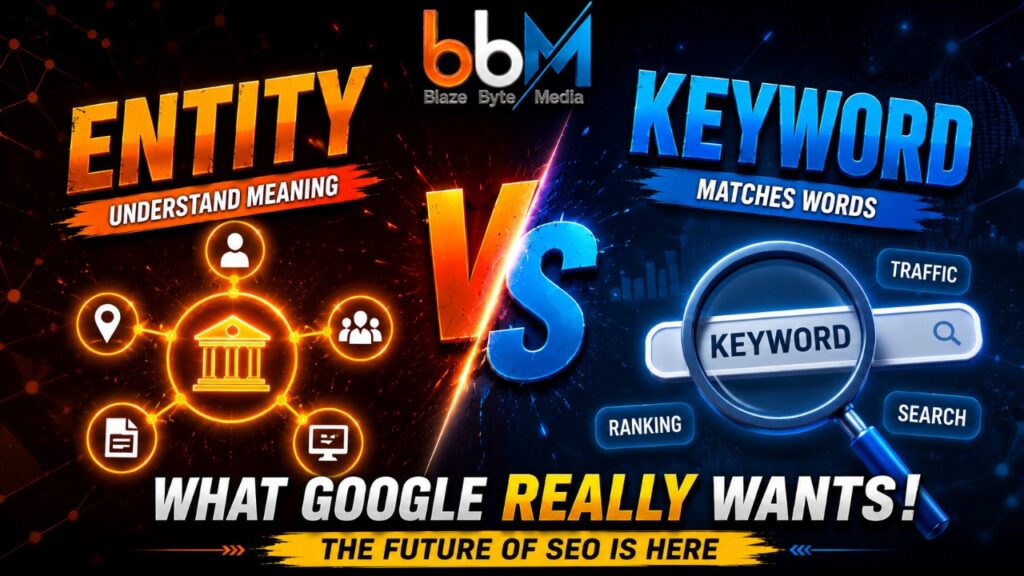
Here’s the simplest way to understand the difference:
Keyword SEO is about matching words. Entity SEO is about proving meaning.
One SEO expert explained it beautifully: “Keyword SEO is basically working on a flat map, while entity SEO lives in three-dimensional space.” Keywords tell Google what page to show. Entities tell Google, and now AI models, why your page deserves to be trusted and cited.
Think about it this way. If keyword SEO gets you a spot on the map, entity SEO determines whether you actually stand out enough to be picked. As Carolyn Shelby, a well-known SEO expert, put it: “Keywords just help you appear on the map. Entities determine whether you ‘shine brightly’ enough to be selected.”
Another important distinction: entity SEO works at the website and brand level, while keyword SEO works at the page level. Keyword SEO is something you do on individual pages. Entity SEO is something you build across your entire brand, your website, your Google Business Profile, your social media, and every place your name appears online.
Why Entity SEO Matters So Much in Google’s AI Search
Here’s where things get interesting. Google Search today isn’t just ten blue links anymore. At the very top, you’ll often see AI Overviews, AI-generated summary boxes that answer your question directly, often before you even click on a website.
Google AI Overviews function as AI-generated summaries that appear at the top of search results, synthesizing information from multiple sources to provide comprehensive answers to user queries. And unlike the old featured snippets that pulled from just one source, AI Overviews pull from 3-8 different websites to create cohesive responses.
This changes everything about how ranking works. AI Overviews don’t work by matching keyword strings. They work by understanding concepts, checking sources, and picking the most trustworthy, well-connected information to summarize.
Here’s the technical reason why: The mechanism behind this is vector embeddings, mathematical representations of concepts in multidimensional space. When a large language model like Google’s Gemini or OpenAI’s GPT processes a query, it does not look for keyword matches. It looks for semantic proximity: which entities, documents, and sources are conceptually closest to what the user is asking?
In plain words: AI search doesn’t scan for the exact phrase you typed. It looks for content that clearly and accurately represents the ideas behind your question, and it trusts sources that are already well-established as real, credible entities.
Content with rich, accurate, well-structured entity representation ranks closer to the user’s query in vector space, and therefore gets cited. That’s the whole game now. If your brand isn’t clearly recognized as an entity, AI search may simply skip over you, even if your keywords are technically perfect.
This is echoed across the industry. As one entity SEO guide puts it: “AI Overviews now appear at the top of a large proportion of search results. These answers are generated by Gemini, which is trained on the Knowledge Graph. If your brand is not established as a recognised entity in the Knowledge Graph, you are essentially invisible to AI-generated answers.”
How AI Tools Like ChatGPT and Perplexity Use Entities Too
It’s not just Google. Other AI search tools work the same way. When a user queries ChatGPT about who the best professional in a certain field or location is, AI does not search for keywords, it looks for entities it already knows and trusts.
If your business is a recognized entity in Google’s Knowledge Graph, your chances of being cited jump significantly. Think of the Knowledge Graph like AI’s contact book. If your business is on that list, with accurate details, clear connections, and trusted mentions, AI can confidently recommend you. If you’re not in it, you’re essentially a stranger.
This is a powerful way to think about it. Keyword SEO gets your foot in the door of a search results page. Entity SEO gets you introduced by name, with trust already built in.
So… Does This Mean Keyword SEO Is Dead?
No, and this is important to understand clearly. Keyword SEO is not dead, but it is progressively less effective as the architecture of search shifts from string matching to semantic understanding.
Keywords still matter because they tell you (and Google) what people are actually searching for. Without keyword research, you wouldn’t know what topics, questions, or phrases matter to your audience in the first place. Keywords are still the starting point for content ideas.
What’s changed is the role keywords play. They’re no longer the finish line, they’re the starting line. The real finish line now is whether your content proves, clearly and consistently, that you are a trustworthy, well-connected source on that topic.
Most experts agree the winning approach is combining both. “In 2026, you need both, but entity SEO is what gets you cited in AI-generated answers.” Similarly: “In 2026, you need both, but entity SEO provides the foundation that makes your keyword strategy far more effective.”
How to Build Entity SEO for Your Website or Business
You might be wondering, how do you actually “become” a recognized entity? Here’s the honest truth: you cannot directly submit your brand to the Knowledge Graph. Instead, you build trust and recognition over time through consistent signals. Here’s how:
1. Add Organization Schema Markup
Add Organisation schema with sameAs properties to your website, this is a technical way of telling Google, “This is my official brand, and here are my verified social profiles and other pages that confirm who I am.”
2. Keep Your Brand Information Consistent Everywhere
Maintain consistent brand information across your website, Google Business Profile, and social platforms. If your business name, address, or details are different on different platforms, it confuses Google’s understanding of who you are.
3. Earn Mentions on Trusted Websites
Get your brand mentioned on authoritative third-party websites. This doesn’t even need to include a link every time. In 2026, brand mentions have become almost equally powerful as backlinks. If respected, high-traffic websites talk about your brand, even without linking to you, Google’s AI registers that as a trust signal.
4. Create a Wikidata Entry
Creating a Wikidata entry for your organisation if you qualify can give Google a clear, structured, third-party-verified profile of your brand to reference.
5. Keep Your Google Business Profile Updated
This one matters more than people think. AI Overviews will generally get its data directly from your Google Business Profile and Google Merchant Center. In cases where your business hours, address, contact number, products listed, or customer feedback is outdated, the AI might overlook your business altogether or list inaccurate details.
6. Build Strong E-E-A-T Signals
E-E-A-T stands for Experience, Expertise, Authoritativeness, and Trustworthiness. Search engines can identify entities using text and schema mark-up, but E-E-A-T signals tell AI systems which entities deserve visibility. This includes clear author bios, real credentials, honest reviews, and proof that real people stand behind your content.
7. Place Your Primary Entity Prominently on Every Page
For entity SEO, you want your primary entity to have a high salience score on every page. This means placing your primary entity in the H1, in the first 100 words, and throughout the content naturally, not stuffing keywords, but building rich semantic context around the thing you want to be known for.
8. Cover Related Subtopics, Not Just One Keyword
By covering a broader semantic field, you increase the chances of ranking for multiple queries, appearing in Featured Snippets, Google AI Overviews and building topical authority. For example, if you want to be known for “AI SEO,” it helps to also publish content on related ideas like AI search tools, semantic SEO, or generative engine optimization.
Structured Data: The Bridge Between Content and AI Understanding
One thing both entity SEO and modern AI search optimization agree on is structured data (also called schema markup). This is behind-the-scenes code that clearly labels parts of your content, like your FAQs, articles, and business details, so machines can read them accurately.
Structured data makes it easier for AI systems to understand the relationships between entities, concepts, and data points on your page. And the results speak for themselves: pages with proper FAQ Schema, HowTo Schema, Article Schema, and Organization Schema are cited in AI Overviews at significantly higher rates, some studies suggest 2-3x higher, than equivalent pages without structured data.
This is exactly why adding an FAQ section (like the one below) isn’t just good for readers, it’s good for AI visibility too.
What About AEO and GEO? How Do They Fit In?
You may have also heard of AEO (Answer Engine Optimization) and GEO (Generative Engine Optimization). These aren’t separate battles, they work alongside entity and keyword SEO.
AEO helps your content provide direct answers for snippets, FAQs, and question-based searches. GEO helps make your content clear, credible, and citation-worthy for generative systems.
In simple terms:
- Keyword SEO helps people find your page.
- Entity SEO helps Google trust and understand your brand.
- AEO helps your content get picked as a direct answer.
- GEO helps your content get cited inside AI-generated summaries.
They’re not competitors, they’re four legs of the same table.
There’s also an important technical point worth knowing: Google says there are no additional technical requirements for appearing in AI features beyond being eligible for Google Search snippets. Content needs to be extractable, short answer blocks, tables, definitions, FAQs, step-by-step workflows, and entity-rich sections help both users and search systems understand the page.
Also worth understanding is “query fan-out”, a term Google uses to describe how AI search actually processes your question. Google says AI Mode can use query fan-out to search across related subtopics and data sources, which means pages should cover the full intent behind a topic, not only the exact keyword. This is another reason why narrow keyword-only content struggles in AI search, it simply doesn’t cover enough ground.
The Real Numbers: Why This Shift Matters for Your Traffic
This isn’t just theory, it’s already changing how much traffic websites get. Google’s AI Overviews have fundamentally altered the search landscape, with studies showing up to 35% reduction in organic click-through rates for certain query types.
Separately, other research shows 20-40% traffic declines for informational queries on sites that haven’t adapted, while simultaneously creating new authority-building opportunities for those that have.
And it’s not a small, occasional feature anymore. Current data shows AI Overviews trigger for approximately 15% of all search queries, with significantly higher rates for specific categories, commercial investigation queries hit a 28% trigger rate.
This matters because ranking #1 on Google no longer guarantees clicks; being cited inside AI Overviews is the new visibility currency. In other words, you can be “number one” and still get fewer visitors than before, because people are getting their answer directly from the AI box at the top.
The upside? People are also more satisfied with what they find. Research from Fractl and Search Engine Land found that 66% of consumers believe AI will replace traditional search within five years, and 82% find AI search more helpful than traditional SERPs.
Which One Actually Wins: Entity SEO or Keyword SEO?
If you strip away all the technical talk, here’s the honest, simple answer:
Entity SEO wins for visibility in AI-generated answers. It’s what determines whether AI trusts your brand enough to mention you by name.
Keyword SEO still wins for discovery. It’s what tells you what your audience is actually searching for, and it still helps traditional search rankings for many query types.
The strongest strategy isn’t picking one over the other, it’s using keyword research to know what to write about, and entity SEO principles to make sure how you write it proves real expertise and builds a trusted brand identity.
As one guide summarized it well: Keyword SEO is not dead, but it is progressively less effective as the architecture of search shifts from string matching to semantic understanding. In 2026, Google, Bing, Perplexity, and every other AI-powered discovery engine are rewarding one thing above all else: topical authority built around entities.
How Long Does It Take to See Results?
Patience matters here, because entity authority isn’t built overnight. For most brands, meaningful improvements in AI Overview citations, featured snippet eligibility, and topical authority scores are visible within three to six months of a properly structured entity-first content programme.
The good news is that this investment pays off longer-term. This is comparable to traditional SEO timelines, but the results are fundamentally more durable because entity authority is algorithm-resistant in ways that keyword rankings are not. In simple words, once you’re a recognized, trusted entity, it’s much harder for a random algorithm update to knock you out of visibility, compared to a page that only ranked because of clever keyword placement.
This is also confirmed elsewhere: websites built on entity authority recover faster from core updates and are less vulnerable to ranking volatility.
Final Thoughts: Build for Both, But Build Trust First
Google’s AI search era isn’t about tricking an algorithm anymore, it’s about genuinely proving who you are, what you know, and why people should trust you. Keywords are still the map that shows you where your audience is searching. But entities are what convince Google, and now AI systems like Gemini, ChatGPT, and Perplexity, that you deserve to be the answer.
If you’re a small business, blogger, or brand starting out, don’t feel like this is only for big companies. Google Business Profile, local citations and a couple of quality third-party mentions can result in a credible entity profile for small and local businesses. You don’t need a massive budget, you need consistency, accuracy, and real proof of expertise.
The brands that win in this new era of search are the ones that stop asking “what keyword should I target?” and start asking “what do I want to be known for, and can I prove it?”
Frequently Asked Questions (FAQs)
1. What is the main difference between entity SEO and keyword SEO? Keyword SEO focuses on matching the exact words people search for. Entity SEO focuses on helping search engines and AI understand what your brand, page, or business truly represents, and how it connects to other real-world concepts.
2. Is keyword SEO still useful in 2026? Yes. Keyword research still helps you understand what your audience is searching for and what topics to cover. It’s the starting point for content planning, even though it’s no longer enough on its own.
3. What exactly is an “entity” in SEO terms? An entity is any distinct, real thing, a person, place, brand, organization, product, or concept, that Google can recognize and store information about in its Knowledge Graph.
4. What is Google’s Knowledge Graph? It’s Google’s massive database that stores facts about entities and how they relate to each other, helping Google (and AI tools trained on it) understand the real world instead of just matching text.
5. Can I directly add my brand to the Knowledge Graph? No, you cannot submit your brand directly. You build recognition over time through consistent schema markup, third-party mentions, and accurate brand information across platforms.
6. Does entity SEO help with ChatGPT and Perplexity, not just Google? Yes. Both tools reference entities they recognize from trusted sources, so a well-established entity profile increases the chance of being mentioned directly in AI-generated answers.
7. How long does it take to build entity authority? Most businesses see meaningful results within three to six months of consistent effort, including schema markup, Google Business Profile optimization, and third-party mentions.
8. Is entity SEO only useful for large, well-known brands? No. Small and local businesses can build a credible entity profile through a solid Google Business Profile, consistent local citations, and a few quality third-party mentions.
9. What are Google AI Overviews? They are AI-generated summary boxes that appear at the top of Google Search results, pulling and combining information from multiple trusted sources to directly answer a user’s question.
10. Do AI Overviews reduce website traffic? In many cases, yes. Some studies show organic click-through rates dropping by up to 35% for certain types of queries, since users often get their answer without clicking through to a website.
11. Does ranking #1 on Google still guarantee traffic? Not anymore. Ranking #1 is less valuable than being cited inside an AI Overview, since many users read the AI summary and don’t scroll down to the traditional listings.
12. What percentage of searches show an AI Overview? Roughly 15% of all search queries trigger an AI Overview, with much higher rates for commercial investigation searches, around 28%.
13. Is schema markup necessary for AI search visibility? While Google says there are no special technical requirements beyond regular snippet eligibility, structured data like FAQ Schema and Article Schema significantly increases the chance of being cited in AI Overviews.
14. What is FAQ Schema and why does it matter? FAQ Schema is structured code that labels question-and-answer content clearly for search engines, making it easier for AI systems to extract and reuse in generated answers.
15. What does “query fan-out” mean? It’s when an AI search system breaks a single search query into several related subqueries to gather broader context, meaning your content should cover a full topic, not just one exact keyword.
16. What is AEO (Answer Engine Optimization)? AEO is the practice of structuring content, like clear answers, FAQs, and step-by-step guides, so it can be easily selected as a direct answer by search engines and AI tools.
17. What is GEO (Generative Engine Optimization)? GEO focuses on making content clear, credible, and citation-worthy specifically for generative AI systems like AI Overviews, ChatGPT, and Perplexity.
18. How are AEO, GEO, and entity SEO related? They work together. Entity SEO builds trust and recognition, AEO structures content for direct answers, and GEO ensures your content is trustworthy enough to be cited by AI-generated summaries.
19. What is E-E-A-T and why does it matter for entity SEO? E-E-A-T stands for Experience, Expertise, Authoritativeness, and Trustworthiness. These signals help search engines confirm that an entity is credible and deserves visibility in search results.
20. Do backlinks still matter for SEO in the AI search era? Yes, backlinks still matter, but brand mentions, even without a link, have become almost equally powerful as a trust signal for AI systems.
21. What is “entity salience” and why is it important? Entity salience measures how clearly and prominently an entity is represented on a page. Higher salience means Google can confidently connect the page to that specific entity.
22. Where should I place my primary entity on a page for the best results? Ideally, in the page title (H1), within the first 100 words, and naturally throughout the content, without keyword stuffing.
23. Can a small business realistically compete with big brands in AI search? Yes. Smaller, specialized brands can achieve citations in AI Overviews if they build clear entity differentiation and consistently publish citation-worthy, accurate content.
24. What tools can help measure entity SEO performance? Google’s Natural Language API can detect entities and salience scores on a page. Tools like Ahrefs and Semrush also offer semantic clustering and topical authority features.
25. Should I stop doing keyword research altogether? No. Keyword research still tells you what topics and questions matter to your audience. It should guide your content planning, even as entity signals shape how you structure and prove that content.
26. What is topical authority and how does it relate to entity SEO? Topical authority is the perception that your website is a trusted, comprehensive source on a specific subject. It’s built by covering a topic and its related subtopics deeply, which strengthens your entity signals.
27. Does an outdated Google Business Profile hurt AI search visibility? Yes. If your business hours, address, phone number, or product listings are outdated, AI Overviews may overlook your business entirely or show inaccurate information.
28. What is Wikidata and why is it mentioned in entity SEO guides? Wikidata is a free, structured knowledge base. Creating a verified entry there can give Google a clear, third-party-confirmed profile of your organization to reference.
29. Are AI Overviews multi-modal, meaning do they include images and videos? Yes. AI Overviews can return image and video results, so optimizing alt text and video titles/descriptions for natural, conversational language can help you appear in these results too.
30. Why is consistency of brand information across platforms so important? If your business name, address, or details differ across your website, social media, and directories, it confuses search engines and weakens your entity’s credibility.
31. Does entity SEO replace the need for good content? No. Entity SEO works best when paired with genuinely helpful, accurate, and well-organized content. Structure and trust signals amplify good content, they don’t replace it.
32. How does voice search relate to entity and keyword SEO? Voice search queries tend to be longer and more conversational, which favors entity-rich, natural-language content over short, exact-match keyword phrases.
33. What happens if my brand isn’t recognized as an entity at all? You risk being largely invisible in AI-generated answers, even if your traditional keyword rankings are strong, since AI systems prioritize citing recognized, trusted entities.
34. Is it worth investing in entity SEO if results take months to show? Yes, because entity authority tends to be more durable and algorithm-resistant than keyword rankings alone, meaning the results last longer once achieved.
35. What’s the single best first step to start improving entity SEO today? Start by claiming and fully updating your Google Business Profile, adding Organization schema to your website, and ensuring your brand name and details are consistent everywhere online.