
If you have refreshed a Google Search Console dashboard lately and felt your stomach drop, you are not imagining things. Something genuinely different is happening to search, and it is not a minor algorithm tweak you can wait out.
Google AI Overviews, the AI generated summary boxes that now sit above the traditional list of blue links, have gone from an experiment to the dominant surface on the world’s biggest search engine. Independent research from Ahrefs puts AI Overview coverage at roughly 48% of all queries as of March 2026, up from about 34.5% in December 2025, a jump of nearly 58% in three months. Other trackers, including SeoProfy and Heroic Rankings, place the figure closer to 20% globally with spikes above 37% in some countries, while informational and how to queries are seeing AI Overviews on more than 70% of results pages according to Digital Applied’s analysis.
Whatever exact number you trust, the direction is the same. AI Overviews are not a side feature anymore. They are becoming the front door of Google Search, and that changes what it means to “rank” in 2026.
This guide breaks down what is actually happening, backed by real research from Ahrefs, Pew Research Center, Semrush, BrightEdge, Search Engine Land, and other credible sources, and what you can do about it whether you run a blog, an ecommerce store, or an in house SEO team.
What Are Google AI Overviews, Exactly
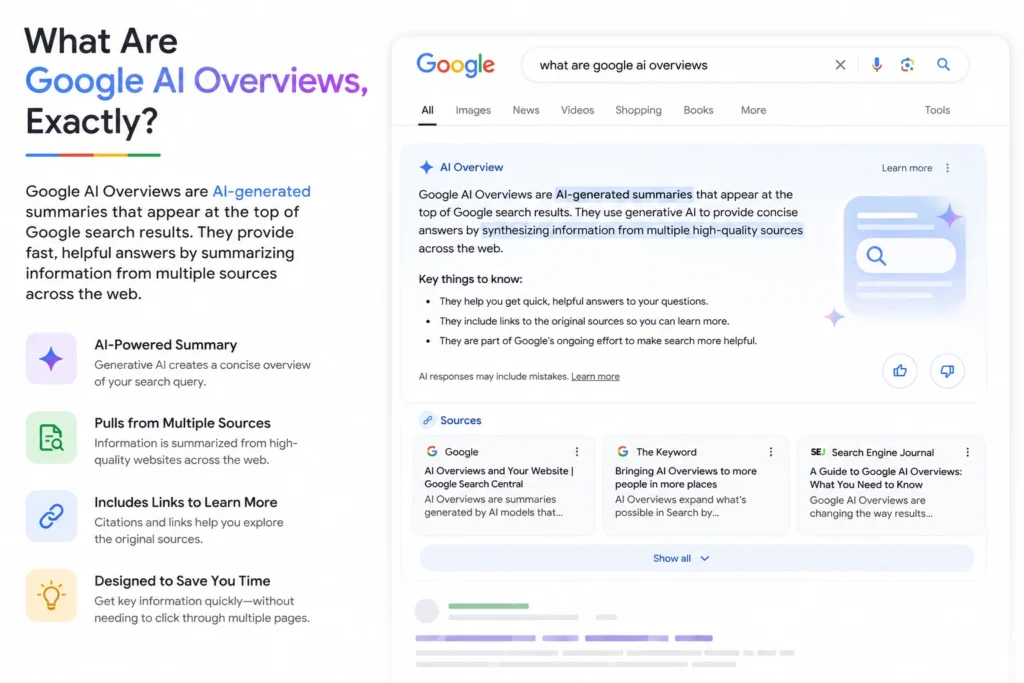
Google AI Overviews are Gemini powered summaries that appear at the very top of a search results page, above organic listings, ads, and even featured snippets in most cases. They synthesize an answer from multiple web pages and attach a handful of citation links so users can click through for more detail if they want to.
They launched broadly in the United States in May 2024. By the Google I/O event in May 2026, Sundar Pichai confirmed that AI Overviews had crossed 2.5 billion monthly active users across more than 200 countries and 40 plus languages, according to reporting from Green Flag Digital. For comparison, ChatGPT reportedly reached around 900 million weekly users in the same period. AI Overviews are, quite simply, the largest AI product on the planet right now, and most people using it do not even think of it as “using AI.” They think they are just using Google.
AI Overviews, AI Mode, and Gemini Are Not the Same Thing
A lot of confusion in 2026 comes from lumping three separate Google products together.
AI Overviews live inside the normal search results page. You still see the classic ten blue links, videos, and People Also Ask boxes underneath the summary.
AI Mode is a separate, conversational tab built for multi step research. It uses a technique called query fan out, where one complex question is broken into many sub queries that run in parallel before Google stitches together a longer, more detailed answer. According to Cyberclick’s 2026 analysis, AI Mode is built for planning and comparison tasks, not quick lookups, and users tend to stay inside it longer because they can ask follow up questions without leaving Google’s ecosystem.
Gemini is the standalone chatbot app, the “brain” behind both of the above, but not itself a search results page.
Google announced in May 2026 that AI Overviews and AI Mode are gradually merging into a single AI powered search experience, so the lines between these products will keep blurring through 2026 and 2027. That merger does not change the optimization work required. It just means the same content now needs to perform across more than one AI surface at once.
The Numbers: How Big Has the Shift Really Gotten
The click through rate data is the part that keeps marketers up at night, and it is consistent across several independent studies even though the exact percentages vary by methodology.
Pew Research Center analyzed roughly 68,000 real user queries and found a 46.7% relative decline in click rates when an AI Overview was present, with only about 1% of users clicking a link inside the AI Overview box itself. Pew also found that around 26% of sessions end entirely once an AI Overview appears on screen, with no further search activity at all.
Ahrefs measured a 34.5% CTR drop for pages holding the number one organic ranking across 300,000 keywords once an AI Overview was shown for that query. Amsive Digital, working from a larger dataset of 700,000 keywords, found a smaller but still significant average decline of 15.49%.
Zooming out further, SparkToro and Superprompt research suggests that around 58% of all US Google searches now end without a single click to any website, AI Overview or not. That is the “zero click search” trend SEOs have talked about for years, and AI Overviews have accelerated it rather than created it from scratch.
The pain is not evenly distributed. According to Harton Works and Conductor, desktop searches see roughly a 50% CTR reduction when an AI Overview appears, while mobile searches see a smaller reduction closer to 30%, likely because mobile screens push the organic results further down regardless.
The Flip Side: Citation Clicks Convert Better
Here is the detail most doom and gloom headlines skip. QuickSEO’s 2026 data point found that while AI Overviews cut overall organic CTR by around 61% for affected queries, brands that are actually cited inside the AI Overview earn about 35% more clicks than a typical blue link result for the same query. Digital Applied’s research found something similar: visitors who click through from an AI Overview citation convert at meaningfully higher rates than average organic traffic, because by the time someone clicks past an AI generated answer, they have already decided they need more than a summary.
In plain terms, being cited is now worth more per click than ranking is. Being ignored is worth nothing at all.
Ranking First No Longer Guarantees You Get Cited
Maybe the most uncomfortable statistic for traditional SEOs comes from an analysis covered by QuickSEO tracking citation overlap between the classic organic top ten and AI Overview citations. In mid 2025, about 76% of AI Overview citations came from a page already ranking in the top ten organic results. By early 2026, that overlap had fallen to somewhere between 17% and 54% depending on the study. Google is now pulling citations from pages ranking well outside the traditional top ten, including positions 11 through 20, according to Heroic Rankings, because the AI Overview system is optimizing for clarity and topical relevance rather than raw ranking signals alone.
That is a genuinely new phenomenon. For twenty years, SEO success was measured almost entirely by position. In 2026, a page can rank fifth and still be the first citation in the AI Overview, or rank first and be excluded from the Overview entirely.
It Varies Heavily By Industry and Intent
Not every query type is affected equally. WebFX’s 2026 benchmarks, cited by Stackmatix, found that informational queries trigger AI Overviews around 39.4% of the time, compared with only about 12% for navigational queries such as brand name searches. Transactional and commercial queries see meaningfully lower AI Overview exposure, which Stackmatix frames as a relative refuge for businesses whose revenue depends on direct clicks, like ecommerce and lead generation sites.
Certain verticals are hit hardest. Health, finance, technology, and education queries see AI Overview exposure climbing above 70% in some analyses from eSEOspace, since these are exactly the categories where people want a fast, synthesized answer rather than ten different articles to compare.
Why This Is Happening: Google’s Own Reasoning
It is worth remembering that Google has never hidden its intent here. Search Liaison Danny Sullivan has said publicly that AI Overviews exist to help people get a quick understanding of a topic while still preserving paths to click through and learn more. Google’s own 2026 guidance to site owners is blunt about the relationship between old and new: optimizing for AI features “is still SEO,” not a replacement discipline, according to reporting summarized by TechTimes following Adobe’s acquisition of Semrush.
That acquisition itself is a useful signal of how seriously the market is taking this shift. Adobe agreed to buy Semrush for about 1.9 billion dollars in an all cash deal announced in November 2025, explicitly framing the purchase around brand visibility in what Adobe called “the agentic AI era.”
The New Playbook: SEO, AEO, and GEO Working Together
A useful way to think about the three disciplines now in play: SEO earns you a ranking, AEO gets you selected for a direct answer box, and GEO gets you cited or recommended inside a generated response. Mature 2026 strategies do all three, and they overlap far more than they compete.
Answer Engine Optimization: Structure for the Direct Answer
AEO focuses specifically on winning the spot for a direct, quotable answer to a clearly phrased question, whether that shows up as a featured snippet or inside an AI Overview.
The practical tactics that show up again and again across current research:
Write the direct answer to your main question in the first one to three sentences under the relevant heading, before adding nuance or context. AI systems and snippet algorithms both favor content that answers first and elaborates second.
Use question based H2 and H3 headings that mirror how real people phrase queries, not internal jargon. A heading like “How long does it take to see SEO results” will get pulled into answer boxes far more often than “SEO Timeline Considerations.”
Keep individual answer blocks self contained. If a paragraph needs three other paragraphs of context to make sense, it is much harder for an AI system to lift cleanly.
Generative Engine Optimization: Earn the Citation
GEO is the newer, broader discipline, and it has real academic grounding. A study titled “GEO: Generative Engine Optimization,” presented at KDD 2024 by researchers including teams from Princeton and the Allen Institute for AI, found that targeted content optimization could increase a source’s visibility inside generative AI answers by as much as 40%. A related analysis covered by ClickForest found that adding direct quotes to a page increased citation likelihood by about 27.8%, adding statistics increased it by around 25.9%, and citing credible external sources added roughly 24.9%.
Concrete GEO tactics supported by current research:
Publish original research, first party data, or a genuinely new framework. SEOScaleUp’s citation benchmark data found that original research gets cited at three to five times the rate of standard blog content that just repeats what is already out there.
Add five to seven current, sourced statistics to your highest traffic existing pages rather than only publishing new content. Refreshed, data backed pages outperform stale ones because AI systems weigh recency heavily, according to Search Engine Land’s 2026 GEO guide.
Include expert quotes with clear attribution. AI systems favor content that reads as a credible, verifiable claim rather than an unsupported opinion.
Use precise technical terminology instead of vague marketing language, which one analysis found improved AI visibility by around 28%.
Build genuine entity presence beyond your own website. That means a well maintained Wikipedia or Wikidata entry where appropriate, a complete LinkedIn company profile, and consistent business information across the web, because AI engines cross reference these sources to judge whether a brand is real and credible before citing it.
Structured Data Still Matters, Just for a Different Reason
Google has been consistent for years that schema markup is not a direct ranking factor, and that has not changed in 2026. What has changed is what structured data unlocks. According to research summarized by GWContent and NeuraPulse, pages with comprehensive, accurate structured data are roughly 2.5 to 3.2 times more likely to be cited inside AI Overviews, because schema gives an AI system an explicit, machine readable way to verify what a page is about and who is behind it, instead of guessing from unstructured text.
The schema types with the clearest impact on AI citation eligibility, per multiple 2026 technical audits, are Article or BlogPosting, FAQPage, HowTo, and Organization, each ideally including the sameAs property linking to your verified social and reference profiles, and the knowsAbout property declaring your actual areas of expertise.
One important caution from GlobeRunner’s 2026 research: FAQPage schema no longer reliably earns you an expanded FAQ rich result in classic search listings the way it once did, since Google narrowed that eligibility in a March 2026 core update. The markup itself does not hurt, and genuine question and answer content underneath it still helps with AI citation, but adding FAQ schema purely to grab extra space in the search results is no longer an effective tactic on its own.
A separate, strict rule to know: content parity is enforced. If your schema markup describes information that is not actually visible on the rendered page for a human reader, Google can flag it as spammy structured data, so never let your schema say more than your page shows.
E-E-A-T and Entity Authority Are the New Moat
As citation patterns stabilize through 2026, Stackmatix’s research found that sources demonstrating consistent topical authority over time earn more stable, repeatable citation placements, rewarding sustained investment in a subject rather than one off optimization sprints. That lines up with what Google has said publicly for years about Experience, Expertise, Authoritativeness, and Trustworthiness, except now those signals decide not just your ranking, but whether an AI system trusts your page enough to quote it to millions of users.
Can You Opt Out of AI Overviews?
Short answer: not cleanly, at least not yet. As SEranking’s analysis explains, the only complete way to prevent your content from being used in AI powered answers is to remove your site from Google’s index entirely, which obviously defeats the purpose of having a website. Google’s own privacy policy states it may use publicly available content to help train and power its AI features.
There are partial technical controls. The nosnippet HTML attribute removes your snippet, including any AI generated summary pulled from your page, from appearing at all. The more targeted data-nosnippet attribute lets you wrap specific sections of a page, like a span or div, so that only that portion is excluded while the rest of the page can still be shown normally.
Stackmatix’s 2026 research is blunt about the tradeoff: publishers cannot selectively opt out of AI Overview citation while keeping normal organic indexing. Your real options are blocking Googlebot entirely, noindexing specific content, or paywalling it, and none of those let you appear in organic results while being excluded only from AI Overviews.
There is a small sign of change on the horizon. Google has publicly stated it is exploring updates that would let sites opt out of Search’s generative AI features specifically, without losing their place in classic search results, though as of mid 2026 no concrete rollout timeline has been confirmed.
A Practical 2026 Action Plan
Given everything above, here is a grounded, non hyped checklist for adapting your content strategy this year.
Audit your existing high traffic pages first. Identify which ones are losing clicks to AI Overviews using Google Search Console’s query and impression data, and prioritize refreshing those before writing anything new.
Rewrite key answers to lead with the direct response in the first sentence or two, then follow with supporting detail, examples, and nuance.
Add real, sourced statistics and at least one attributed expert quote to your most important pages, refreshed on a regular schedule rather than left untouched for years.
Implement Article, FAQPage, HowTo, and Organization schema where genuinely relevant, always matching the visible page content exactly.
Build your entity presence outside your own site: a complete, accurate Wikipedia or Wikidata entry if you qualify, a maintained LinkedIn presence, and consistent business details across the web.
Track citation appearances, not just rankings. Tools like Semrush’s AI toolkit, direct manual checks in Perplexity and AI Overviews, and Search Console’s newer reporting can all help you see whether you are actually being cited, since a page can rank fifth and still be the top AI citation, or rank first and be invisible to AI systems entirely.
Do not abandon transactional and commercial content. Current data shows these query types see meaningfully lower AI Overview exposure, so strong product pages, comparison content, and clear purchase paths remain a comparatively safer place to earn direct clicks in 2026.
The Bottom Line
Google AI Overviews have not killed SEO, but they have genuinely rewritten what winning looks like. Ranking well is still the foundation, since AI systems still draw heavily from strong, well optimized pages, but ranking alone no longer guarantees traffic. The sites winning in 2026 are the ones treating citation worthiness, structured clarity, and demonstrable authority as seriously as they used to treat keyword density and backlink counts.
The good news buried in all these statistics is this: the traffic that does come through, whether from a classic organic click or an AI Overview citation, tends to be more qualified and more likely to convert, because by the time someone clicks past an AI generated summary, they have already decided your page is worth a closer look.
Frequently Asked Questions
1. What exactly is a Google AI Overview?
It is an AI generated summary, powered by Google’s Gemini models, that appears above the traditional organic results for a search query. It answers the question in a few sentences and links out to a small number of cited source pages.
2. When did Google AI Overviews launch?
They rolled out broadly in the United States in May 2024, after an earlier experimental phase called Search Generative Experience, and have since expanded to more than 200 countries and over 40 languages.
3. How many searches now trigger an AI Overview?
Estimates vary by source and methodology, ranging from around 20% of all global queries to as high as 48 to 64% depending on the study and query type, with informational queries triggering them far more often than transactional ones.
4. Do AI Overviews reduce website traffic?
Yes, for most informational content. Multiple independent studies, including Pew Research Center and Ahrefs, found meaningful click through rate declines, often between 15% and 47% depending on the query and dataset.
5. Is the CTR drop the same for every website?
No. Desktop searches see a larger reduction, often around 50%, compared to roughly 30% on mobile. Sites that are actually cited inside the AI Overview see far smaller losses, and in some cases higher converting traffic, than sites that are not cited at all.
6. What is the difference between AI Overviews and AI Mode?
AI Overviews are short summaries embedded inside a normal search results page, still showing organic links underneath. AI Mode is a separate, conversational tab designed for longer, multi step research using a technique called query fan out, where Google breaks one question into several sub queries before answering.
7. Is AI Mode replacing AI Overviews?
Not exactly, though Google announced in May 2026 that the two are gradually merging into a single AI powered search experience over the following quarters, so the technical and optimization distinctions between them are expected to blur further.
8. What is Answer Engine Optimization, or AEO?
AEO is the practice of structuring content so it can be selected as a direct answer, whether in a featured snippet or an AI Overview, typically by leading with a clear, self contained answer before adding supporting detail.
9. What is Generative Engine Optimization, or GEO?
GEO is the broader practice of structuring content, technical signals, and brand presence so that generative AI systems such as ChatGPT, Perplexity, Gemini, and Google AI Overviews cite, quote, or recommend a source inside the answers they generate.
10. Is GEO just a rebrand of SEO?
Not entirely. Google itself says optimizing for AI features is still fundamentally SEO, but GEO leans harder on extractable answers, structured data, entity signals, and third party citations than traditional ranking focused SEO did.
11. Does ranking first on Google guarantee an AI Overview citation?
No. Research covered by QuickSEO found that citation overlap with the organic top ten fell from around 76% in mid 2025 to somewhere between 17% and 54% in early 2026, meaning pages ranking outside the top ten, even in positions 11 through 20, are now regularly cited.
12. Does schema markup directly improve rankings?
Google has said for years that structured data is not a direct ranking factor. What it does influence in 2026 is AI Overview citation eligibility, rich result appearance, and Knowledge Graph entity recognition.
13. Which schema types matter most for AI visibility?
Current research points to Article or BlogPosting, FAQPage, HowTo, and Organization schema as having the clearest connection to AI citation eligibility, especially when paired with the sameAs and knowsAbout properties.
14. Does FAQPage schema still help my page appear in a rich result?
Less than it used to. A March 2026 Google core update narrowed FAQ rich result eligibility significantly, so the main remaining value of genuine question and answer content is supporting AI citation, not guaranteed rich result display.
5. Can I opt my website out of Google AI Overviews entirely?
Not cleanly. The only complete way to prevent your content from feeding AI powered answers is to remove your site from Google’s index altogether. Partial tools like the nosnippet and data-nosnippet HTML attributes can limit specific content from being shown in snippets or AI summaries.
16. What does the nosnippet tag actually do?
It removes any snippet, including an AI generated one, from being shown for that page in search results. It can be scoped specifically to Google’s crawler by targeting the googlebot user agent.
17. What does data-nosnippet do differently?
It lets you wrap a specific section of a page, such as a span, div, or section element, so only that portion is excluded from snippets while the rest of the page remains eligible for normal display.
18. Will Google eventually let sites opt out of AI Overviews without losing search visibility?
Google has said it is exploring exactly that kind of control, aiming to let sites opt out of generative AI features specifically while remaining in classic search results, but no confirmed rollout date exists as of mid 2026.
19. Which industries are hit hardest by AI Overviews?
Health, finance, technology, and education queries show some of the highest AI Overview exposure rates, in some analyses climbing above 70% of informational searches in those verticals.
20. Are transactional and commercial searches affected the same way?
No. Current benchmark data shows transactional and navigational queries trigger AI Overviews far less often than informational ones, making strong product and comparison content a relatively safer bet for direct clicks in 2026.
21. What kind of content gets cited most often inside AI Overviews?
Original research, first party data, and genuinely new frameworks are cited at three to five times the rate of generic content that just restates existing information, according to citation benchmark research.
22. Do direct quotes and statistics actually increase citation odds?
Research referenced in multiple 2026 GEO studies found that adding direct quotes increased citation likelihood by roughly 27.8%, adding statistics by about 25.9%, and citing credible outside sources by around 24.9%.
23. Does content freshness matter for AI citation?
Yes. AI systems tend to weigh recency heavily when choosing which source to cite, so a page last meaningfully updated years ago will typically lose ground to a competitor’s recently refreshed, similarly authoritative page.
24. What is entity SEO, and why does it matter now?
Entity SEO means building a clear, verifiable presence for your brand or expertise across trusted third party sources, such as Wikipedia, Wikidata, and LinkedIn, so AI systems can confirm who you are and judge your credibility before citing you.
25. How do I actually measure AI Overview visibility?
Google Search Console shows impression and click data by query, which can reveal AI Overview impact indirectly. Dedicated AI visibility tools, along with manual checks inside AI Overviews and Perplexity for your target queries, can show direct citation appearances.
26. Does being cited in an AI Overview actually convert better than a normal organic click?
Early data suggests yes for many query types. Visitors who click through despite already seeing an AI generated summary have typically decided they need more depth, which tends to correlate with stronger engagement and conversion.
27. Should small businesses worry about AI Overviews as much as large publishers?
The impact is broad, but the risk is highest for purely informational content competing on generic queries. Local, transactional, and highly specific service based queries currently see meaningfully less AI Overview exposure.
28. Is keyword optimization still relevant in 2026?
Yes, but it is no longer sufficient on its own. Current research shows AI systems reward clarity, direct answers, and topical depth more than exact keyword placement, so keyword strategy now needs to sit alongside answer structure and entity signals.
29. What is query fan out, and why does it matter for content strategy?
It is the technique Google’s AI Mode uses to break one complex question into multiple sub queries processed in parallel before generating a combined answer, which means a single piece of content may need to satisfy several related sub questions, not just the original phrasing.
30. How long does it typically take to see results from AEO and GEO efforts?
Most current guidance suggests a realistic window of three to six months of consistent, structured content work before meaningful, measurable shifts in AI citation or answer engine visibility appear.
31. Are AI Overviews the same everywhere in the world?
No. Coverage varies significantly by country and language, with some markets seeing AI Overview presence above 37% of queries while others remain closer to the global baseline, reflecting Google’s staged rollout approach.
32. Do I need to write differently for AI Overviews versus a human reader?
Not fundamentally. The tactics that help AI systems, a clear direct answer up front, accurate structure, genuine sourcing, and specific language, also make content easier and more useful for human readers, so the two goals largely reinforce each other rather than conflict.
Sources referenced in this article include research and reporting from Ahrefs, Pew Research Center, SparkToro, Semrush, BrightEdge, Search Engine Land, SeoProfy, Heroic Rankings, Digital Applied, QuickSEO, Stackmatix, GWContent, GlobeRunner, Green Flag Digital, Cyberclick, TechTimes, ClickForest, SEOScaleUp, SEranking, and public statements from Google, including Search Liaison Danny Sullivan and CEO Sundar Pichai.