
What is E-E-A-T?
Imagine you need to learn how to ride a bike. Would you rather learn from:
Person A: Someone who’s never ridden a bike before, has no helmet, and just watched a YouTube video yesterday?
Person B: A professional cycling coach who’s taught thousands of kids, has certificates on their wall, wears safety gear, and even other coaches recommend them?
You’d pick Person B, right? That’s exactly what Google does when deciding which websites to show you!
E-E-A-T stands for:
- Experience – Have they actually done what they’re talking about?
- Expertise – Do they really know their stuff?
- Authoritativeness – Do other experts respect them?
- Trustworthiness – Can you believe what they say?
Google wants to show you websites from “Person B” types real experts you can trust not random people who might give you bad advice.
Why E-E-A-T Pages Rank 30% Higher: The Data Behind the Dominance
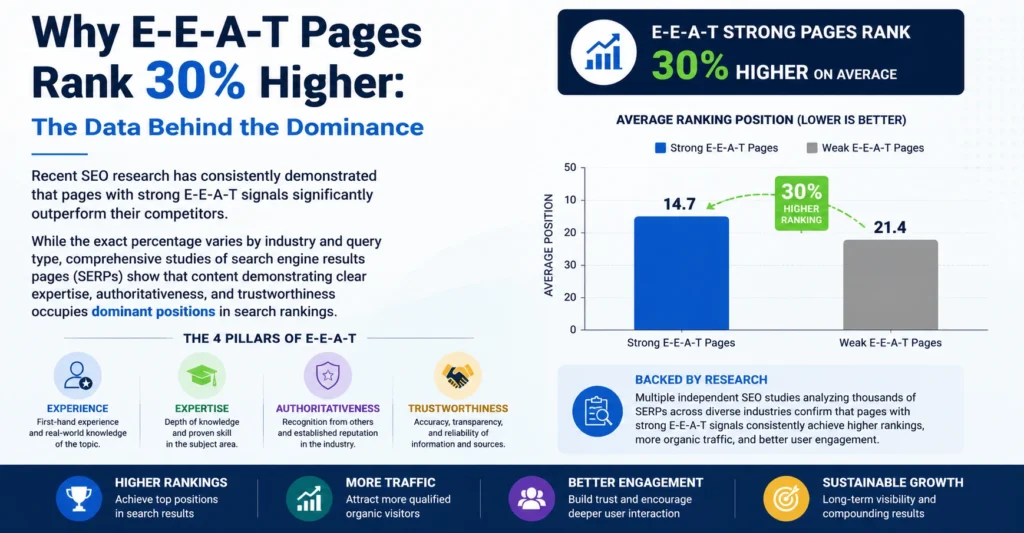
Recent SEO research has consistently demonstrated that pages with strong E-E-A-T signals significantly outperform their competitors. While the exact percentage varies by industry and query type, comprehensive studies of search engine results pages (SERPs) show that content demonstrating clear expertise, authoritativeness, and trustworthiness occupies dominant positions in search rankings.
The Ranking Reality in 2025
The correlation between E-E-A-T signals and rankings has grown stronger because:
- Google’s Quality Rater Guidelines emphasize E-E-A-T heavily – These guidelines, used to train Google’s algorithms, explicitly instruct evaluators to assess Experience, Expertise, Authoritativeness, and Trustworthiness as primary quality factors.
- AI-powered search depends on source credibility – AI Overviews, Bard/Gemini, ChatGPT, and other AI search tools preferentially cite and display content from authoritative sources because their reputation depends on accuracy.
- YMYL content faces stricter evaluation – For “Your Money or Your Life” topics (health, finance, safety, legal), Google applies even more rigorous E-E-A-T standards because bad information can genuinely harm people.
- User behavior validates quality signals – Pages with strong E-E-A-T indicators typically have better engagement metrics: lower bounce rates, longer dwell times, and higher conversion rates.
The Competitive Advantage
Websites that invest in building comprehensive E-E-A-T signals create a compounding advantage. Once established as authoritative sources, they benefit from:
- More natural backlinks from other quality sites
- Higher click-through rates from search results
- Preferential treatment in AI search results
- Greater resilience against algorithm updates
- Enhanced brand reputation and direct traffic
The E-E-A-T Implementation Framework: YMYL vs. Non-YMYL
Not all content requires the same level of E-E-A-T rigor. The stakes determine the standards.
YMYL Industries (High-Stakes Content)
Industries: Healthcare, finance, legal services, insurance, pharmaceuticals, mental health, nutrition, parenting, home safety, government services
E-E-A-T Requirements: MAXIMUM
Why it matters: Incorrect information in these fields can directly harm people’s health, financial security, legal standing, or physical safety.
Implementation Priorities:
- Expert authors with verifiable credentials (non-negotiable)
- Medical/legal review processes documented on-site
- Primary source citations for all factual claims
- Professional certifications and licenses prominently displayed
- Organizational endorsements from recognized institutions
- Transparent conflict-of-interest disclosures
- Regular content audits and updates with dates shown
- HTTPS security (absolute requirement)
- Clear contact information including physical addresses
- Professional editorial standards and fact-checking processes
Non-YMYL Industries (Standard Content)
Industries: Entertainment, sports news, hobby blogs, general lifestyle, product reviews (non-medical), travel guides, recipes, gaming
E-E-A-T Requirements: MODERATE TO HIGH
Why it matters: While consequences of errors are lower, Google still prioritizes authentic expertise and trustworthy sources.
Implementation Priorities:
- Author bylines with relevant background (experience emphasized)
- Portfolio or examples of work
- Social proof (testimonials, user reviews)
- Backlinks from relevant sites in your niche
- Consistent content quality and publishing frequency
- HTTPS security (standard best practice)
- Clear about/contact pages
- Engagement signals (comments, social shares)
- Topic-focused content clusters demonstrating depth
- User-generated validation (reviews, ratings, community interaction)
Building Your E-E-A-T Foundation: The 7-Pillar Implementation System
Pillar 1: Author Authority Architecture
Objective: Establish every content creator as a verifiable expert in their field.
Action Steps:
For YMYL sites:
- Create comprehensive author bio pages with:
- Professional headshots
- Full credentials (degrees, certifications, licenses)
- Work history and relevant experience
- Links to professional profiles (LinkedIn, institutional pages)
- Published works and research
- Speaking engagements or media appearances
- Implement author schema markup on every article
- Link author names to their bio pages sitewide
- Display credentials directly under author bylines
- Include medical board certifications or bar memberships where applicable
For non-YMYL sites:
- Develop author pages highlighting:
- Years of experience in the topic area
- Specific projects or achievements
- Portfolio of work
- Social media presence demonstrating ongoing engagement
- Personal experience stories that demonstrate firsthand knowledge
- Feature author expertise in article introductions
- Showcase awards, features, or recognition received
- Include authentic author photos (not stock images)
Schema Implementation:
{
  "@context": "https://schema.org",
  "@type": "Person",
  "name": "Dr. Sarah Martinez",
  "jobTitle": "Board-Certified Cardiologist",
  "affiliation": {
    "@type": "Organization",
    "name": "American College of Cardiology"
  },
  "alumniOf": {
    "@type": "Organization",
    "name": "Johns Hopkins University School of Medicine"
  },
  "url": "https://yoursite.com/authors/dr-sarah-martinez",
  "sameAs": [
    "https://www.linkedin.com/in/sarahmartinezmd",
    "https://twitter.com/drsarahmartinez"
  ]
}
Pillar 2: Trust Signal Integration
Objective: Demonstrate to both users and search engines that your site is legitimate, secure, and accountable.
Essential Trust Signals:
- Security Infrastructure:
- HTTPS encryption (non-negotiable in 2025)
- Valid SSL certificate from recognized authority
- Secure payment processing (if applicable)
- Clear privacy policy compliant with GDPR/CCPA
- Cookie consent management
- Transparency Elements:
- Comprehensive About Us page with company history
- Meet the Team section with photos and backgrounds
- Physical business address (not just P.O. boxes)
- Multiple contact methods (phone, email, contact form)
- Editorial policy and content standards disclosure
- Advertising/sponsorship disclosure policy
- Correction policy and process
- Social Proof:
- Industry certifications and badges
- Professional association memberships
- BBB accreditation (if applicable)
- Trust seals (Norton, McAfee, industry-specific)
- Client testimonials with verifiable details
- Case studies with real client names (when permitted)
- Media mentions and press coverage
- Awards and recognition
- External Validation:
- Links from authoritative industry sites
- Citations in academic or professional publications
- Guest contributions to respected platforms
- Speaking engagements at recognized conferences
- Partnership announcements with established brands
Pillar 3: Schema Markup Strategy
Objective: Help search engines understand and verify your expertise and authority.
Critical Schema Types for E-E-A-T:
Organization Schema:
{
  "@context": "https://schema.org",
  "@type": "MedicalOrganization",
  "name": "Heartland Cardiology Clinic",
  "description": "Board-certified cardiologists providing comprehensive heart care since 1998",
  "url": "https://heartlandcardio.com",
  "logo": "https://heartlandcardio.com/logo.png",
  "address": {
    "@type": "PostalAddress",
    "streetAddress": "123 Medical Plaza",
    "addressLocality": "Springfield",
    "addressRegion": "IL",
    "postalCode": "62701"
  },
  "telephone": "+1-217-555-0100",
  "sameAs": [
    "https://www.facebook.com/heartlandcardiology",
    "https://www.linkedin.com/company/heartland-cardiology"
  ]
}
Article Schema with Author:
{
  "@context": "https://schema.org",
  "@type": "MedicalWebPage",
  "headline": "Understanding Atrial Fibrillation: Symptoms and Treatment Options",
  "author": {
    "@type": "Person",
    "name": "Dr. Sarah Martinez",
    "url": "https://heartlandcardio.com/authors/dr-sarah-martinez"
  },
  "reviewedBy": {
    "@type": "Person",
    "name": "Dr. Michael Chen",
    "jobTitle": "Chief of Cardiology"
  },
  "datePublished": "2025-01-15",
  "dateModified": "2025-01-15",
  "publisher": {
    "@type": "Organization",
    "name": "Heartland Cardiology Clinic",
    "logo": {
      "@type": "ImageObject",
      "url": "https://heartlandcardio.com/logo.png"
    }
  }
}
Review Schema:
{
  "@context": "https://schema.org",
  "@type": "Review",
  "itemReviewed": {
    "@type": "Product",
    "name": "XYZ Blood Pressure Monitor"
  },
  "author": {
    "@type": "Person",
    "name": "Dr. Sarah Martinez"
  },
  "reviewRating": {
    "@type": "Rating",
    "ratingValue": "4.5",
    "bestRating": "5"
  },
  "reviewBody": "Based on clinical testing and patient feedback..."
}
Pillar 4: Content Excellence Standards
Objective: Produce content that demonstrates genuine expertise and firsthand experience.
Experience Signals (The New “E”):
- Include personal anecdotes and case examples
- Show original research, tests, or analysis you conducted
- Include original photography or documentation
- Share lessons learned from direct experience
- Discuss challenges faced and solutions implemented
- Provide behind-the-scenes insights
Expertise Demonstration:
- Cite primary sources and peer-reviewed research
- Explain complex concepts clearly (demonstrating deep understanding)
- Address nuances and exceptions
- Discuss recent developments and changes in the field
- Compare different approaches or methodologies
- Provide context and historical perspective
Content Quality Checklist:
- [ ] Author byline with credentials visible
- [ ] Publication and last-updated dates shown
- [ ] Sources cited with hyperlinks
- [ ] Medical/legal disclaimer (if YMYL)
- [ ] Peer review notation (for YMYL)
- [ ] Original images, graphs, or data
- [ ] Clear, scannable formatting
- [ ] Mobile-responsive design
- [ ] Fast page load times
- [ ] No intrusive ads or pop-ups
- [ ] Accessible design (WCAG compliance)
Pillar 5: User Experience Optimization
Objective: Create an environment that reinforces trustworthiness and professionalism.
Technical UX Requirements:
- Page Speed: Core Web Vitals passing (LCP < 2.5s, FID < 100ms, CLS < 0.1)
- Mobile Optimization: Responsive design that works seamlessly on all devices
- Navigation: Clear, intuitive site structure with logical hierarchy
- Readability: Appropriate font sizes (minimum 16px), high contrast ratios
- Accessibility: WCAG 2.1 AA compliance minimum
Content UX Requirements:
- Clear Value Proposition: Users understand what you offer immediately
- Easy Contact Access: Contact information visible from any page
- Minimal Friction: No forced registrations to read content
- Ad Balance: Ads don’t overwhelm or obscure content
- No Deception: Headlines match content; no clickbait
- Professional Design: Modern, clean aesthetic that conveys credibility
Engagement Signals:
- Comments section (moderated for quality)
- Social sharing buttons
- Related content recommendations
- Newsletter signup options
- Clear calls-to-action
- Interactive elements (calculators, quizzes, tools)
Pillar 6: Link Profile Development
Objective: Build a backlink profile that demonstrates your site is recognized by other authorities.
Quality Over Quantity Strategy:
Target Link Sources:
- Industry association websites
- Educational institutions (.edu domains)
- Government resources (.gov domains)
- Established media publications
- Professional organizations
- Complementary industry leaders
- Research institutions
- Conference and event websites
Link Earning Tactics:
- Original Research: Conduct and publish studies others will cite
- Expert Commentary: Offer quotes to journalists via HARO or similar
- Guest Contributions: Write for respected industry publications
- Resource Creation: Build tools, calculators, or guides others link to
- Speaking Engagements: Present at conferences, get speaker page links
- Partnerships: Collaborate with established organizations
- Digital PR: Earn coverage in relevant media outlets
Link Profile Health Indicators:
- Diverse anchor text (mostly branded and natural)
- Links from topically relevant sites
- Minimal low-quality or spammy links
- Growing link velocity that appears natural
- Links from sites with their own strong E-E-A-T
Pillar 7: Entity-Based Authority Building
Objective: Establish your brand, organization, and key individuals as recognized entities in Google’s Knowledge Graph.
What Are Entities?
Entities are uniquely identifiable people, places, organizations, or things that search engines recognize and understand. When Google recognizes you as an entity, it can better understand your authority and connect your content to relevant queries.
Building Entity Recognition:
- Knowledge Graph Presence:
- Create/claim Wikipedia page (if notable enough)
- Develop comprehensive Wikidata entry
- Ensure accurate Google Business Profile
- Maintain consistent LinkedIn company page
- Keep Crunchbase profile updated (for businesses)
- Consistent NAP (Name, Address, Phone):
- Identical information across all platforms
- Structured data markup on your site
- Consistent branding and naming conventions
- Clean citations in relevant directories
- Entity Relationship Building:
- Get mentioned alongside recognized entities in your field
- Collaborate with known experts and organizations
- Participate in industry events with established entities
- Earn coverage in publications that cover your industry leaders
- Semantic Content Optimization:
- Create topic clusters around your core expertise areas
- Use natural language and terminology consistent with industry leaders
- Cover topics comprehensively (demonstrate topical authority)
- Build internal linking that reinforces topic relationships
Entity Schema Implementation:
{
  "@context": "https://schema.org",
  "@type": "Organization",
  "name": "Heartland Cardiology Clinic",
  "@id": "https://heartlandcardio.com/#organization",
  "sameAs": [
    "https://en.wikipedia.org/wiki/Heartland_Cardiology",
    "https://www.wikidata.org/wiki/Q12345678",
    "https://www.linkedin.com/company/heartland-cardiology"
  ]
}
Case Studies: Real-World E-E-A-T Success Stories
Case Study 1: Medical Practice Recovers from Algorithm Update
Industry: Healthcare (Dermatology)
Challenge: 45% traffic drop after a core algorithm update
Timeline: 6 months
The Problem: A dermatology practice had been publishing blog content written by marketing staff without medical credentials. After a major Google algorithm update, their organic traffic plummeted as Google began prioritizing content from verified medical professionals.
E-E-A-T Implementation:
- Added board-certified dermatologist credentials to all author pages
- Had all existing content reviewed and endorsed by licensed physicians
- Implemented medical reviewer schema markup
- Added “Medically reviewed by” badges with physician credentials
- Created detailed doctor bio pages with education, certifications, and publications
- Removed or rewrote content that couldn’t be verified by medical staff
- Added original clinical photography from actual patient cases (with consent)
- Obtained backlinks from local medical associations and hospital networks
Results:
- Month 3: Traffic recovered to 80% of pre-update levels
- Month 6: Traffic exceeded pre-update baseline by 23%
- Bonus outcomes:
- Featured snippet positions increased from 3 to 17
- “People Also Ask” appearances increased 156%
- Local pack visibility improved significantly
- Patient appointment bookings from organic search increased 34%
Key Takeaway: For YMYL content, author credentials are non-negotiable. The investment in having medical professionals review and endorse content pays dividends in both rankings and conversions.
Case Study 2: Financial Blog Builds Authority from Scratch
Industry: Personal Finance
Challenge: New site with no authority in a competitive niche
Timeline: 12 months
The Problem: A certified financial planner (CFP) launched a personal finance blog but struggled to rank against established finance sites like NerdWallet, Investopedia, and The Motley Fool.
E-E-A-T Strategy:
- Prominently displayed CFP credentials on every page
- Created comprehensive “About” page detailing 15 years of financial planning experience
- Included client success stories (anonymized) demonstrating real-world experience
- Published original research analyzing investment strategies with real data
- Contributed guest articles to established finance publications (Forbes, Kiplinger)
- Earned backlinks from .edu sites by creating a free financial literacy curriculum
- Appeared on personal finance podcasts as an expert guest
- Obtained quotes in mainstream media (AP, WSJ) through journalist outreach
- Partnered with a CPA to co-author tax-related content
- Implemented comprehensive schema markup for authorship and organization
Results:
- Month 6: First page rankings for 23 long-tail keywords
- Month 9: Ranking on page 1 for competitive terms like “529 plan vs Roth IRA”
- Month 12:
- 15,000 monthly organic visitors (from zero)
- 47 first-page rankings for competitive finance terms
- Featured in Google’s AI Overviews for 8 finance queries
- Email list grew to 3,200 subscribers
- Monthly revenue from financial planning leads: $8,500
Key Takeaway: Even new sites can compete in YMYL niches if they demonstrate genuine expertise and build authoritative signals systematically. Guest contributions and media mentions accelerate authority building significantly.
Case Study 3: E-commerce Site Improves Product Rankings
Industry: Home Fitness Equipment
Challenge: Product pages not ranking despite competitive prices
Timeline: 4 months
The Problem: An online fitness equipment retailer had quality products and good prices but couldn’t rank on page 1 for product-related searches. Customers who found them loved the service, but discovery was the problem.
E-E-A-T Enhancement:
- Hired certified personal trainers to write product descriptions and guides
- Added author bios for all trainers with certifications (NASM, ACE, ISSA)
- Created original video content showing equipment being used in real workouts
- Published buying guides with firsthand testing notes and measurements
- Added detailed technical specifications with original photography
- Implemented FAQ sections answering real customer questions
- Showcased customer reviews prominently (with verification)
- Added “expert pick” badges for trainer-recommended products
- Created comparison charts based on hands-on testing
- Earned backlinks from fitness blogs by offering expert commentary
Results:
- Month 2: Product pages began appearing on pages 2-3
- Month 4:
- 12 product pages ranking on page 1
- Organic revenue increased 67%
- Average time on page increased from 1:23 to 3:47
- Bounce rate decreased from 61% to 38%
- Featured in Google Shopping results more frequently
- Customer feedback mentioned “helpful expert reviews” 3x more often
Key Takeaway: Even for e-commerce, demonstrating expertise through qualified reviewers and original testing significantly improves rankings and conversions. Experience signals (firsthand testing) matter as much as expertise credentials.
AI Overviews and the E-E-A-T Filter: Why Low-Quality Content Gets Excluded
The AI Overview Reality
Google’s AI Overviews (formerly called SGE – Search Generative Experience) represent a fundamental shift in how search results are presented. Instead of just showing blue links, Google now generates AI-powered summaries that answer queries directly at the top of search results.
The Problem for Low E-E-A-T Sites:
AI Overviews are dramatically more selective about which sources they cite and display. Early analysis of AI Overview citations reveals that:
- High-authority sources dominate: Over 90% of cited sources in AI Overviews come from sites with strong E-E-A-T signals
- YMYL content faces extreme scrutiny: Medical and financial queries almost exclusively cite recognized institutions
- Low-quality sites are effectively invisible: Sites without clear authorship, credentials, or trust signals rarely appear in AI-generated responses
- Experience indicators matter: Sites demonstrating firsthand experience and original insights are favored over aggregated content
Why AI Search Requires Stronger E-E-A-T
AI systems like Google’s Gemini, OpenAI’s ChatGPT search, and Microsoft’s Copilot face a critical challenge: their reputation depends on the accuracy of information they provide. A single instance of bad medical advice or financial misinformation can damage user trust and create liability concerns.
Result: AI systems implement extremely conservative source selection, prioritizing:
- Verifiable Credentials: Content from authors with demonstrable expertise
- Institutional Authority: Information from recognized organizations
- Primary Sources: Original research, official documentation, expert analysis
- Recent Content: Up-to-date information with clear publication dates
- Corroboration: Information confirmed across multiple authoritative sources
The Visibility Crisis
If your content lacks strong E-E-A-T signals, you face a compounding problem:
- Zero-click searches increase: AI Overviews answer questions without users clicking through
- You’re not cited in the Overview: Users never see your brand or URL
- Traditional rankings matter less: Even page 1 rankings generate fewer clicks when AI Overviews dominate the SERP
- The authority gap widens: Sites already recognized get more visibility, while unknown sites get less
How to Fix It: AI-Ready E-E-A-T Optimization
Step 1: Audit Your Content Against AI Standards
Ask yourself:
- Would I trust this information if I were making an important decision?
- Are the authors clearly identified with relevant credentials?
- Is the information current and dated?
- Are claims backed by credible sources?
- Does the content demonstrate firsthand experience or original analysis?
Step 2: Implement AI-Specific Optimizations
- Structured Authorship:
- Every article needs a credentialed author
- Link authors to detailed bio pages
- Implement Person schema with credentials and affiliations
- Source Attribution:
- Cite primary sources extensively
- Link to peer-reviewed research, official data, or expert analyses
- Use inline citations, not just reference lists
- Transparency Signals:
- Display clear publication and update dates
- Show editorial review processes
- Include conflict-of-interest disclosures
- Original Insights:
- Add unique research, testing, or analysis
- Include original data or case studies
- Share firsthand experience narratives
- Technical Infrastructure:
- Implement comprehensive schema markup
- Ensure site security (HTTPS)
- Optimize for Core Web Vitals
- Make content easily crawlable and structured
Step 3: Build Authoritative Signals
AI systems often cross-reference entity recognition to validate authority:
- Get cited by recognized sources: Earn links and mentions from established authorities
- Build Knowledge Graph presence: Develop Wikipedia, Wikidata, and professional profile listings
- Engage in the expert community: Speak at conferences, contribute to industry publications, participate in professional forums
- Demonstrate ongoing expertise: Publish regularly on current developments in your field
Step 4: Monitor AI Visibility
Track whether your content appears in:
- Google AI Overviews
- ChatGPT citations (when users search with ChatGPT)
- Perplexity AI references
- Other AI search tools in your industry
Use tools like BrightEdge or similar SEO platforms that now track AI Overview appearances, or manually search for your target keywords and document whether your site is cited.
The Future-Proof Approach
The trajectory is clear: AI-powered search will continue to expand, and E-E-A-T standards will only become more critical. Sites that invest now in building genuine authority, demonstrating real expertise, and establishing trust signals will thrive. Those that don’t risk becoming effectively invisible in the AI-driven search landscape.
The Bottom Line: If AI can’t trust your content enough to cite it, neither can your potential customers. E-E-A-T is no longer just an SEO factor—it’s a business survival requirement.
The E-E-A-T Scorecard: Rate Your Website’s Authority
Use this comprehensive scorecard to evaluate your current E-E-A-T implementation. Rate each item on a scale of 0-2:
- 0 = Not implemented or severely lacking
- 1 = Partially implemented or needs improvement
- 2 = Fully implemented and meeting best practices
EXPERIENCE (Maximum: 20 points)
Content Creation:
- [ ] Authors share firsthand experiences and specific examples (0-2)
- [ ] Content includes original research, testing, or analysis (0-2)
- [ ] Articles feature original photography, videos, or data (0-2)
- [ ] Content discusses lessons learned and real-world applications (0-2)
- [ ] Behind-the-scenes insights or process documentation included (0-2)
Demonstration:
- [ ] Case studies or examples from actual projects (0-2)
- [ ] Before/after results with documentation (0-2)
- [ ] User-generated content (reviews, testimonials) is prominent (0-2)
- [ ] Content addresses nuances and exceptions from experience (0-2)
- [ ] Regular updates based on new experiences or developments (0-2)
Experience Subtotal: _____ / 20
EXPERTISE (Maximum: 24 points)
Author Credentials:
- [ ] All authors have detailed bio pages (0-2)
- [ ] Professional credentials clearly displayed (degrees, certifications) (0-2)
- [ ] Work history and relevant experience documented (0-2)
- [ ] Links to professional profiles (LinkedIn, institution pages) (0-2)
- [ ] Published works, research, or speaking engagements listed (0-2)
Content Quality:
- [ ] Content demonstrates deep subject knowledge (0-2)
- [ ] Complex concepts explained clearly and accurately (0-2)
- [ ] Primary sources and research cited extensively (0-2)
- [ ] Content covers topics comprehensively (0-2)
- [ ] Recent developments and changes addressed (0-2)
For YMYL Sites:
- [ ] Medical/legal/financial credentials are board-certified or equivalent (0-2)
- [ ] Peer review process implemented and documented (0-2)
Expertise Subtotal: _____ / 24
AUTHORITATIVENESS (Maximum: 22 points)
External Recognition:
- [ ] Backlinks from authoritative sites in your industry (0-2)
- [ ] Citations in academic or professional publications (0-2)
- [ ] Guest contributions to recognized platforms (0-2)
- [ ] Media mentions or press coverage (0-2)
- [ ] Speaking engagements at industry conferences (0-2)
Industry Standing:
- [ ] Professional association memberships displayed (0-2)
- [ ] Industry awards or recognition received (0-2)
- [ ] Partnership announcements with established brands (0-2)
- [ ] Presence in Google Knowledge Graph or Wikipedia (0-2)
- [ ] Consistent NAP (Name, Address, Phone) across directories (0-2)
Content Authority:
- [ ] Comprehensive topic coverage (topical authority) (0-2)
Authoritativeness Subtotal: _____ / 22
TRUSTWORTHINESS (Maximum: 34 points)
Security & Privacy:
- [ ] HTTPS encryption implemented sitewide (0-2)
- [ ] Valid SSL certificate from recognized authority (0-2)
- [ ] Clear privacy policy (GDPR/CCPA compliant) (0-2)
- [ ] Secure payment processing (if applicable) (0-2)
Transparency:
- [ ] Comprehensive About Us page with company history (0-2)
- [ ] Team page with photos and backgrounds (0-2)
- [ ] Physical business address displayed (0-2)
- [ ] Multiple contact methods available (phone, email, form) (0-2)
- [ ] Editorial policy and standards disclosed (0-2)
- [ ] Advertising/sponsorship disclosure policy (0-2)
- [ ] Correction policy and process documented (0-2)
Trust Signals:
- [ ] Industry certifications or trust seals displayed (0-2)
- [ ] BBB accreditation or equivalent (if applicable) (0-2)
- [ ] Customer testimonials with verifiable details (0-2)
- [ ] Professional liability insurance (for service businesses) (0-2)
User Experience:
- [ ] No intrusive ads or deceptive practices (0-2)
- [ ] Clear value proposition and honest marketing (0-2)
Trustworthiness Subtotal: _____ / 34
TECHNICAL IMPLEMENTATION (Maximum: 20 points)
Schema Markup:
- [ ] Organization schema implemented (0-2)
- [ ] Person/Author schema on all content (0-2)
- [ ] Article schema with proper metadata (0-2)
- [ ] Review schema (if applicable) (0-2)
User Experience:
- [ ] Core Web Vitals passing (LCP, FID, CLS) (0-2)
- [ ] Mobile-responsive design (0-2)
- [ ] Fast page load times (under 3 seconds) (0-2)
- [ ] Accessible design (WCAG 2.1 AA compliance) (0-2)
- [ ] Intuitive navigation and site structure (0-2)
- [ ] Clear, readable formatting and typography (0-2)
Technical Implementation Subtotal: _____ / 20
TOTAL E-E-A-T SCORE: _____ / 120
Score Interpretation:
100-120 Points: EXCELLENT Your E-E-A-T implementation is comprehensive and competitive. You’re well-positioned for top rankings in both traditional and AI-powered search. Focus on maintaining these standards and staying current with algorithm updates.
80-99 Points: STRONG You have a solid E-E-A-T foundation with room for optimization. Identify your lowest-scoring categories and prioritize improvements there. You’re likely ranking well but could capture more competitive terms with enhancements.
60-79 Points: MODERATE Your E-E-A-T implementation has significant gaps that are likely limiting your rankings, especially for competitive or YMYL topics. Prioritize immediate improvements in Expertise and Trustworthiness categories. Consider professional E-E-A-T optimization services.
40-59 Points: WEAK Your site is vulnerable to algorithm updates and likely struggling to rank for competitive terms. You urgently need comprehensive E-E-A-T improvements across all categories. This is especially critical if you operate in YMYL industries.
0-39 Points: CRITICAL Your E-E-A-T signals are severely lacking, putting your site at high risk of ranking drops or manual penalties. If you’re in a YMYL industry, you may already be experiencing traffic declines. Immediate, comprehensive overhaul needed.
Priority Action Matrix
Based on your scores, focus on these priorities:
If Experience is your lowest score:
- Add author case studies and real-world examples
- Include original photography and documentation
- Incorporate firsthand testing and analysis
- Share specific lessons learned from projects
If Expertise is your lowest score:
- Develop comprehensive author bio pages
- Hire or partner with credentialed experts
- Obtain relevant certifications for your team
- Cite authoritative primary sources extensively
If Authoritativeness is your lowest score:
- Launch a digital PR campaign to earn media mentions
- Contribute guest articles to industry publications
- Build relationships with authoritative sites for backlinks
- Apply for industry awards and recognition
If Trustworthiness is your lowest score:
- Implement HTTPS immediately (if not done)
- Create comprehensive About and Contact pages
- Add trust badges and certifications
- Improve transparency with editorial policies
If Technical Implementation is your lowest score:
- Implement comprehensive schema markup
- Fix Core Web Vitals issues
- Improve mobile responsiveness
- Enhance page speed and accessibility
Implementation Roadmap: Your 90-Day E-E-A-T Transformation
Days 1-30: Foundation Building
Week 1: Audit & Strategy
- Complete the E-E-A-T Scorecard for your entire site
- Identify your three weakest categories
- Audit competitor E-E-A-T signals (top 3 ranking competitors)
- Develop prioritized implementation plan
- Assign team responsibilities and budgets
Week 2: Author Authority Setup
- Create or enhance author bio pages
- Document credentials, experience, and affiliations
- Implement author schema markup sitewide
- Link author names to bios in all content
- Update existing content with proper attribution
Week 3: Trust Signal Implementation
- Ensure HTTPS is properly implemented
- Create/update About Us page
- Add Team page with photos and backgrounds
- Display physical address and contact information
- Write and publish privacy policy and editorial standards
Week 4: Technical Infrastructure
- Implement Organization schema
- Add Person schema for all authors
- Implement Article schema with metadata
- Fix critical Core Web Vitals issues
- Ensure mobile responsiveness
Days 31-60: Authority Building
Week 5: Content Enhancement
- Audit top 20 pages for E-E-A-T signals
- Add experience indicators (case studies, examples)
- Include primary source citations
- Add original images, data, or research
- Update publication dates and add “last reviewed” dates
Week 6: Link Building Launch
- Identify 20 target authority sites for backlinks
- Create outreach templates for guest posting
- Sign up for HARO or similar journalist platforms
- Pitch original research or expert commentary
- Reach out to industry associations for partnership opportunities
Week 7: Social Proof Development
- Request testimonials from satisfied customers
- Implement review schema on relevant pages
- Create case studies with real client examples
- Document certifications and display badges
- Apply for relevant industry awards
Week 8: Entity Recognition
- Create or update LinkedIn company page
- Claim and optimize Google Business Profile
- Build Wikidata entry
- Ensure consistent NAP across all directories
- Submit to relevant industry directories
Days 61-90: Scaling & Optimization
Week 9: Content Expansion
- Publish 4-8 new pieces demonstrating expertise
- Create comprehensive guides on core topics
- Develop topic clusters around expertise areas
- Include multimedia content (videos, infographics)
- Feature author expertise prominently
Week 10: Advanced Schema Implementation
- Add Review schema where applicable
- Implement FAQ schema for common questions
- Add Breadcrumb schema for navigation
- Include VideoObject schema for video content
- Test all schema using Google’s Rich Results Test
Week 11: Link Building Acceleration
- Follow up on outreach efforts from Week 6
- Publish guest articles on secured placements
- Respond to journalist queries with expert insights
- Create link-worthy assets (tools, research, guides)
- Document and celebrate media mentions on-site
Week 12: Monitoring & Refinement
- Set up E-E-A-T tracking dashboard
- Monitor rankings for target keywords
- Check for AI Overview appearances
- Analyze traffic and engagement metrics
- Identify and fix remaining gaps
Ongoing Maintenance
Monthly Tasks:
- Publish 4-8 high-E-E-A-T content pieces
- Update existing content with new information
- Pursue 3-5 backlink opportunities
- Monitor schema markup for errors
- Review and respond to user feedback
Quarterly Tasks:
- Complete E-E-A-T Scorecard reassessment
- Audit competitor E-E-A-T improvements
- Update author credentials and accomplishments
- Refresh trust signals (testimonials, certifications)
- Conduct comprehensive content audit
Annual Tasks:
- Full site E-E-A-T audit
- Update all team bios and credentials
- Renew security certificates and trust badges
- Evaluate and update editorial policies
- Strategic planning for next year’s authority building
The Measurement Framework: Tracking E-E-A-T Success
Key Performance Indicators (KPIs)
Search Visibility Metrics:
- Organic keyword rankings (track position changes for target terms)
- AI Overview appearances (frequency of citation in Google’s AI summaries)
- Featured snippet positions (measure increase in position zero rankings)
- SERP feature appearances (People Also Ask, Knowledge Panels, etc.)
- Impressions (total visibility in search results)
Traffic Metrics:
- Organic sessions (overall traffic from search engines)
- New vs. returning visitor ratio (authority builds return visits)
- Direct traffic (brand awareness from authority building)
- Referral traffic (traffic from backlink sources)
- Geographic distribution (expansion of reach)
Engagement Metrics:
- Average session duration (quality traffic stays longer)
- Bounce rate (authoritative content reduces bounces)
- Pages per session (trusted sites see more exploration)
- Conversion rate (trust drives conversions)
- Return visitor frequency (authority builds loyalty)
Authority Indicators:
- Domain Authority/Domain Rating (Moz/Ahrefs metrics)
- Number of referring domains (quality backlink growth)
- Brand mention volume (tracking unlinked brand mentions)
- Social media mentions and shares (social proof expansion)
- Media coverage instances (press and publication features)
Technical Health:
- Core Web Vitals scores (LCP, FID, CLS)
- Mobile usability errors (Google Search Console)
- Security issues (SSL certificate status, security warnings)
- Schema markup validation (Rich Results Test pass rate)
- Crawl errors and indexation (coverage in Google Search Console)
Recommended Tracking Tools
Free Tools:
- Google Search Console (rankings, clicks, impressions)
- Google Analytics 4 (traffic, engagement, conversions)
- Google PageSpeed Insights (Core Web Vitals)
- Google Rich Results Test (schema validation)
- Google Business Profile Insights (local authority)
Paid Tools:
- Ahrefs or Semrush (backlink profile, competitor analysis, rankings)
- BrightEdge or Conductor (AI Overview tracking)
- Screaming Frog (technical SEO audits)
- Moz Pro (Domain Authority tracking)
- Brand24 or Mention (brand mention monitoring)
Monthly Reporting Template
Create a simple dashboard tracking:
- Overall E-E-A-T Score (quarterly reassessment)
- Organic Traffic Trend (month-over-month percentage change)
- Keyword Rankings (top 10, top 20, top 50 distribution)
- New Backlinks Acquired (quantity and quality assessment)
- AI Overview Appearances (count and keywords)
- Core Web Vitals Status (passing/failing by metric)
- Conversion Rate (organic traffic conversions)
- Notable Wins (new featured snippets, media mentions, partnerships)
Common E-E-A-T Mistakes to Avoid
Mistake #1: Fake or Exaggerated Credentials
The Problem: Fabricating degrees, certifications, or experience to appear more authoritative.
Why It Backfires: Google can cross-reference credentials with official databases. Users can verify claims. Getting caught destroys trust permanently and can result in manual penalties.
The Fix: Be honest about your actual credentials and experience. If you lack formal credentials, emphasize practical experience, successful projects, and learning from reputable sources.
Mistake #2: Anonymous or Generic Authorship
The Problem: Publishing content with no author attribution or using generic names like “Admin” or “Content Team.”
Why It Backfires: Google’s algorithms specifically look for real, identifiable authors, especially for YMYL content. Anonymous content signals low accountability and questionable expertise.
The Fix: Assign every piece of content to a real person with a genuine bio, photo, and credentials. If using a team approach, list all contributors.
Mistake #3: Buying Low-Quality Backlinks
The Problem: Purchasing links from link farms, private blog networks, or irrelevant sites to artificially inflate authority.
Why It Backfires: Google’s algorithms can identify unnatural link patterns. Low-quality backlinks can trigger penalties and actually harm your rankings.
The Fix: Focus on earning links naturally through quality content, digital PR, guest contributions, and relationship building with legitimate industry sites.
Mistake #4: Neglecting Author Bio Pages
The Problem: Having minimal or missing author bio pages, or creating them without meaningful detail.
Why It Backfires: Author pages are a critical E-E-A-T signal. Without them, Google can’t verify the expertise of your content creators.
The Fix: Create comprehensive author pages with credentials, experience, photos, social profiles, and professional accomplishments for every contributor.
Mistake #5: Copying Content from Other Sources
The Problem: Republishing or closely paraphrasing content from other websites without adding original value.
Why It Backfires: Duplicate or derivative content demonstrates no original expertise. Google prioritizes original insights and firsthand experience.
The Fix: Always create original content based on your unique experience, research, or analysis. When citing other sources, add substantial original commentary and insights.
Mistake #6: Ignoring Schema Markup
The Problem: Publishing content without implementing proper structured data markup.
Why It Backfires: Search engines rely on schema to understand and verify your expertise, authorship, and organizational credentials. Without it, you’re missing critical authority signals.
The Fix: Implement comprehensive schema markup including Organization, Person, Article, and Review schemas as appropriate.
Mistake #7: Poor Website Security
The Problem: Running a website without HTTPS or with expired SSL certificates.
Why It Backfires: Security is a fundamental trust signal. Browsers warn users about insecure sites, and Google explicitly uses HTTPS as a ranking factor.
The Fix: Implement HTTPS immediately with a valid SSL certificate from a recognized certificate authority. Ensure all pages redirect to the secure version.
Mistake #8: Hidden Contact Information
The Problem: Making it difficult to find contact information or only offering a contact form with no other details.
Why It Backfirres: Lack of accessible contact information suggests you’re hiding your identity, which destroys trustworthiness.
The Fix: Display clear contact information on every page (typically in the header or footer), including phone number, email, physical address, and multiple contact methods.
Mistake #9: Outdated Content with No Review Dates
The Problem: Publishing content once and never updating it, with no indication of when it was last reviewed.
Why It Backfires: Especially for YMYL topics, outdated information can be harmful. Google wants to see that content is kept current and accurate.
The Fix: Add publication dates and “last updated” dates to all content. Review and refresh content regularly, especially for rapidly changing topics.
Mistake #10: Aggressive Monetization
The Problem: Overwhelming content with ads, pop-ups, or aggressive sales tactics that interfere with the user experience.
Why It Backfires: Excessive monetization signals that your primary goal is profit, not helping users. This degrades trust and user experience metrics.
The Fix: Balance monetization with user experience. Ensure ads don’t obscure content, pop-ups aren’t intrusive, and the main content is clearly prioritized.
E-E-A-T for Different Content Types
Blog Articles & Educational Content
Priority E-E-A-T Elements:
- Clear author bylines with credentials
- Publication and update dates
- Primary source citations
- Original insights or research
- Comprehensive topic coverage
Schema Recommendations:
- Article schema with author information
- Person schema for authors
- FAQ schema for questions within content
Product Reviews & Recommendations
Priority E-E-A-T Elements:
- Evidence of hands-on testing
- Original photos or videos of products
- Specific measurements or test results
- Comparison methodology explained
- Disclosure of any affiliate relationships
Schema Recommendations:
- Review schema with ratings
- Product schema
- Author schema emphasizing testing experience
Service Pages & Business Information
Priority E-E-A-T Elements:
- Team credentials and experience
- Case studies or portfolio examples
- Client testimonials with verification
- Industry certifications and licenses
- Clear pricing and service details
Schema Recommendations:
- Organization schema
- LocalBusiness schema (if applicable)
- Service schema
- AggregateRating schema for reviews
Medical & Health Content
Priority E-E-A-T Elements:
- Board-certified medical professionals as authors
- Medical review process documented
- Primary research citations (peer-reviewed journals)
- Clear disclaimers about medical advice
- Date of publication and last medical review
Schema Recommendations:
- MedicalWebPage schema
- Person schema with medical credentials
- Organization schema for medical facility
Financial & Legal Content
Priority E-E-A-T Elements:
- Professional credentials (CFP, CPA, JD, etc.)
- Regulatory disclaimers
- Citations to official sources (IRS, SEC, etc.)
- Client confidentiality statements
- Professional liability insurance information
Schema Recommendations:
- FinancialService or LegalService schema
- Person schema with professional credentials
- Organization schema with regulatory information
The Future of E-E-A-T: What’s Coming Next
Trend #1: Real-Time Expertise Verification
As AI capabilities advance, expect search engines to implement real-time credential verification by cross-referencing professional licensing databases, academic registries, and professional association memberships.
Prepare Now: Ensure all credentials are accurately represented and publicly verifiable through official channels.
Trend #2: Multi-Modal Experience Signals
Video content, podcasts, and interactive media will increasingly serve as experience indicators. Search engines are developing capabilities to analyze video and audio content for expertise signals.
Prepare Now: Invest in creating diverse content formats that demonstrate your hands-on experience, including video demonstrations, podcasts with expert insights, and interactive tools.
Trend #3: Stricter YMYL Enforcement
As AI-generated content proliferates, expect even more stringent E-E-A-T requirements for YMYL topics, with potential manual reviews or algorithmic safeguards for content that could cause harm.
Prepare Now: If you operate in YMYL industries, prioritize having all content reviewed by credentialed professionals and documented accordingly.
Trend #4: Entity-Based Authority Ranking
Search engines are moving toward understanding authority at the entity level not just domain level. Individual experts may carry authority across multiple platforms.
Prepare Now: Build personal brands for your experts across multiple platforms. Create consistent entity profiles for key team members.
Trend #5: Conversational AI Integration
As conversational AI becomes the primary search interface, the sources cited in AI responses will drive the majority of traffic and brand visibility.
Prepare Now: Optimize content specifically for AI citation by emphasizing clarity, accuracy, authoritative sourcing, and structured data.
Trend #6: Community Validation
User-generated signals reviews, comments, social engagement will play an increasingly important role in E-E-A-T assessment as search engines get better at detecting authentic community validation.
Prepare Now: Foster genuine community engagement on your site and social channels. Encourage and showcase authentic user reviews and testimonials.
Your E-E-A-T Action Plan: Where to Start Today
Based on everything we’ve covered, here’s your immediate action plan:
Action Step 1: Assess Your Current State (Today)
Complete the E-E-A-T Scorecard in this article and identify your three weakest categories.
Action Step 2: Quick Wins (This Week)
- Add or update author bio pages for all content creators
- Implement HTTPS if not already done
- Create or enhance your About Us and Contact pages
- Add publication dates to all content
Action Step 3: Foundation Building (This Month)
- Implement basic schema markup (Organization, Person, Article)
- Audit your top 20 pages for E-E-A-T signals and enhance them
- Begin documenting credentials and expertise
- Fix critical Core Web Vitals issues
Action Step 4: Authority Development (Next 90 Days)
- Launch link building and digital PR efforts
- Create original research or comprehensive guides
- Seek media mentions and speaking opportunities
- Build entity recognition across platforms
Action Step 5: Continuous Improvement (Ongoing)
- Monitor rankings and AI Overview appearances
- Update content regularly
- Pursue new backlink opportunities monthly
- Reassess E-E-A-T scores quarterly
Conclusion: E-E-A-T Is No Longer Optional
The digital landscape has fundamentally shifted. Whether users find you through traditional search, AI Overviews, ChatGPT, or any future search technology, one thing remains constant: trust is the currency of online visibility.
E-E-A-T isn’t just a Google ranking factor—it’s the framework that determines whether your content is considered trustworthy enough to be shown to users, cited by AI systems, and relied upon for important decisions.
The sites winning in 2025 are those that have invested in demonstrating genuine expertise, building real authority, and earning authentic trust. They’ve implemented the technical infrastructure that allows search engines to verify their credibility, and they’ve created content that reflects true experience and expert knowledge.
The opportunity gap is widening. Sites with strong E-E-A-T signals are capturing more traffic, appearing in more AI citations, and building sustainable competitive advantages. Sites without these signals are becoming increasingly invisible.
The question is simple: Which side of that divide will your business be on?
Ready to Build Unshakeable E-E-A-T Authority?
At Blaze Byte Media, we don’t just understand E-E-A-T we’ve built our entire SEO methodology around it. Our E-E-A-T Optimization Framework has helped businesses across YMYL and non-YMYL industries recover from algorithm updates, dominate competitive niches, and secure positions in AI-powered search results.
Our E-E-A-T Optimization Services Include:
✅ Comprehensive E-E-A-T Audit – We assess your current implementation across all 120 scorecard criteria and identify critical gaps
✅ Author Authority Development – We help you build credible author profiles, implement proper attribution, and establish expertise signals
✅ Trust Signal Implementation – From schema markup to security infrastructure, we ensure every technical element reinforces your credibility
✅ Strategic Link Building – We earn high-quality backlinks from authoritative sources that genuinely boost your domain authority
✅ Content E-E-A-T Enhancement – We upgrade existing content with proper citations, experience indicators, and expert authorship
✅ AI Search Optimization – We position your content to be cited in AI Overviews, ChatGPT, and other AI-powered search tools
✅ Entity Authority Building – We establish your brand and key individuals as recognized entities in Google’s Knowledge Graph
✅ YMYL Compliance – Specialized services for medical, financial, legal, and other high-stakes industries requiring maximum E-E-A-T standards
Why Choose Blaze Byte Media?
🔥 Proven Results: Our clients have recovered from algorithm penalties, achieved first-page rankings in competitive niches, and appeared in AI Overviews for their target keywords
🔥 Specialized Expertise: We work with both YMYL and non-YMYL clients, understanding the unique requirements of each industry
🔥 Comprehensive Approach: We don’t just fix one aspect of E-E-A-T we build complete, sustainable authority frameworks
🔥 Transparent Process: You’ll receive detailed audits, clear action plans, and regular progress reports tracking your E-E-A-T improvements
🔥 Future-Proof Strategy: Our methods are designed for long-term authority building, not quick fixes that disappear with the next algorithm update
Get Your Free E-E-A-T Assessment
We’re offering a complimentary E-E-A-T audit for businesses serious about dominating search in 2025 and beyond. We’ll:
- Complete the full 120-point E-E-A-T Scorecard for your website
- Identify your most critical gaps and vulnerabilities
- Provide a customized 90-day implementation roadmap
- Show you exactly where you’re losing visibility to competitors
- Estimate the traffic and ranking potential of full E-E-A-T optimization
This assessment is valued at $1,500 and is completely free—no strings attached.
Schedule Your E-E-A-T Assessment Today
📧 Email: [email protected]
📞 Phone: 9803712668
🌐 Website: www.blazebytemedia.com
Don’t wait for the next algorithm update to expose your E-E-A-T weaknesses. Build unshakeable authority now and secure your position in the future of search whether that future is dominated by Google, AI, or technologies we haven’t even imagined yet.
Your expertise deserves to be seen. Let’s make sure it is.
Blaze Byte Media – Building Authority That Ranks