
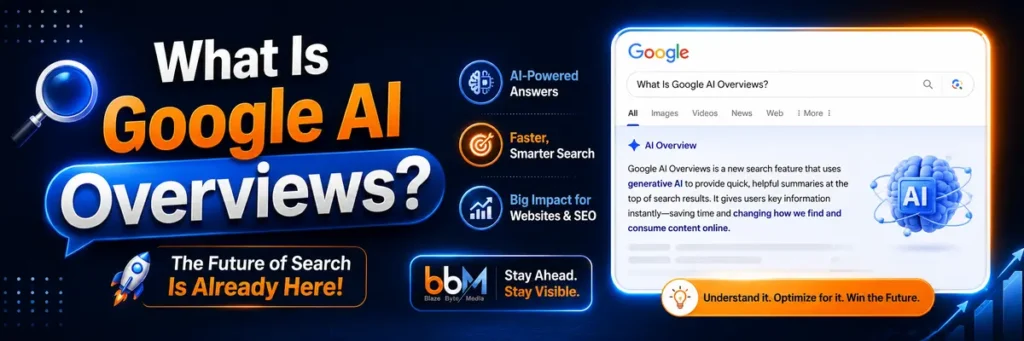
What Is Google AI Overviews? A Complete Guide for Businesses in 2026
Search doesn’t look the way it did two years ago. Instead of ten blue links, many Google searches now open with a written summary sitting above everything else, an AI-generated answer with its own sources, images, and sometimes ads. That feature is Google AI Overviews, and it has changed what it means to rank well.
Google AI Overviews are AI-generated summaries that appear at the top of Google Search results, pulling information from multiple web sources to answer a query directly on the results page. They cite roughly four to seven source links per answer and now appear on a large share of informational and commercial searches worldwide.
This guide explains what AI Overviews are, how they actually work, where they show up, why they matter for your business, and what you can do to get your content cited instead of buried beneath it.
What Is Google AI Overviews?
Google AI Overviews is a Google Search feature that uses artificial intelligence, specifically Google’s Gemini model, to generate a summarized answer to a search query, displayed at the top of the results page along with links to the sources it drew from.
Google AI Overviews sit in what’s often called “position zero,” above the traditional organic listings and, on commercial queries, sometimes followed by a small set of AI Overview ads. When you search a question, instead of scanning ten separate links to piece together an answer yourself, Google’s AI reads across multiple ranking pages and writes a synthesized response for you.
The feature started as an experimental part of Google’s Search Generative Experience (SGE), shown for the first time at Google I/O in May 2023. It launched publicly in the United States under the name AI Overviews in May 2024, and by late 2024 had expanded to the United Kingdom, India, Japan, Brazil, Mexico, and Indonesia. As of mid-2026, AI Overviews are available in more than 200 countries and territories and over 40 languages.
Clicking “Show more” on an AI Overview no longer just expands the answer. It now carries you into AI Mode, Google’s fuller conversational search experience, where you can keep asking follow-up questions and Google remembers the context of what you already asked.
A Timeline: How AI Overviews Came to Be
Understanding how quickly this feature has evolved helps explain why so many businesses feel caught off guard by it.
- May 2023: Google unveils Search Generative Experience (SGE) as an experimental, opt-in feature at Google I/O, aimed at competing with the rise of tools like ChatGPT.
- May 2024: Google rebrands the feature as AI Overviews and rolls it out to all US searchers, no opt-in required.
- Mid-to-late 2024: AI Overviews expands to the UK, India, Japan, Brazil, Mexico, Indonesia, and eventually more than 100 countries.
- May 2025: Coverage grows to over 200 countries and territories and more than 40 languages.
- January 2026: Google merges AI Overviews and AI Mode into a single, fluid experience, so clicking “Show more” carries searchers directly into a conversational AI Mode session.
- May 2026: Google further streamlines this handoff, so searchers flow into a chatbot conversation that keeps context as they refine their questions.
- August 2026 (planned): Google’s AI search features are expected to become available in France, among other markets still rolling out the feature.
Along the way, the feature has also drawn regulatory and legal attention, which we cover later in this guide.
How Google AI Overviews Work
AI Overviews generate a written response using Google’s Gemini large language model, then attach citations pulled from Google’s separate organic search index, meaning the AI’s writing and its sources come from two different systems working together.
It’s worth understanding this distinction, because it explains a lot about how to optimize for the feature. The text of an AI Overview is generated based on Gemini’s underlying knowledge and reasoning. But Gemini’s training data has a cutoff and can’t be traced back to a specific, linkable page. So Google pairs the generated answer with a separate list of source links pulled from its organic search index, the same crawled and indexed catalog of the web that powers traditional “ten blue link” rankings.
This is also what separates AI Overviews from the older featured snippet feature. A featured snippet extracts and displays the exact text from one specific page. An AI Overview generates new, synthesized text that may combine and rephrase information from several pages at once, then credits those pages as sources.
Most sources cited in an AI Overview are already ranking highly in traditional organic search, generally within the top 12 to 20 positions, though appearing there is a prerequisite, not a guarantee of citation.
You Can Ask in More Than One Way
Google has built AI Overviews to accept more than typed text. According to Google’s own materials on the feature, searchers can ask questions using text, voice, or an image, and still get a relevant AI-generated response with links to explore further. This multimodal flexibility is part of why AI Overviews trigger on more complex, multi-part questions than older search features typically handled well. A single query that would once have required several separate searches, “what’s this plant, is it toxic to pets, and how do I get rid of it”, can now be answered in one AI Overview.
Answers Can Be Simplified or Made More Detailed
Google also lets searchers adjust the reading level of an AI Overview, toggling between a simplified explanation and a more detailed one. For content creators, this is a useful reminder that the same underlying facts on your page may get rephrased at different complexity levels depending on who’s asking and how. Writing clearly at a foundational level, then backing it up with more technical detail further down the page, gives the model material to draw from either way.
What an AI Overview Is Made Of
An AI Overview isn’t one block of text. It’s assembled from separate modules, a written summary, linked key points, cited sources, and sometimes images, video, product cards, or comparison tables, each of which can pull from different sources.
Recognizing these components matters because a page can win one module and be completely absent from another sitting right next to it. The main pieces include:
| Component | What it does |
|---|---|
| AI Summary | The core generated answer, often collapsed until a searcher clicks to expand it |
| Key Points | A bulleted breakdown of the main ideas, each linked to a source |
| Citations / Cited Sources | The clickable list of source websites behind the answer |
| Images and Video | Visual modules that can appear alongside or within the summary |
| Product Lists and Places | Shopping or local business modules relevant to commercial or local queries |
| Comparison Tables | Side-by-side data used for decision-heavy queries |
| Follow-up Prompts | Suggested next questions that extend the search session into AI Mode |
| AI Overview Ads | Sponsored placements that can appear above or below the AI-generated content on commercial queries |
Because these modules are assembled independently, a brand strong in written content might win the summary and key points but lose the product card or image slot to a competitor with better structured shopping data. Treating “AI Overview visibility” as a single yes-or-no outcome misses most of what’s actually happening on the page.
Where and How Often AI Overviews Appear
AI Overviews appear on a substantial share of Google searches, more often on informational queries than transactional ones, and the exact placement (a standalone panel, folded into People Also Ask, or inside a “Things to Know” box) varies significantly by industry and device.
Reported figures vary depending on methodology and time period, since Google doesn’t publish official appearance rates. Independent research gives a useful range:
- One industry analysis found AI Overviews appearing on roughly 59% of searches with informational intent and about 19% of searches with commercial intent, reflecting that AI Overviews are most common when someone is asking a question rather than ready to buy.
- A separate 2026 cross-industry study measured AI Overviews (across all query types combined) appearing on approximately 47% of US searches as of May 2026.
- The same study found that the classic standalone Overview panel most people picture accounts for only around 27% of AI answer placements. The rest surface folded inside the People Also Ask accordion (about 59%) or inside a “Things to Know” panel (about 14%).
Placement also splits by industry. Retail queries lean heavily toward People Also Ask and Things to Know rather than the main panel, while financial services and high-tech queries are more likely to trigger the standalone Overview panel. There’s a device pattern too: the standalone Overview panel skews mobile, while the Things to Know panel skews desktop. A brand only checking desktop search results for AI Overviews is likely missing where most of its customers actually encounter the feature.
Why AI Overviews Matter for Your Business
AI Overviews push traditional organic results further down the page, which measurably reduces click-through rates even for a first-place ranking, making citation inside the AI answer a new visibility metric that sits alongside, not instead of, your search ranking.
Because an AI Overview sits above the fold and often fully answers the searcher’s question, fewer people need to click through to a website at all. Industry research has linked the presence of an AI Overview and Featured Snippet together to consuming roughly two-thirds of the visible screen on desktop and over three-quarters on mobile, and separate tracking has associated AI Overviews with click-through rate declines in the range of 15% to 30% for listings that would otherwise sit in position one.
That has real consequences for a business relying on organic search for leads or sales:
- Zero-click searches increase. A searcher can get their answer and never visit any website, including yours, even if you’re the top-ranked result.
- Citation and ranking are separate outcomes. A page ranking fifth organically can still be cited inside the AI Overview while the page ranking first is left out entirely, and the reverse happens just as often.
- E-commerce visibility now includes product feeds. Google’s AI Mode draws shopping information partly from the Shopping Graph, which is powered by product data submitted directly through Google Merchant Center, not just from crawled web pages.
- Local businesses face the same shift. AI Overviews can include a “Places” module pulling from local business data, meaning local SEO fundamentals, like a complete Google Business Profile, now feed AI visibility too.
What This Means for Businesses in Nepal and Other Growing Digital Markets
AI Overviews have rolled out unevenly around the world, but coverage now spans more than 200 countries and 40-plus languages, and it continues to expand into new markets. For businesses in Nepal and similar markets where AI Overviews are still becoming a familiar part of search behavior, that creates a window of opportunity rather than a crisis. Competition for AI citations in a given local niche is often lower than in saturated markets like the US or UK, which means a business investing in clear, well-structured, technically sound content now can establish citation presence before every competitor catches up. The same fundamentals apply everywhere: strong organic rankings, clean technical SEO, and content that answers questions directly.
For businesses that primarily use Nepali or mixed-language content, it’s also worth checking whether AI Overviews are currently returning results in your target language and region, since coverage and behavior can differ from English-language markets even where the feature is technically available.
For businesses in competitive or research-heavy categories, this means visibility work has to account for two audiences at once: the person scanning organic results, and the AI system deciding what to summarize and cite on their behalf.
AI Overviews vs. Featured Snippets vs. AI Mode
Featured snippets extract exact text from a single page, AI Overviews generate new synthesized text from multiple pages, and AI Mode extends that into a full back-and-forth conversation, three related but distinct search experiences that require slightly different optimization approaches.
| Feature | What it shows | Source behavior | Best suited for |
|---|---|---|---|
| Featured Snippet | Exact extracted text from one page | Pulls directly from a single ranking page | Clear, single-answer questions |
| AI Overview | AI-generated summary synthesized from multiple pages | Cites 4 to 7 sources pulled from the organic index | Broader or multi-part questions |
| AI Mode | Full conversational, multi-turn AI search experience | Draws on ongoing context across a session | Research, comparison, and follow-up-heavy queries |
Optimizing for a featured snippet is mostly about giving a single page a clean, extractable, self-contained answer. Optimizing for an AI Overview means making sure your page’s information is clear enough and credible enough that a model can confidently attribute a claim to it among several competing sources. AI Mode adds a further layer: your content needs to hold up across a conversation, not just answer the first question in isolation.
Criticism and Controversy
AI Overviews have faced real criticism for factual errors, including widely publicized nonsensical answers, and have triggered lawsuits from publishers concerned about lost traffic and unauthorized use of their content.
No honest overview of this feature can skip its rockier moments. Early versions of AI Overviews were criticized for producing inaccurate and occasionally bizarre answers. In one widely covered example from May 2024, the feature suggested people eat rocks and put glue on pizza, prompting Google to temporarily restrict AI Overviews for certain query types while it worked on fixes. The feature has also occasionally generated hallucinated explanations for idioms and phrases that don’t actually exist.
More recently, in January 2026, Google restricted AI Overviews on certain health-related searches following a Guardian investigation that found the summaries were giving risky or misleading health guidance for some queries.
Publishers have pushed back through the courts as well. In February 2025, education company Chegg sued Google’s parent company Alphabet, arguing that AI Overviews were leading students toward “low-quality, unverified AI summaries” instead of paying for Chegg’s services, and considered a sale of the company as a result. In September 2025, Penske Media, the publisher behind Rolling Stone and The Hollywood Reporter, filed suit against Google, alleging that AI Overviews reproduce publisher content without adequate compensation and reduce the incentive for users to click through to original sources. Google has disputed these claims, stating that AI Overviews send traffic to a wider range of sites rather than concentrating it.
Google has said it is committed to improving how it validates content and filters unreliable information, and has adjusted how source links are placed within AI Overviews as part of that effort. Whether that fully resolves publisher concerns remains an open and actively litigated question.
How to Optimize Your Content for AI Overviews
Getting cited in an AI Overview depends less on keyword density and more on whether your page gives an AI model a clean, credible, directly extractable answer, backed by strong organic rankings and technically accessible content.
There’s no guaranteed formula, and even pages doing everything right can lose a citation to an older, less polished source the model happens to trust more. That said, a few practices consistently improve your odds.
Answer the question immediately. Put the direct answer to a heading’s implied question in the first sentence or two beneath it, before adding context or backstory. Models tend to lift the cleanest, most immediate answer rather than paraphrasing a paragraph that builds up to the point.
Structure content so it’s easy to extract. Clear H2 and H3 headings, numbered steps, bullet lists, and comparison tables all give a model something concrete to pull from. Long, undifferentiated paragraphs, even well-written ones, are harder for a model to lift cleanly.
Build and defend your E-E-A-T signals. Experience, expertise, authoritativeness, and trustworthiness still matter, arguably more than ever, since a model deciding which source to trust among several options leans on the same credibility signals a human reader would look for: a real author, cited data, and up-to-date information.
Match the exact phrasing people search for. AI Overviews and AI Mode trigger most often on longer, more conversational, question-style queries. Reviewing the “People Also Ask” questions related to your topic is one of the most direct ways to find that phrasing.
Keep your technical foundation solid. Since AI Overview citations are pulled from Google’s organic search index, your site still needs to be crawlable, indexable, and free of the technical barriers that would keep it out of organic rankings altogether. Content that isn’t indexed can’t be cited, no matter how well it’s written.
Rank well organically first. Because most cited sources are already ranking in the top organic positions, strong on-page, off-page, and technical SEO fundamentals remain the foundation AI Overview visibility is built on, not a separate, parallel discipline.
Use structured data. Schema markup helps both traditional rich results and AI systems parse what your content means, its type, its author, its key facts, reducing the ambiguity a model has to resolve on its own.
For e-commerce, push structured product data directly to Google. Submitting accurate, complete product feeds through Google Merchant Center feeds the Shopping Graph that powers product modules inside AI Mode, a channel that exists separately from your crawled web content.
Refresh content on a regular cadence. Because AI Overviews weigh accuracy and currency, a page with outdated statistics, old pricing, or stale examples is an easy source for a model to drop in favor of a more recently updated competitor. Revisiting your highest-value pages every few months to update figures, examples, and dates helps protect citations you’ve already earned.
Write for the question behind the question. AI Overviews often synthesize an answer to a broader question than the literal search term suggests, combining what someone typed with what they probably meant. Anticipating the natural follow-up questions a reader would have, and answering them within the same page, increases the chance your content covers what the model needs to construct a complete response.
How to Measure Your AI Overview Visibility
Google Search Console does not report AI Overview appearances, citations, or ad placements, so measuring your visibility inside the feature currently requires third-party rank tracking tools built specifically to monitor AI search surfaces.
This is one of the more frustrating realities of the current landscape. Search Console shows impressions and clicks for traditional search, but it has no equivalent metric for whether your page appeared inside an AI Overview, was cited, or lost a citation to a competitor. Google Ads similarly gives no placement-level reporting for AI Overview ads. GA4 can’t cleanly isolate traffic that originated from an AI Overview click either.
In practice, that means businesses serious about tracking their AI search visibility need to either manually spot-check target queries on a regular basis or use a specialized SERP and AI-visibility tracking tool that monitors AI Overview appearance, citation share, and module type over time. Because citations can shift week to week as Google’s models and rankings update, a one-time check tells you very little. Ongoing monitoring is what actually reveals whether you’re gaining or losing ground.
Common Mistakes That Keep Content Out of AI Overviews
- Burying the answer. Making a reader (or a model) scroll through several paragraphs of setup before reaching the actual answer reduces your odds of being the source that gets lifted.
- Ignoring technical SEO. A page that isn’t properly indexed or is difficult for crawlers to access can’t be cited, regardless of content quality.
- Chasing AI visibility while ignoring organic rankings. Since most citations come from pages already ranking well organically, treating AI Overview optimization as separate from core SEO work usually backfires.
- Skipping structured data. Leaving out schema markup makes your content’s meaning less explicit at exactly the moment machine readability matters most.
- Letting content go stale. Outdated statistics or claims are one of the fastest ways to lose a citation you previously held, since freshness and accuracy both factor into whether a model keeps trusting a source.
- Only checking desktop results. Since placement patterns differ by device, a desktop-only view of your AI Overview presence can miss the surfaces your mobile customers actually see.
Conclusion
Google AI Overviews have changed what “ranking well” means. It’s no longer only about where your page sits in the traditional list of results. It’s also about whether Google’s AI trusts your content enough to summarize and credit it directly on the results page. That requires the same fundamentals that have always mattered, solid technical SEO, genuine expertise, and content that answers questions clearly, applied with a sharper focus on structure, clarity, and freshness.
Businesses that treat AI Overview visibility as an extension of strong SEO, rather than a separate trick, are the ones most likely to keep showing up as this feature keeps evolving.
FAQ on Google AI Overviews
1. What is Google AI Overviews in simple terms?
Google AI Overviews is a Google Search feature that reads information from multiple websites and writes a short, AI-generated summary at the top of the results page, along with links to its sources.
2. When did Google AI Overviews launch?
AI Overviews started as an experimental feature called Search Generative Experience in May 2023, then launched publicly under its current name in the US in May 2024.
3. Is Google AI Overviews the same as Search Generative Experience (SGE)?
Yes. SGE was the original name for the experimental version of the feature. Google rebranded it as AI Overviews when it launched more broadly in May 2024.
4. How is an AI Overview different from a featured snippet?
A featured snippet displays exact text pulled from one page. An AI Overview generates new, synthesized text drawn from several sources and cites them together.
5. Where do AI Overview sources come from?
Sources are pulled from Google’s organic search index, the same catalog of crawled and indexed pages used for traditional rankings, not from the AI model’s internal training data.
6. Do I need to rank number one to appear in an AI Overview?
No. Citations and organic rankings are separate outcomes. A page ranking lower on the page can still be cited while a higher-ranked page is left out, though most cited pages already rank in the top organic positions.
7. How many sources does a typical AI Overview cite?
Independent research has found AI Overviews typically cite around four to seven source URLs per answer, though this can vary by query.
8. Do AI Overviews reduce website traffic?
Research has associated AI Overviews with meaningful click-through rate declines, in the range of 15% to 30% for listings that would otherwise hold the top organic spot, since many searchers get their answer without clicking through.
9. Can I track how often my site appears in AI Overviews?
Not through Google Search Console, which doesn’t report AI Overview data. Tracking currently requires manual spot-checks or third-party AI-visibility monitoring tools.
10. What is AI Mode and how does it relate to AI Overviews?
AI Mode is Google’s fuller conversational AI search experience. Clicking “Show more” on an AI Overview now carries searchers directly into AI Mode, where they can ask follow-up questions with context retained.
11. Are there ads inside Google AI Overviews?
Yes. On queries with commercial intent, Google can display AI Overview ads above or below the AI-generated summary.
12. Has Google AI Overviews faced any lawsuits?
Yes. Chegg sued Alphabet in February 2025 over lost traffic, and Penske Media sued Google in September 2025 alleging unauthorized use of publisher content. Both cases raise questions about AI Overviews’ impact on the broader web.
13. Why did Google restrict AI Overviews on health searches?
In January 2026, Google restricted AI Overviews on certain health-related queries after an investigation found some summaries were giving risky or misleading medical guidance.
14. How can a small business optimize for AI Overviews?
Focus on strong organic SEO fundamentals, answer questions directly near the top of each section, use clear headings and structured data, and keep content accurate and current.
15. Do AI Overviews affect local businesses?
Yes. AI Overviews can include a “Places” module drawing on local business information, so an optimized Google Business Profile and consistent local citations can influence AI visibility, not just traditional local rankings.
16. What is GEO or AEO, and how does it relate to AI Overviews?
Generative Engine Optimization (GEO) and Answer Engine Optimization (AEO) refer to the practice of structuring content so AI search tools like Google AI Overviews, ChatGPT, and Perplexity can accurately understand, summarize, and cite it.
17. Do AI Overviews appear on every search?
No. They appear more often on informational, question-style searches than on highly transactional ones, and their placement (standalone panel, People Also Ask, or Things to Know) varies by industry and device.
18. Can product information appear inside AI Overviews or AI Mode?
Yes, particularly for shopping queries. Google’s AI Mode draws some product data from the Shopping Graph, which is populated by product feeds submitted through Google Merchant Center.
19. Is AI Overview visibility the same everywhere in the world?
No. As of mid-2026, AI Overviews are available in over 200 countries and more than 40 languages, but coverage, query types affected, and rollout timing vary by market.
20. Will AI Overviews replace traditional SEO?
No. Most cited sources are already ranking well organically, so traditional SEO fundamentals remain the foundation AI Overview visibility is built on rather than something separate from it.
AI Overviews reward businesses that already have strong SEO fundamentals and structure their content for clarity. If you’re not sure whether your site is set up to earn citations in Google’s AI search results, Blaze Byte Media can run an AI visibility and technical SEO audit and show you exactly where the gaps are. Talk to our team about AEO services in Nepal and get a clear plan for showing up in both traditional and AI-powered search.