
Introduction
If you have spent any time reading SEO advice this year, you have probably run into two terms that get used almost interchangeably: topical authority and topical relevance. They sound similar, they get name-dropped in the same breath, and most articles never explain how they actually differ.
That confusion has a real cost. Businesses often pour months into one strategy while ignoring the other, then wonder why their rankings stall or their content never shows up in an Google AI Overviews or a ChatGPT answer.
This guide breaks the two concepts apart in plain language, explains why the difference matters more than ever in 2026 now that AI search engines sit between your content and your reader, and gives you a practical framework for building both at once. Whether you run a small business site, manage content for a growing brand, or write SEO strategy for clients, you will leave with a clear answer for your own website, not just a textbook definition.
What Is Topical Relevance?
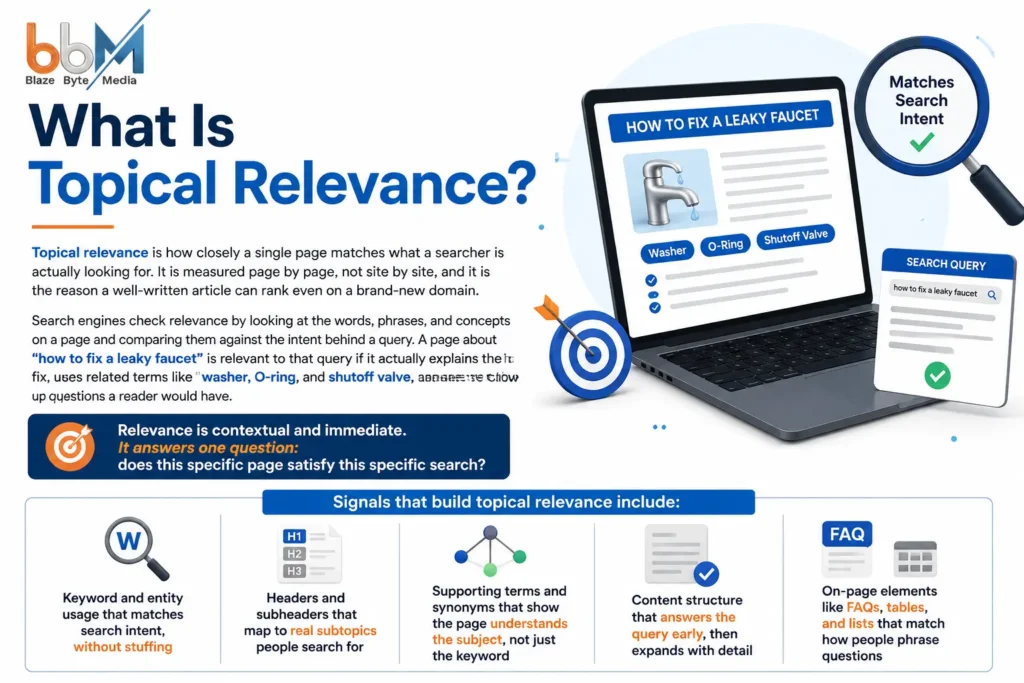
Topical relevance is how closely a single page matches what a searcher is actually looking for. It is measured page by page, not site by site, and it is the reason a well-written article can rank even on a brand-new domain.
Search engines check relevance by looking at the words, phrases, and concepts on a page and comparing them against the intent behind a query. A page about “how to fix a leaky faucet” is relevant to that query if it actually explains the fix, uses related terms like washer, O-ring, and shutoff valve, and answers the follow-up questions a reader would have.
Relevance is contextual and immediate. It answers one question: does this specific page satisfy this specific search?
Signals that build topical relevance include:
- Keyword and entity usage that matches search intent, without stuffing
- Headers and subheaders that map to real subtopics people search for
- Supporting terms and synonyms that show the page understands the subject, not just the keyword
- Content structure that answers the query early, then expands with detail
- On-page elements like FAQs, tables, and lists that match how people phrase questions
A single, well-optimized page can rank for its target query purely on relevance. That is why relevance is often the fastest lever a website can pull. It does not require months of publishing or a large content library. It requires one page that genuinely nails the intent behind the search.
Think about the last time you searched for something specific, like “how to remove a wine stain from carpet.” You were not looking for a general cleaning brand. You wanted a page that solved that one problem, quickly and clearly. If that page also mentioned club soda, baking soda, and enzyme cleaners, and addressed both fresh and dried stains, it would feel complete even if the rest of the site had nothing else to do with carpet cleaning. That completeness at the page level is relevance doing its job.
Relevance also has a quality dimension that goes beyond matching words. A page can contain every expected keyword and still fail if it does not actually resolve the reader’s problem. Search engines increasingly weigh whether a reader’s next action is to leave satisfied or bounce back to the results and click a different link. That behavioral pattern reinforces or undercuts whatever the on-page text suggests about relevance.
What Is Topical Authority?
Topical authority is your entire website’s demonstrated expertise on a subject, built across many connected pages rather than one. It answers a bigger question than relevance does: does this whole domain deserve to be treated as a trusted source on this topic?
Search engines and AI systems build this picture by looking at your site as a network. They look at how many angles of a subject you cover, whether your content links together in a logical structure, and whether your coverage goes deep enough that a reader rarely needs to leave your site to get a complete answer.
Think of it the way you would judge a professional. A single good blog post about tax deductions does not make someone a trusted tax advisor. A body of work covering deductions, filing status, self-employment tax, audits, and state-specific rules, all connected and consistent, does.
Signals that build topical authority include:
- A content cluster of many interlinked articles covering a subject and its subtopics
- Consistent terminology and entity usage across the entire site, not just one page
- Internal linking that connects related articles in a logical hierarchy
- Coverage that spans beginner, intermediate, and advanced angles of the topic
- Author expertise, credentials, and consistent publishing in the niche
- External signals like mentions, citations, and backlinks tied to the same subject
Topical authority is slow to build and hard to fake. It rewards sites that commit to a niche over sites that publish widely across unrelated subjects.
Picture two websites writing about home espresso machines. The first publishes one long article covering everything from bean grinding to steam wands. The second has fifty interlinked articles: grinder comparisons, water hardness guides, maintenance schedules, troubleshooting pages for specific machine models, and a glossary of espresso terminology. Even if the single article on the first site is well written, the second site looks like the more credible source once a reader, or a search engine, considers the whole picture. That impression, repeated across thousands of queries, is what topical authority captures.
Authority also tends to be self-reinforcing. Once a site is recognized as a trusted source in a niche, new content on that site benefits from an existing head start, because search engines and AI systems already associate the domain with the subject.
Topical relevance measures how well a single page matches a specific search query, while topical authority measures how completely an entire website covers a subject over time. Relevance is built page by page. Authority is built site-wide, through content clusters, internal linking, and consistent subject-matter depth across many pages.
Topical Authority vs Topical Relevance: The Key Differences
Seeing the two side by side makes the distinction much easier to apply.
| Factor | Topical Relevance | Topical Authority |
|---|---|---|
| Scope | Single page | Entire website or content cluster |
| Built by | Keyword and entity matching on one page | Many interlinked pages covering a subject in depth |
| Timeframe | Can be achieved quickly | Builds gradually over months |
| Best for | Ranking a specific query fast | Ranking across dozens of related queries and earning AI citations |
| Main risk if missing | Page does not match search intent | Site looks thin or scattered, even with good individual pages |
| Domain age impact | Low, new sites can rank | Higher, but a focused small site can still outrank a broad big one |
| Typical fix | Rewrite or expand the page | Publish a connected cluster and build internal links |
Neither factor replaces the other. A page can be perfectly relevant and still rank poorly if the rest of the site never demonstrates authority on the subject. A site can have strong topical authority overall and still lose a specific ranking if the individual page is thin or off-target.
Why This Debate Matters More in 2026
The gap between these two ideas used to be a minor technical distinction. In 2026, it has become a strategic decision that affects whether your content shows up at all.
Search results are no longer a single list of ten blue links. Google’s AI Overviews, Perplexity, ChatGPT search, Gemini, and Microsoft Copilot now sit between many searchers and the open web. These systems do not just rank a page. They select which sources to cite, and they tend to pull from domains that already demonstrate consistent depth on a subject rather than a single strong article sitting on an otherwise unrelated site.
AI systems run hidden follow-up searches. When someone asks an AI assistant a question, the system often runs several related sub-queries behind the scenes to build a complete answer. A domain with strong topical authority is positioned to get cited across several of those sub-queries, not just one. A single relevant page can only ever answer one piece of that puzzle.
Zero-click behavior has grown. More searches now end with an answer inside the search results or the AI response itself, without a click. Ranking for one query is worth less than it used to be if the click never happens. Owning a topic well enough to be the cited source across many related queries protects visibility even as click-through patterns shift.
Competition on individual pages has intensified. With more content being produced, including AI-assisted content, standing out on relevance alone is harder. A page that is technically relevant but sits on a shallow, unfocused site is easier to outrank than it was a few years ago.
AI systems favor domains they can cite repeatedly. When an AI assistant answers a question, it often needs to support several claims within one response. A domain that can supply several of those supporting facts, because it has covered the subject from multiple angles, saves the AI system a step. A domain with one relevant page can only ever supply one piece of that answer, which makes it a less efficient source to lean on across an entire conversation or a follow-up question.
The definition of a “result” has broadened. A decade ago, ranking meant showing up in a list of links. Today a result might be a conversational answer, a summary card, or a voice response with no visible link at all. Topical authority increases the odds that your brand becomes the underlying source behind that answer, even in formats where a traditional blue link never appears.
None of this means relevance stopped mattering. It means relevance without authority now has a shorter shelf life, especially in competitive or informational niches.
How Search Engines and AI Tools Evaluate Each One
Google evaluates relevance through on-page language matching and evaluates authority through site-wide patterns like content clusters, internal linking, and entity consistency. AI search tools add a citation layer on top, favoring domains that already show depth across a subject.
Modern search systems work with entities, meaning real-world concepts, people, places, and things, rather than isolated keywords. When you write about “content marketing,” search engines connect that phrase to related entities like content strategy, editorial calendars, SEO writing, and audience personas. A page that naturally references these connected concepts signals relevance. A site that covers all of them across multiple well-linked pages signals authority.
For topical relevance, search engines look at:
- How closely the page’s language matches the semantic pattern of the query
- Whether the page answers the query directly near the top of the content
- Whether supporting details, examples, and related terms are present
- Page-level quality signals like readability, formatting, and freshness
For topical authority, search engines and AI systems look at:
- The size and depth of your content cluster around a subject
- Internal linking patterns that connect subtopic pages back to a central pillar page
- Consistency of terminology, facts, and definitions across your site
- External recognition, such as being cited or mentioned by other sites in the niche
- Author and brand signals tied to the subject over time
AI answer engines add another layer. They tend to favor content that opens with a direct, self-contained answer, formats information into scannable blocks like short paragraphs, bullet points, and tables, and comes from a domain that already ranks and is recognized as a source on the subject. In practice, that means the technical formatting choices that help topical relevance, like BLUF writing and clear structure, also help your content get pulled into AI answers, while the underlying site-wide depth is what earns you a seat at the table across many related questions rather than just one.
When Topical Relevance Matters Most
Topical relevance is your best lever when you need to rank quickly, target a specific long-tail query, or compete on a page-level basis against sites that may have more overall authority than you do.
Relevance-first strategies work well in several situations:
- New websites without an established niche yet. A single, excellent page can start ranking for a specific long-tail query long before a full content cluster exists.
- Long-tail and highly specific queries. Searches like “best humidity level for a nursery in winter” reward a page that answers that exact question well, regardless of how broad the rest of the site is.
- Local search. A single well-optimized service page for a specific city or neighborhood can rank on relevance even if the business does not have deep topical authority nationally.
- Time-sensitive content. News, seasonal offers, and trend-driven topics often need a fast, relevant page rather than a slow-built cluster.
- Testing a new content direction. Before investing in a full cluster, one relevant page can validate whether an audience responds to a topic.
If your goal is a fast win on a narrow, well-defined query, prioritize relevance first.
When Topical Authority Matters Most
Topical authority matters most in competitive niches, YMYL subjects like health and finance, and any strategy built around long-term organic growth or AI search citations rather than a single ranking.
Authority-first strategies pay off in these situations:
- Competitive, broad topics. Ranking for “content marketing strategy” is difficult with one page, no matter how well written, if the rest of the site never demonstrates expertise in marketing.
- YMYL subjects. Health, finance, legal, and safety topics face extra scrutiny. A single article rarely earns trust here; a body of consistent, accurate content does.
- Businesses building a long-term content engine. If your goal is sustained organic traffic over years, not a single campaign, authority compounds in a way relevance alone cannot.
- AI search visibility. Getting cited consistently across ChatGPT, Perplexity, and AI Overviews favors domains that already look like the trusted source on a subject.
- Defending rankings during algorithm updates. Sites with broad, connected coverage of a topic tend to recover faster after core updates than sites relying on a handful of standalone pages.
If your goal is durable visibility across many related searches and AI answers, prioritize authority first, even though it takes longer to show results.
Can You Have Strong Relevance Without Authority (and Vice Versa)?
Yes, and understanding the failure modes on both sides helps you diagnose your own site.
Strong relevance, weak authority looks like a website with a few excellent, well-optimized pages that rank for their exact target queries but never expand into related searches. Traffic plateaus because the site never gets pulled into adjacent questions, and it struggles to earn AI citations because there is no depth behind the one good page.
Strong authority, weak relevance looks like a large, well-linked content library where individual pages are outdated, poorly targeted, or do not clearly answer the specific query a searcher typed. The site has earned trust on the subject broadly, but individual pages underperform because they were not built with a clear, matching search intent.
The healthiest sites avoid both traps by treating every new page as two jobs at once: answer this specific query well, and add real depth to the subject as a whole.
How to Build Both at the Same Time
The most efficient approach is a pillar-and-cluster content model, where one comprehensive pillar page covers a topic broadly and several supporting pages go deep on subtopics, all connected through deliberate internal linking.
Step 1: Map the topic before you write anything. List every subtopic, question, and related entity a reader would expect to find across the subject. Group them into a logical hierarchy with one central pillar topic and several supporting subtopics.
Step 2: Build a pillar page. This page should give a broad, well-organized overview of the main topic and link out to each supporting article. It targets the core keyword and serves as the hub of the cluster.
Step 3: Publish supporting content around each subtopic. Each supporting page should go deep on one piece of the puzzle and link back to the pillar page, as well as sideways to closely related supporting pages.
Step 4: Keep every individual page relevance-focused. Even within an authority-building cluster, each page still needs to satisfy its own specific search intent. Depth at the site level does not excuse a thin or unfocused individual page.
Step 5: Maintain consistency. Use the same terminology, definitions, and facts across the cluster. Contradicting yourself between articles undermines the trust signal you are trying to build.
Step 6: Refresh content on a schedule. Authority erodes if a cluster goes stale. Revisit older articles, update statistics and examples, and add new subtopics as the subject evolves.
Step 7: Support the cluster externally. Earn mentions, guest contributions, and backlinks tied to the same subject rather than scattering outreach across unrelated topics.
Step 8: Sequence publication deliberately. Do not publish all subtopic pages at once and hope they connect themselves. Draft the pillar page first, or at least outline it, so every supporting article knows what it is linking back to and what gap it is meant to fill. Publishing in a planned sequence also gives you room to spot overlap between planned articles before you have written duplicate content by accident.
Step 9: Assign clear ownership within the cluster. On larger sites, confusion creeps in when several writers cover the same subject without a shared reference document. Keep a simple internal style sheet for the cluster that lists agreed definitions, preferred terminology, and links to the pillar page, so every contributor reinforces the same story instead of quietly contradicting it.
This structure lets a single new page contribute to page-level relevance immediately while compounding into site-wide authority over time. The pillar page benefits every time a new supporting article links to it, and every supporting article benefits from sitting inside a cluster the site has already invested in.
Common Mistakes That Hold Websites Back
- Publishing broad, unrelated topics on one domain. This dilutes topical authority because the site never looks like a specialist in any one subject.
- Treating every page as a standalone asset. Without internal linking, even great individual pages fail to build authority for the site as a whole.
- Chasing keyword volume instead of query intent. A page can include the right keyword and still miss the actual reason someone searched it.
- Letting older cluster content go stale. Outdated statistics, broken examples, or old screenshots quietly erode both relevance and authority.
- Ignoring internal link anchor text. Vague anchors like “click here” waste an opportunity to reinforce the entity relationships between pages.
- Fabricating expertise instead of building it. Claiming authority through generic bios or vague credentials does not substitute for actual depth of coverage and accurate content.
- Expanding into adjacent topics too early. Topical authority grows outward like rings from a center. Jumping to a loosely related subject before the core topic is fully covered weakens the whole cluster.
- Writing for search engines instead of the reader in front of you. Content that exists purely to hit a word count or a keyword target tends to read as hollow, and both readers and AI systems increasingly treat that hollowness as a trust signal working against the page.
- Forgetting to prune or consolidate. As a cluster grows, some early articles get overtaken by newer, better ones on the same subtopic. Leaving both live, competing with each other, splits relevance signals instead of concentrating them. Merging or redirecting overlapping pages keeps the cluster focused.
How to Measure Your Progress
Tracking relevance and authority requires slightly different metrics, since one lives at the page level and the other at the site level.
To track topical relevance:
- Monitor keyword rankings for the specific queries a page targets
- Review click-through rate and average position for that page in search console tools
- Check whether the page appears in featured snippets or “People Also Ask” boxes for its target query
To track topical authority:
- Count how many ranking keywords fall under a single content cluster or topic, not just one page
- Track how many pages within a cluster rank on page one, rather than just the pillar
- Monitor whether your domain appears as a citation across multiple related AI search answers, not only one
- Watch for ranking recovery speed after core algorithm updates compared to competitors in the same niche
Reviewing both sets of metrics side by side shows you whether a stalled ranking is a page-level relevance problem or a site-level authority gap, which points you toward the right fix instead of guessing.
Most standard analytics and search console tools already contain the data you need. The extra step is grouping pages by content cluster instead of reviewing them one at a time, so you can see cluster-wide trends rather than isolated page performance. If ten pages in a cluster gain traffic together after you add a new pillar page, that is a strong signal the cluster is functioning as intended. If one page rises while the rest stay flat, the gain is likely coming from relevance on that page alone rather than authority spreading through the cluster.
A Worked Example: Two Sites, Same Niche
Seeing the concepts play out on real-looking sites makes the strategy easier to apply to your own content plan.
Site A runs a home renovation blog. It has one outstanding, 3,000-word guide to kitchen backsplash tile that ranks on page one for its exact target keyword. The rest of the site covers travel, recipes, and parenting. The backsplash guide performs well on its own, but it never shows up for related searches like grout sealing, tile spacing, or backsplash height above a stove, because nothing else on the site supports those angles.
Site B runs a narrower home renovation blog focused only on kitchens. It has a pillar page on kitchen renovation basics, plus separate articles on backsplash tile, countertop materials, cabinet refacing, kitchen lighting, and layout planning, all linked together. No single article is as long as Site A’s flagship guide, but the cluster as a whole answers almost every question a kitchen renovator might have.
Over time, Site B tends to pull ahead. It shows up across dozens of related searches instead of one, it recovers faster after algorithm updates because its visibility is not tied to a single page, and it is more likely to get pulled into AI-generated answers about kitchen renovation because it can support several related claims at once. Site A is not doing anything wrong. It is simply optimized for a single win rather than a durable position in the niche.
The Verdict: Which Matters More in 2026?
Topical authority matters more for long-term visibility and AI search citations in 2026, but topical relevance is still the fastest way to win an individual ranking, and neither one works well without the other.
If forced to choose one investment for 2026, topical authority is the stronger long-term bet. It protects a site during algorithm updates, expands visibility across dozens of related queries instead of one, and lines up with how AI search tools select which domains to trust and cite. A business trying to build durable organic growth, especially in a competitive or YMYL niche, should prioritize a connected content cluster over a scattering of one-off pages.
That said, topical relevance is not optional, and it is not something authority can substitute for. Every page inside an authoritative cluster still has to earn its own ranking by matching real search intent. The strongest 2026 content strategy treats the two as a system rather than a choice: build relevance into every individual page, and let those pages accumulate into genuine topical authority over time.
FAQ Section
1. What is the main difference between topical authority and topical relevance?
Topical relevance measures how well one page matches a specific search query. Topical authority measures how completely an entire website covers a subject across many connected pages.
2. Is topical authority a confirmed Google ranking factor?
Google has not published a single named “topical authority” ranking factor, but multiple patents and public statements describe evaluating sites based on subject-matter coverage, entity relationships, and content depth, which are the mechanisms behind topical authority.
3. Can a brand-new website rank without topical authority?
Yes. A new site can rank for specific long-tail or local queries through strong page-level relevance, even before it has built broader authority on the subject.
4. How long does it take to build topical authority?
It varies by niche and competition, but it typically takes several months of consistent, connected publishing rather than a single content sprint.
5. Does topical authority replace the need for backlinks?
No. Backlinks still function as a trust signal, but in 2026 they work best when they reinforce an already strong content cluster rather than substituting for one.
6. How many articles does it take to build a content cluster?
There is no fixed number, but most effective clusters include a pillar page plus enough supporting articles to cover every major subtopic a reader would expect, often ranging from a handful to several dozen depending on the topic’s breadth.
7. Does topical relevance still matter if I already have strong domain authority?
Yes. Even authoritative domains can lose rankings on individual pages if those pages do not clearly match search intent.
8. What is a content cluster?
A content cluster is a group of related articles built around one core topic, organized around a central pillar page with supporting pages that go deeper on individual subtopics, all connected through internal links.
9. How do AI search tools like ChatGPT and Perplexity use topical authority?
These tools tend to favor citing domains that already demonstrate consistent depth on a subject, since that depth increases the chance the domain can answer several related sub-questions, not just one.
10. Can too many unrelated topics on one site hurt my rankings?
Publishing widely across unrelated subjects can dilute the perception of expertise on any single topic, making it harder to build strong topical authority in any one niche.
11. What is the fastest way to improve topical relevance on an existing page?
Rewrite the opening section to answer the target query directly, add missing subtopics and related terms, and restructure the content with clear headers that match how people actually search.
12. Should small businesses focus on relevance or authority first?
Most small businesses benefit from starting with relevance on a few high-intent pages to generate early traffic, then expanding into a full content cluster to build authority over time.
13. Does internal linking really affect topical authority?
Yes. Internal links help search engines understand how your pages relate to each other and signal that your site covers a subject as a connected system rather than isolated articles.
14. How do YMYL rules affect this decision?
Health, finance, legal, and safety topics face extra scrutiny, so sites in these niches generally need stronger topical authority and clear expertise signals before a single page will earn full trust.
15. Can competitors with more backlinks still be outranked?
Yes. A smaller, more focused site with deeper topical coverage of a specific niche can outrank a larger site that only covers the topic on the surface.
16. What role does content freshness play in topical authority?
Authority erodes if a content cluster is not maintained, so periodically updating facts, examples, and statistics helps preserve the trust a cluster has built.
17. Is keyword density still relevant to topical relevance?
Keyword density in the old sense of repeating an exact phrase matters far less than covering the topic naturally with related terms, synonyms, and entities that match how people actually ask questions.
18. How do I know if my site has a topical authority problem?
Common signs include individual pages ranking inconsistently, new content taking a long time to gain traction, and rankings dropping sharply after core algorithm updates.
19. What is the risk of prioritizing authority while ignoring relevance?
A site can build a large, well-linked library of content that still underperforms if individual pages fail to clearly match the specific intent behind their target searches.
20. Which should a content calendar prioritize in 2026?
A content calendar should plan clusters around core topics first, then sequence individual articles so each one satisfies a specific search intent while also filling a gap in the broader subject.
Building both topical relevance and topical authority takes a clear content map, consistent publishing, and a team that understands how AI search engines actually select sources. If you want a content strategy built around this exact framework, BlazeByte Media can map your content cluster, audit your existing pages for relevance gaps, and build the internal linking structure that turns individual articles into genuine topical authority. Reach out to BlazeByte Media to start with a content audit.