
Most pages target one keyword and one search intent, then wonder why they rank for only a fraction of the queries a topic actually generates. Search intent stacking fixes that by building a single page that answers the informational question, addresses the comparison a reader is quietly running in their head, and gives them a clear next step, all without diluting the page’s focus. Done well, it turns one well-built page into a magnet for dozens of related queries instead of one.
This guide breaks down what search intent stacking actually is, how to structure a page so it satisfies multiple intents without becoming a mess, and where the tactic backfires. It also covers how this approach lines up with how AI search tools like Google AI Overviews, Perplexity, and ChatGPT pull and summarize content, since a page that answers a question completely is exactly what those systems are built to reward.
What Is Search Intent Stacking?
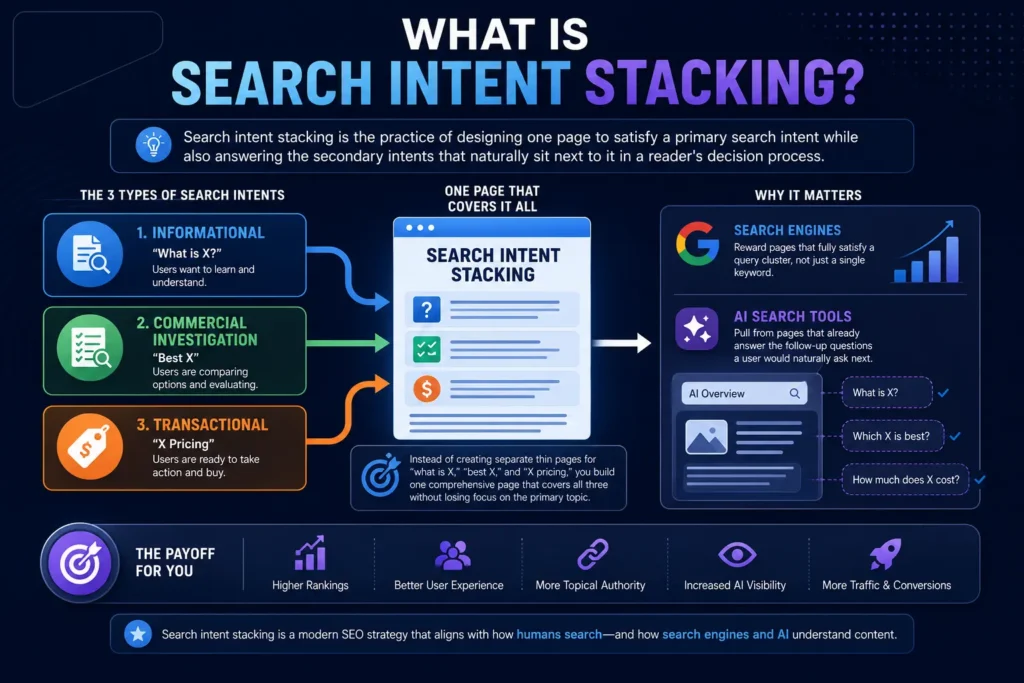
Search intent stacking is the practice of designing one page to satisfy a primary search intent while also answering the secondary intents that naturally sit next to it in a reader’s decision process. Instead of writing separate thin pages for “what is X,” “best X,” and “X pricing,” you build one page deep enough to cover all three without losing focus on the primary topic.
The idea is not new. It is a formalized version of what strong pillar pages and comprehensive guides have always done. What has changed is the payoff. Search engines increasingly reward pages that fully satisfy a query cluster rather than a single keyword, and AI search tools tend to pull from pages that already answer the follow-up questions a user would naturally ask next.
The Four Types of Search Intent You’re Working With
Before you can stack intents, you need to know what you are stacking. SEO practitioners generally group queries into four categories, and Google’s own Search Quality Rater Guidelines describe a similar breakdown using the terms Know, Do, Website, and Visit-in-Person.
| Informational | To learn something or answer a question | how, what, why, guide, definition | Guides, explainers, tutorials |
| Commercial Investigation | To compare options before deciding | best, top, vs, review, alternative | Comparison tables, reviews, roundups |
| Transactional | To take an action, usually a purchase or signup | buy, price, discount, near me, order | Product pages, pricing pages, service pages |
| Navigational | To find a specific brand, site, or page | brand names, “login,” “official site” | Homepage, branded landing pages |
Informational queries make up the largest share of search volume, which is one reason educational content anchors most intent-stacked pages. Commercial investigation sits in the middle of the funnel, where a reader already knows they have a need and is weighing options. Transactional intent is the readiest-to-act stage, and navigational intent is largely about brand recognition rather than content depth.
Most intent stacking happens between informational and commercial investigation, with a light transactional layer added near the end of the page. Stacking navigational intent onto a topic page rarely makes sense, since navigational searches are looking for a specific destination, not a broader answer.
Why Single-Intent Pages Struggle in Modern Search
A page built for exactly one intent leaves ranking opportunity on the table because real searchers move through informational, comparison, and decision questions in the same session, often without leaving the search results page.
Search behavior rarely stays in one lane. Someone researching “best project management software” is asking an informational-flavored question, but they are also implicitly asking “which one is right for a small team” and “how much does it cost.” A page that only answers the first question sends that reader back to Google, which shows up in your bounce and pogo-sticking data even if your content is technically accurate.
There is also a structural cost. If you build three thin pages instead of one thorough page, you risk keyword cannibalization, where your own pages compete against each other in the same search results and dilute the ranking signals each one could have earned individually. Search engines also increasingly reward topical depth. A single page that thoroughly answers a cluster of related questions signals more expertise than three separate pages that each answer one narrow question.
Finally, AI-driven search tools change the calculation again. When Google’s AI Overviews, Perplexity, or a chat assistant summarizes an answer, they tend to draw from sources that already cover the follow-up questions a user is likely to have. A page that answers only the surface-level question is less useful to summarize than one that anticipates what comes next.
The Intent Stacking Framework: A Step-by-Step Process
Building an intent-stacked page is not the same as cramming every keyword you can find onto one URL. It follows a deliberate order.
Step 1: Identify Your Primary Intent Anchor
Every stacked page still needs one dominant intent that determines its structure, its title, and its primary keyword. Look at the current search results for your target query. If the top-ranking pages are mostly guides and explainers, your primary intent is informational. If they are mostly comparison posts or product pages, your primary intent leans commercial or transactional. The primary intent decides what the page is fundamentally about; everything else is supporting layers.
Step 2: Map the Secondary Intents That Naturally Sit Beside It
Secondary intents are the questions a reader would ask right after getting the primary answer. For a page targeting “what is a HELOC,” the secondary intents might include “HELOC vs home equity loan” (commercial investigation) and “how to apply for a HELOC” (transactional). You can surface these by looking at:
- Google’s “People also ask” boxes for your target query
- Related searches at the bottom of the results page
- Autocomplete suggestions when you type the query
- Questions your sales or support team hears repeatedly
Only stack intents that genuinely belong to the same topic cluster. If the secondary intent requires an entirely different keyword strategy and audience, it likely deserves its own page instead.
Step 3: Architect the Content in Layers, Not a Blend
The biggest execution mistake is mixing intents sentence by sentence instead of section by section. A well-stacked page keeps each intent in its own clearly labeled zone: the top of the page satisfies the primary informational question, a middle section handles comparison or evaluation content, and a lower section (or a persistent sidebar module) handles the transactional layer. Readers and search engines should always be able to tell which section answers which type of question.
Step 4: Use Content Blocks That Match Each Intent
Different intents respond to different formats. Match the block to the job it needs to do:
- Informational layer: short definition, explainer paragraphs, a step-by-step process, a diagram or table
- Commercial investigation layer: comparison table, pros and cons list, “how to choose” criteria
- Transactional layer: pricing summary, service overview, a clear call to action, contact or quote form
Step 5: Signal Intent Structure to Search Engines With Markup and Formatting
Use heading hierarchy to make the intent zones machine-readable. H2s should mark the major intent shifts, and H3s should break down supporting detail within a zone. Add structured data where it applies: FAQ schema for question-and-answer sections, HowTo schema for process content, and Product or Service schema if the transactional layer includes a specific offer. This does not change what the page says, but it helps search engines and AI crawlers parse which part of the page answers which type of query.
Intent Stacking by Page Type: Real Examples
Different page types stack intents differently depending on what the primary goal already is.
| Definitional / glossary page | Informational | Commercial investigation | Definition, use cases, “types of X” comparison table |
| “Best X” listicle | Commercial investigation | Transactional | Ranked list, comparison table, pricing column, CTA per entry |
| Service page (e.g., agency, contractor) | Transactional | Informational | Service description, process explainer, FAQ, quote CTA |
| How-to guide | Informational | Transactional | Step-by-step instructions, tools needed, “hire a pro” CTA |
| Product page | Transactional | Informational | Spec sheet, use-case explainer, FAQ, buy button |
A local SEO and content agency page is a good illustration. BlazeByte Media, for example, structures its own service pages to open with a plain-language explanation of what a service like technical SEO or content strategy actually involves, move into a section that helps a visitor compare their situation against when that service makes sense, and close with a direct path to start a project. That is intent stacking applied to a transactional page: the primary intent stays transactional, but the informational layer at the top does the work of building trust before the ask.
How to Physically Structure a Multi-Intent Page
Structure is what keeps an intent-stacked page from turning into a wall of unfocused text. A few rules keep it usable:
- Lead with the primary intent, always. The first two or three sentences under any heading should answer the question directly (a BLUF approach), not build up to it.
- Use a table of contents with jump links for pages over 1,500 words. This lets a reader with transactional intent skip straight to pricing without scrolling past the informational layer.
- Keep transactional content visible but not intrusive. A sticky CTA button, a pricing box in a sidebar, or a clearly labeled “Get a Quote” section works better than interrupting an explainer paragraph with a sales pitch.
- Separate zones with clear H2s that describe the intent, not just the topic. “What Is X” and “X Pricing and Plans” tell both readers and search engines exactly what they will find in each section.
- End with a single, clear CTA that matches the strongest intent on the page, rather than three competing calls to action.
Common Intent Stacking Mistakes
Even experienced content teams get this wrong in a few predictable ways.
- Treating it as keyword stuffing. Piling in every related keyword phrase without a clear content block for each one produces a page that reads like a list, not an answer.
- Losing the primary intent. If a “what is X” page spends half its length pitching a product, it stops satisfying the informational searcher who clicked expecting an explanation.
- Cannibalizing existing pages. If you already have a dedicated pricing page, stacking a full pricing breakdown onto an unrelated guide can create two pages competing for the same transactional query.
- Writing thin sections for the sake of coverage. A two-sentence FAQ answer that adds nothing new does not count as satisfying that intent; it just adds length.
- Ignoring the reader’s actual sequence of questions. Stacking intents in a random order forces readers to hunt for the section relevant to them instead of moving naturally through the page.
- Forcing unrelated intents together. Not every secondary keyword belongs on the page just because it is technically related to the topic. If a query requires a different tone, a different audience, or a different depth of detail, forcing it in usually weakens both sections rather than strengthening either one.
- Skipping the table of contents. On longer stacked pages, a reader who arrived for the transactional layer has no way to skip past several thousand words of informational content without jump links. That friction shows up as a higher bounce rate even when the content itself is good.
These mistakes share a common root: treating intent stacking as a way to rank for more keywords rather than a way to serve more of a reader’s actual needs. When the structure follows the reader’s decision process, the keyword coverage tends to follow naturally. When the structure follows a keyword list instead, the page usually reads as disjointed no matter how well each individual section is written.
How to Measure Whether Intent Stacking Is Working
A few signals tell you whether the approach is paying off, most of them available in Google Search Console and standard analytics tools.
- Query diversity per page. In Search Console’s Performance report, filter by page and check how many distinct queries drive impressions. A successfully stacked page should show growth across informational, comparison, and transactional query variants, not just one.
- SERP feature capture. Track whether the page starts appearing in featured snippets, People Also Ask boxes, or AI Overviews for more than one query type.
- Scroll depth and section engagement. If analytics show readers scrolling well into the commercial or transactional sections rather than bouncing after the intro, the layering is working.
- Assisted conversions from non-transactional entry queries. If visitors who arrive through an informational query later convert, that page is successfully carrying a reader through more than one stage of intent.
- Average position spread across the query cluster. Rather than tracking one keyword, track the whole cluster of informational, comparison, and transactional variants together. A well-stacked page usually shows the informational queries ranking strongest first, with the commercial and transactional variants climbing over time as the page accumulates relevance signals for the full cluster.
Give any structural change like this time before judging results. Search engines need to recrawl and reassess the page, and ranking movement for a broader query cluster typically takes longer to show up than movement for a single keyword. A reasonable review window is six to twelve weeks after a significant restructure, checked against the baseline data pulled before the change.
When to Split Intents Into Separate Pages Instead
Intent stacking is not the right move for every situation. Split intents into dedicated pages when:
- The secondary intent has enough search volume to justify its own page and would get diluted by sharing space with another topic.
- The topic is YMYL (Your Money or Your Life), such as medical, legal, or financial advice, where depth and precision on a single intent matter more than breadth.
- The intents point to genuinely different audiences. A page for “how [product] works” aimed at end users and a page for “[product] API documentation” aimed at developers should almost never be combined.
- Navigational intent is involved. Brand or product-specific searches want a direct destination, not a broader explainer wrapped around it.
A useful test: if removing the secondary intent section would make the page feel incomplete to the reader who arrived through the primary keyword, it belongs on the page. If it would feel like an unrelated detour, it belongs on its own page instead.
Search Intent Stacking for AI Search and AEO
AI-driven search tools, including Google’s AI Overviews, Microsoft Copilot, Perplexity, and conversational assistants, tend to summarize from pages that already answer the follow-up questions a user is likely to ask. This makes intent stacking directly relevant to answer engine optimization (AEO) and generative engine optimization (GEO), not just traditional rankings.
A few practices help a stacked page perform well in AI-generated answers:
- Answer the core question in the first two to three sentences of each section, since summarization tools tend to pull from the opening of a relevant passage.
- Use question-based subheadings that mirror how people phrase queries in conversational search and voice assistants.
- Keep facts specific and attributable. Vague, generic statements are harder for an AI system to confidently cite than clear, well-supported claims.
- Cover the natural next questions, since a chat assistant answering a follow-up question is more likely to draw on a source that already addressed it than to synthesize from a page that stopped at the surface level.
The overlap between good intent stacking and good AEO is not a coincidence. Both reward the same underlying behavior: genuinely anticipating what the reader needs next and providing it clearly, in the same place, without making them search again.
A Walkthrough: Stacking Intents on a Real Page
It helps to see the framework applied end to end. Say the target topic is “commercial roof coating,” and the primary keyword is informational: people searching this phrase mostly want to understand what roof coating is and whether it is worth doing.
Primary intent (informational): The page opens with a plain-language explanation of what commercial roof coating is, what problems it solves, and how it compares to a full roof replacement. This section satisfies the reader who typed “what is roof coating” or “roof coating vs replacement.”
Secondary intent (commercial investigation): A comparison table follows, breaking down coating types (silicone, acrylic, polyurethane) by lifespan, cost range, and best-use scenario. This section captures readers who are further along and searching “best roof coating for flat roofs” or “silicone vs acrylic roof coating.”
Tertiary intent (transactional): Near the end, a section addresses “how much does roof coating cost per square foot” with a general pricing range, followed by a clear call to action to request an inspection or quote. This captures the reader who is ready to act, without forcing every visitor through a sales pitch before they understand the basics.
Each layer is clearly labeled with its own H2, so a reader who already knows what roof coating is can skip straight to the comparison table or the pricing section using the table of contents. Nothing is duplicated across sections, and the page still has one unmistakable primary purpose: explaining what roof coating is and helping the right visitor take the next step.
Tools and Signals for Finding Stackable Intents
You do not need expensive software to find the secondary intents worth stacking onto a page, though a few sources make the process faster and more reliable.
- Google Search Console’s Performance report. Filter by page for content you already have, and look at the full list of queries driving impressions. Queries with meaningful impressions but low click-through or poor average position often reveal a secondary intent your current page only partially addresses.
- “People also ask” and “related searches.” These SERP features are Google surfacing the exact follow-up questions real users have for a topic. Treat each one as a candidate for its own subsection rather than a separate page, unless it clearly diverges from your primary topic.
- Keyword research tools with intent labeling. Most keyword research platforms tag queries by likely intent type. Cluster your keyword list by topic first, then check whether a single cluster spans more than one intent type. If it does, that cluster is a strong candidate for one intent-stacked page instead of several thin ones.
- Site search and support queries. If your own site search logs or customer support tickets show people asking pricing or comparison questions on a page that is purely informational, that is a direct signal to add a stacked section.
- Competitor SERP analysis. Look at what ranks for your primary keyword. If the top results already blend informational and commercial content, a single-intent page from you is unlikely to outrank them.
None of these tools replace judgment. The goal is not to stack every intent you can find; it is to stack the two or three that a real reader on this specific topic would naturally want answered in the same place.
Getting Started With Intent Stacking on Your Own Content
The fastest way to apply this is to audit your existing top-performing pages first. Pull the query report for each one in Search Console and look for query clusters you are already ranking for inconsistently. Those are strong candidates for an intent-stacking rebuild, since you already have partial relevance to build on rather than starting from zero.
Agencies that specialize in content strategy, including teams like BlazeByte Media, typically start there: identifying which existing pages are close to ranking for a broader cluster of intents and restructuring them before creating anything new. It is usually a faster path to ranking gains than building additional thin pages from scratch.
If your team is weighing whether to tackle a content architecture overhaul in-house or bring in outside help, it is worth getting a second opinion on which pages are the best candidates before committing the time. A short consultation with a content or SEO specialist can usually identify the two or three pages on a site with the most upside.
Frequently Asked Questions
1. What is search intent stacking in SEO?
Search intent stacking is structuring one page to satisfy a primary search intent, such as informational, along with one or more related secondary intents, such as commercial investigation or transactional, so the page can rank for a broader cluster of related queries.
2. Is intent stacking the same as keyword stuffing?
No. Keyword stuffing crams in unrelated keywords without adding value, while intent stacking adds genuine, well-structured sections that answer real follow-up questions a reader would naturally have.
3. How many intents can one page realistically satisfy?
Most successful pages stack two to three intents. Trying to cover four or more usually spreads the content too thin and confuses both readers and search engines about the page’s primary purpose.
4. What are the four main types of search intent?
Informational, commercial investigation, transactional, and navigational. Google’s own guidelines describe a similar structure using the terms Know, Do, Website, and Visit-in-Person.
5. Does Google officially recognize “search intent stacking” as a ranking factor?
No. It is not an official Google ranking factor or term. It is an SEO strategy built on well-documented principles, including topical depth and satisfying the full range of a query cluster’s intent.
6. How do I find the secondary intents to stack onto a page?
Check Google’s “People also ask” box, related searches, autocomplete suggestions, your existing Search Console query data, and common questions from your sales or support team.
7. Should every blog post use intent stacking?
No. Short, narrowly focused posts on a single clear intent, especially navigational or highly specific informational queries, often perform better as standalone pages.
8. Can intent stacking cause keyword cannibalization?
It can if done carelessly. If you already have a dedicated page for a secondary intent, duplicating that content elsewhere can create competing pages instead of one stronger page.
9. What is the difference between commercial and transactional intent?
Commercial investigation intent means the searcher is comparing options before deciding. Transactional intent means the searcher is ready to act, such as buying, signing up, or requesting a quote.
10. How long should an intent-stacked page be?
Length should match the number of intents and the depth each one requires, not a fixed word count. A page stacking two or three intents thoroughly is often 1,500 to 3,000 words, though there is no universal rule.
11. Do I need a table of contents on a multi-intent page?
Yes, for any page long enough to cover multiple intents. Jump links let readers skip directly to the section relevant to their specific need.
12. How does intent stacking help with featured snippets?
Each clearly labeled section with a direct BLUF-style answer gives Google multiple distinct passages that could qualify for a featured snippet, rather than one shot at a single snippet opportunity.
13. Does intent stacking work for e-commerce product pages?
Yes. Product pages often stack a primarily transactional intent with a supporting informational layer, such as a short buying guide or FAQ, to catch shoppers who are still researching.
14. What is the risk of putting too much sales content on an informational page?
It frustrates the reader who arrived expecting an explanation and can increase bounce rates, which signals to search engines that the page is not fully meeting the query’s needs.
15. How does search intent stacking relate to topical authority?
Topical authority is built by comprehensively covering a subject area. Intent stacking is one practical way to build that comprehensiveness within a single page rather than across many thin ones.
16. Should FAQ sections be included on every intent-stacked page?
FAQ sections are useful when they answer genuinely different follow-up questions rather than restating content already covered elsewhere on the page. Redundant FAQs add length without adding value.
17. How does intent stacking affect AI Overviews and AI search results?
AI-driven search tools tend to summarize from pages that already answer follow-up questions, so a page that anticipates the next question a reader would ask is more likely to be pulled into an AI-generated answer.
18. What schema markup works best for a multi-intent page?
FAQ schema for question-and-answer sections, HowTo schema for step-by-step content, and Product or Service schema for the transactional layer, applied based on what each section of the page actually contains.
19. Can intent stacking hurt conversion rates if not done carefully?
Yes, if the transactional call to action is buried too deep in the page or the informational content is padded, readers with transactional intent may leave before reaching it.
20. Is intent stacking more important for B2B or B2C content?
Both benefit, though B2B buying journeys often involve longer research phases with more overlapping intents, making stacked pages especially useful for early-stage informational and comparison content.
21. How do I know if my existing content is a good candidate for intent stacking?
Check Search Console for pages already picking up impressions across a range of related queries with inconsistent rankings. That inconsistency often signals an intent gap the current page only partially addresses.
22. What is BLUF and why does it matter for intent stacking?
BLUF stands for Bottom Line Up Front. It means answering a question directly in the first two or three sentences of a section, which helps both readers scanning the page and search engines identifying the core answer of each section.
23. Should local service businesses use intent stacking?
Yes. Service pages commonly stack a transactional primary intent with an informational layer explaining the service, which builds trust before asking for the conversion.
24. Does intent stacking apply to YMYL topics like health or finance?
It applies more cautiously. YMYL topics often benefit from focused, deeply researched single-intent pages rather than broad stacking, since accuracy and depth on one intent typically matter more than breadth.
25. How often should an intent-stacked page be updated?
Review it whenever the underlying query cluster shifts, new related questions emerge in Search Console data, or competitor content in the space adds coverage your page is missing.
26. Can intent stacking be used for local SEO pages?
Yes. A local service page can stack informational content about the service with transactional content about scheduling, plus location-specific proof points, without needing separate pages for each.
27. What tools help identify search intent for a keyword?
Search Console query reports, SERP analysis of currently ranking pages, and most modern keyword research platforms that label queries by likely intent type.
28. Is it better to rewrite an existing page or create a new one for intent stacking?
Rewriting an existing page that already has some ranking history is usually faster and more effective than starting a new page from zero, since it retains existing relevance signals.
29. How does intent stacking differ from a traditional pillar page?
Pillar pages typically link out to supporting cluster content on separate URLs. Intent stacking keeps multiple intents on the same URL, which works best when the secondary intents do not have enough independent search volume to justify their own page.
30. What is the biggest sign that intent stacking is working?
Growth in the diversity of queries driving impressions and clicks to a single page, combined with the page picking up more than one type of SERP feature over time.
Call to Action
If your best-performing pages are ranking inconsistently across a cluster of related queries, that inconsistency is usually a sign the page is only satisfying part of what searchers want. BlazeByte Media works with businesses to audit existing content, identify which pages are strong candidates for intent stacking, and rebuild them for broader, more durable rankings. Reach out to BlazeByte Media to get a content audit and see which of your pages have the most upside.