
Introduction
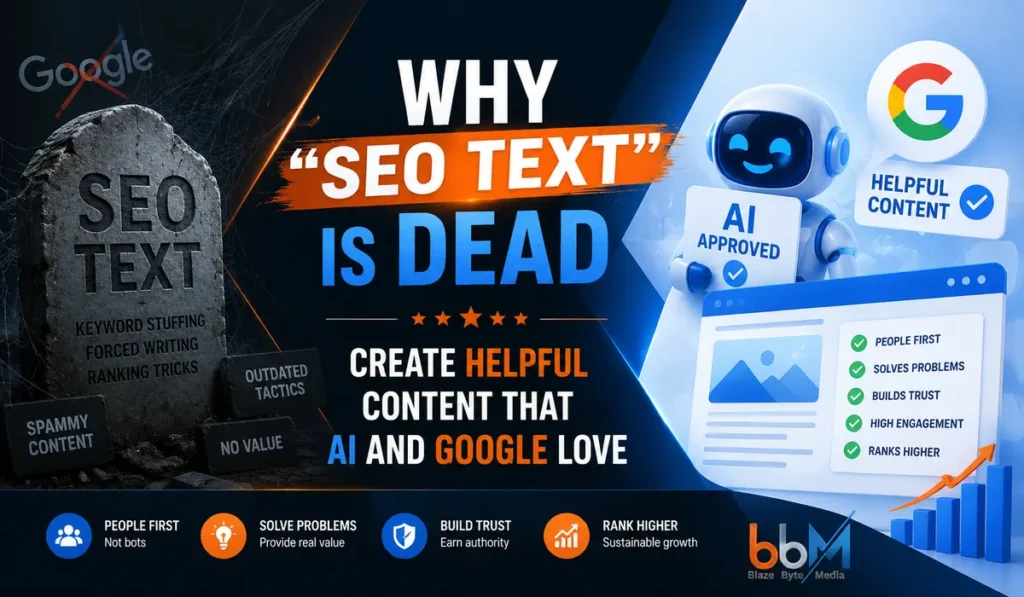
SEO text is content written primarily to satisfy search algorithms through keyword repetition and formulaic structure rather than to help a real reader. Google’s Helpful Content system, folded into its core ranking algorithm in March 2024, actively demotes it. AI search engines like ChatGPT and Google AI Overviews go further, simply skipping over shallow, keyword-stuffed pages when choosing what to cite. Content that survives both is written for a specific reader first, then structured for machines second
If you’re still writing content the way SEO blogs taught you in 2015, stop. Cramming your primary keyword into every other sentence, publishing 300-word “answers” padded with fluff, or hiring the cheapest writer to hit a word count doesn’t work anymore. Google calls this “SEO text,” and its systems are built specifically to find it, discount it, and bury it.
At the same time, a second shift is happening. People aren’t just typing keywords into Google anymore. They’re asking ChatGPT, Perplexity, Gemini, and Google’s own AI Overviews full questions and expecting direct answers. These AI systems don’t care how many times you repeated your keyword. They care whether your content actually answers the question, clearly and accurately, better than the next source.
This guide breaks down exactly what “SEO text” is, why it stopped working, and what to write instead if you want to rank in traditional search and get cited by AI. You’ll get a practical framework, a comparison table, a self-audit checklist, and answers to the questions people actually ask about this topic.
1. What “SEO Text” Actually Means
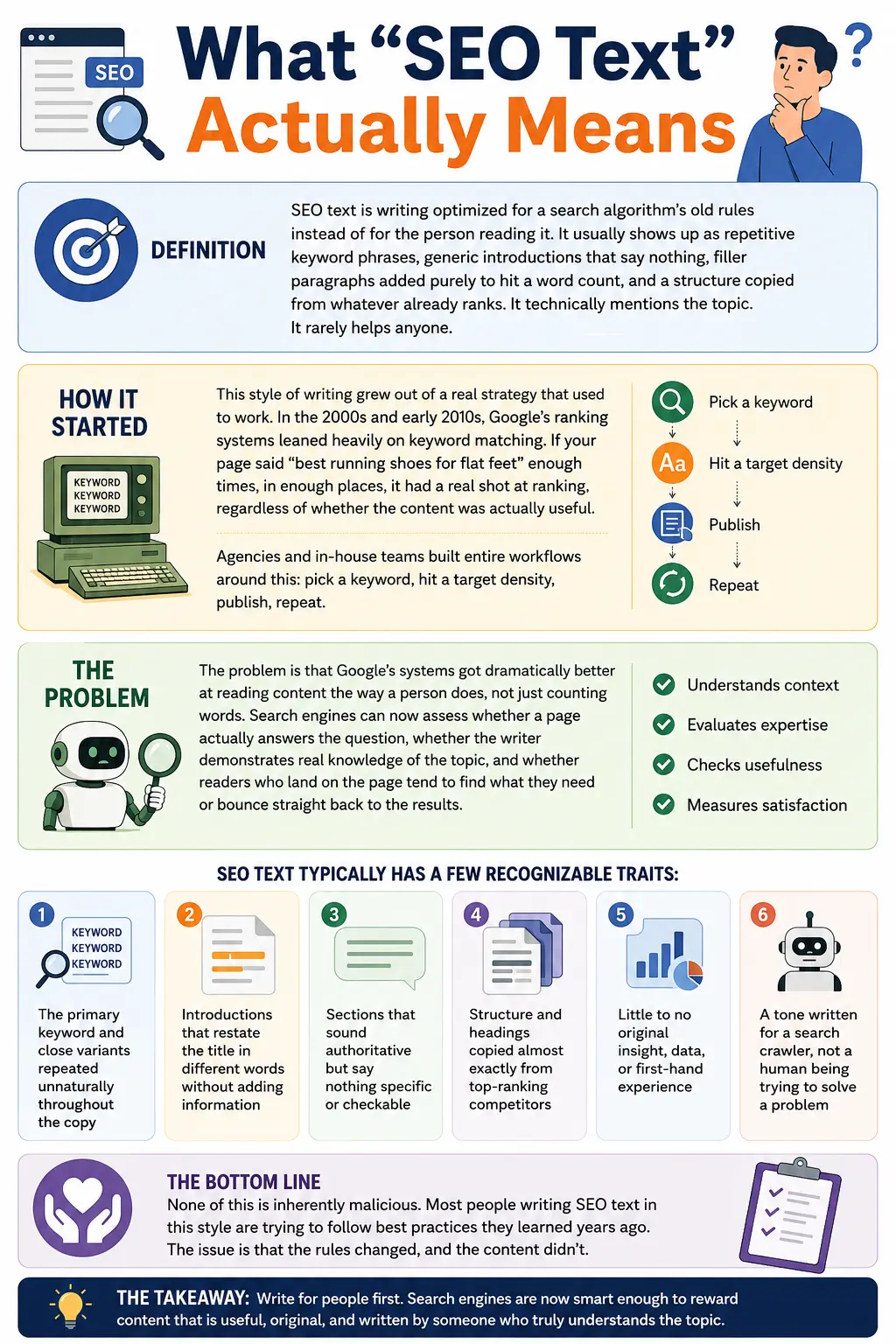
SEO text is writing optimized for a search algorithm’s old rules instead of for the person reading it. It usually shows up as repetitive keyword phrases, generic introductions that say nothing, filler paragraphs added purely to hit a word count, and a structure copied from whatever already ranks. It technically mentions the topic. It rarely helps anyone.
This style of writing grew out of a real strategy that used to work. In the 2000s and early 2010s, Google’s ranking systems leaned heavily on keyword matching. If your page said “best running shoes for flat feet” enough times, in enough places, it had a real shot at ranking, regardless of whether the content was actually useful. Agencies and in-house teams built entire workflows around this: pick a keyword, hit a target density, publish, repeat.
The problem is that Google’s systems got dramatically better at reading content the way a person does, not just counting words. Search engines can now assess whether a page actually answers the question, whether the writer demonstrates real knowledge of the topic, and whether readers who land on the page tend to find what they need or bounce straight back to the results.
SEO text typically has a few recognizable traits:
- The primary keyword and close variants repeated unnaturally throughout the copy
- Introductions that restate the title in different words without adding information
- Sections that sound authoritative but say nothing specific or checkable
- Structure and headings copied almost exactly from top-ranking competitors
- Little to no original insight, data, or first-hand experience
- A tone written for a search crawler, not a human being trying to solve a problem
None of this is inherently malicious. Most people writing SEO text in this style are trying to follow best practices they learned years ago. The issue is that the rules changed, and the content didn’t.
2. What Killed SEO Text
Three forces converged to end keyword-stuffed content: Google’s Helpful Content system, the rise of AI-generated search results, and tighter E-E-A-T standards. Together they mean content written to please an algorithm, instead of a reader, now actively underperforms in both traditional and AI-driven search.
Google’s Helpful Content System
Google introduced its Helpful Content update in August 2022 specifically to identify and demote content “created primarily for search engines rather than people.” In March 2024, Google folded this system directly into its core ranking algorithm, making it a permanent, always-on part of how every page is evaluated rather than a periodic standalone update. Google has stated this change was designed to significantly reduce low-quality, unoriginal content in search results.
The important detail most content teams miss: this is a site-wide signal, not just a page-level one. If a meaningful share of your site reads as thin or written for search engines, it can suppress the visibility of your genuinely good pages too. Cleaning up or removing weak content isn’t just tidiness. It can directly protect the rankings of your best work.
The Rise of AI Overviews and AI Search
By 2026, AI-generated answers are no longer a fringe feature of search. Google’s AI Overviews now appear on roughly half of tracked search queries, and question-style, longer queries trigger them even more often. When an AI Overview appears, it typically pulls the click away from the traditional blue links, meaning fewer people ever reach a “top 10” result the old-fashioned way.
At the same time, millions of people now search directly inside ChatGPT, Perplexity, Gemini, and Microsoft Copilot instead of Google. These tools don’t rank ten blue links. They read across many sources, synthesize an answer, and cite a handful of them. Getting cited in that answer, not just ranking on page one, has become its own goal, usually called Answer Engine Optimization (AEO).
Neither Google’s AI Overviews nor conversational AI tools reward keyword density. They reward content that is easy to extract a clear, accurate answer from.
Tighter E-E-A-T Standards
Google’s quality guidelines evaluate content against Experience, Expertise, Authoritativeness, and Trust, usually shortened to E-E-A-T. This isn’t a ranking factor you can tick off with a checklist entry. It’s a lens Google’s systems and human quality raters use to judge whether the person or organization behind a page actually knows what they’re talking about and whether the content can be trusted.
SEO text almost never demonstrates real experience. It describes a topic from the outside, the way someone writes about a product they’ve never used or a process they’ve never run. Content that shows first-hand knowledge, specific detail, and a clear point of view tends to satisfy E-E-A-T naturally, because that’s exactly what real expertise looks like on the page.
3. What Google’s Helpful Content System Actually Rewards
Google rewards content created by people with genuine knowledge of a topic, written primarily to help the reader rather than to rank, that fully satisfies the search intent behind the query. In practice, that means content a reader wouldn’t need to search again after reading, and wouldn’t feel manipulated by.
Google has published guidance on the kinds of questions its systems effectively ask about a page. A useful way to translate that guidance into an editorial checklist:
- Would a reader leave this page feeling like they’d learned something from someone who knows the topic well?
- Does the content go beyond the obvious and cover details a beginner wouldn’t think to ask about?
- Is there a clear person or organization behind the content who could reasonably be expected to know this subject?
- Does the page exist primarily to serve people, with search visibility as a secondary benefit, not the other way around?
- If this page ranked first, would that feel like a fair, useful result to the person searching?
Content that scores well against these questions tends to share a few practical qualities: it answers the question early, it goes deeper than competitors on at least a few subtopics, it uses specific and checkable details instead of vague generalities, and it reads like it was written by someone who has actually done the thing being described.
4. How AI Search Engines Decide What to Cite
AI search tools scan multiple sources for a query, then select and cite the ones that most directly, clearly, and accurately answer the question, often favoring content with well-structured sections and confident, specific answers over long, meandering articles. This is why the same writing habits that satisfy Google’s Helpful Content system also tend to earn AI citations.
A few patterns show up consistently in how these systems select sources:
- Direct answers win. AI tools tend to pull from sections that state the answer plainly in the first sentence or two, rather than building up to it.
- Structure matters more than length. Clear headings, short paragraphs, and well-labeled sections make it easier for an AI system to extract the exact piece of information it needs.
- Specificity beats generality. A page with concrete numbers, named sources, and precise detail is easier to trust and cite than one full of vague claims.
- Freshness and accuracy count. Outdated or contradicted information gets passed over in favor of sources that reflect current facts.
- Being cited doesn’t always mean a click. Research from multiple SEO analytics firms in 2025 and 2026 has found that organic click-through rates on queries triggering an AI Overview or AI answer tend to drop substantially compared to standard search results, even when a brand is the cited source. Visibility inside the answer itself, not just the resulting click, has become a legitimate goal on its own.
The practical takeaway is that writing for AI citation and writing for Google’s Helpful Content system point in almost the same direction: clear, direct, well-structured, genuinely informative content. You aren’t choosing between optimizing for humans, Google, or AI. Content built the right way tends to work for all three at once.
5. SEO Text vs. Helpful Content: A Side-by-Side Comparison
| SEO Text (Old Approach) | Helpful Content (Current Approach) | |
|---|---|---|
| Starting point | Target keyword and desired word count | The reader’s actual question or problem |
| Opening paragraph | Restates the title, adds no new information | Answers the core question directly (BLUF) |
| Keyword use | Repeated as often as possible throughout | Used naturally where it fits the meaning |
| Depth | Surface-level, similar to competitors | Covers subtopics competitors miss |
| Evidence | Vague claims, no sources | Specific data, named sources, real examples |
| Structure | Copied from top-ranking pages | Built around how a reader actually thinks through the topic |
| Tone | Generic, could apply to any brand | Reflects real experience and a clear point of view |
| Goal | Rank for the keyword | Fully satisfy the reader’s intent |
| AI search performance | Rarely cited; too shallow to extract a clean answer from | Frequently cited due to clear, direct, well-structured answers |
| Longevity | Loses rankings after each core update | More resilient across algorithm changes |
6. The Framework: Writing Content That AI and Google Both Love
The most reliable way to satisfy both Google’s ranking systems and AI search engines is to write for one specific reader with one specific problem, answer their core question immediately, then build out depth, structure, and evidence around that answer. Below is a practical, five-step framework for applying that in practice.
Step 1: Define One Real Reader and One Real Intent
Before writing a word, identify who this content is actually for and what they’re trying to accomplish. “Beginners researching X for the first time” and “experienced professionals comparing X against an alternative” need two different articles, not one piece trying to serve both. Vague targeting is one of the biggest hidden causes of SEO text, because writing for “everyone” almost always ends up saying very little to anyone.
Step 2: Lead With the Answer (BLUF)
Bottom Line Up Front means every major section opens with a direct two-to-three sentence answer before expanding into detail. This isn’t just a courtesy to busy readers. It’s also exactly the format both featured snippets and AI answer engines are built to extract. Save the buildup, the caveats, and the nuance for after the reader already has the core answer in hand.
Step 3: Go Deeper Than the Obvious
Cover the subtopics a reader would reasonably expect, then go one layer further than competing content typically does. This might mean addressing an edge case competitors skip, explaining the “why” behind a recommendation instead of just the “what,” or including a comparison table that makes a decision easier. Depth is what separates genuinely helpful content from a slightly reworded version of what already exists.
Step 4: Back Claims With Real, Checkable Detail
Replace vague statements with specifics. “Many businesses see improved results” says nothing. A named data source, a described process, or a concrete example says a great deal. If you don’t have verified data or a real case study to cite, say so plainly rather than inventing a number. Readers and AI systems alike treat unsupported, overconfident claims as a trust signal in the wrong direction.
Step 5: Structure for Skimmability and Extraction
Use descriptive, often question-based headers. Break up long blocks of text with bullet points and tables wherever they clarify a comparison or list. Keep paragraphs short, generally two to four sentences. This structure helps human readers scan efficiently, helps Google identify featured-snippet-worthy passages, and helps AI tools lift a clean, accurate answer without misquoting or distorting your content.
7. Common Signals That Scream “SEO Text”
Even well-intentioned content can drift into SEO text without anyone noticing. Watch for these patterns:
- Introductions that could be swapped between two different articles without anyone noticing the mismatch
- The same 3 to 5 word phrase repeated more than a handful of times in a way that reads unnaturally out loud
- Sections with headers but no real substance underneath them, added purely to hit a target section count
- Claims with no source, example, or specific number attached
- Content that reads identically to the top three competing articles, just rearranged
- Overused clichés and filler phrases such as “in today’s fast-paced world” or “unlock the power of,” which add words without adding meaning
- A total absence of first-person experience, opinion, or original insight
If a piece of content has three or more of these traits, it’s a strong candidate for a rewrite rather than a light edit.
8. How to Audit Your Existing Content
You don’t need to rewrite an entire site at once. A focused audit helps you prioritize the pages that matter most. For each page, work through this checklist:
- Does the opening paragraph answer the core question, or just restate the title?
- Could this page be mistaken for a competitor’s, with the brand name swapped out?
- Does it include at least one specific, checkable detail: a number, a named source, a real example?
- Does it cover at least one subtopic that competing top-ranking pages miss?
- Is there a clear author or organization with relevant credibility behind the content?
- Are headers descriptive and specific, rather than generic labels like “Overview” or “More Information”?
- Would a reader need to search again after reading this, because it left their question unanswered?
- Is the information current, or does it reference outdated facts, prices, or tools?
Pages that fail several of these checks are strong candidates for a full rewrite. Pages that fail one or two often just need a stronger opening, a missing data point, or better structure. Prioritize by traffic potential and business value first, since Google’s site-wide helpfulness signal means cleaning up your weakest pages can lift the whole domain.
9. Building Topical Authority Instead of Keyword Density
Topical authority means your site is recognized, by both search engines and readers, as a genuinely comprehensive and trustworthy source on a subject, not just a page that happens to rank for one keyword. It’s built through coverage and consistency, not through repeating a single phrase more often than competitors do.
A few practical ways to build it:
- Map the full topic, not just the keyword. List every subtopic, related question, and adjacent concept a reader interested in this subject would eventually want to know, then build content that covers the cluster, not just the single search term.
- Interlink related content deliberately. When your pages on related subtopics link to each other with clear, descriptive anchor text, it signals to both readers and search engines that your site has depth on the subject.
- Address beginner, intermediate, and advanced angles where relevant. A single all-purpose article can’t serve someone brand new to a topic and an expert evaluating fine details equally well. Separate content for each audience tends to perform better than one piece trying to do everything.
- Reuse real expertise across the cluster. If your team has hands-on experience, data, or a documented process, that expertise should show up consistently across your related content, not just in one flagship article.
10. Measuring Success in the AI Search Era
Rankings and organic traffic are still meaningful, but they’re no longer the full picture. As more queries end in an AI-generated answer instead of a click, a growing share of your content’s value shows up in ways traditional analytics don’t fully capture.
Worth tracking alongside standard SEO metrics:
- Whether your brand or content is cited in AI Overviews and AI chatbot answers for your target queries
- Branded search volume over time, which often rises when AI answers reference your brand without a click
- Engagement metrics on the pages that do get clicks, such as time on page and scroll depth, as a proxy for whether the content actually satisfied intent
- Rankings for the full topic cluster, not just a single primary keyword, as a measure of topical authority
- Featured snippet ownership, since the same well-structured, direct-answer content that wins snippets also tends to win AI citations
None of these fully replace click-based metrics, but together they give a more honest picture of whether your content is actually working in a search landscape where the “answer” often appears before the click ever happens.
FAQ
1. What does “SEO text” mean?
SEO text refers to content written primarily to satisfy search engine algorithms through keyword repetition and formulaic structure, rather than to genuinely help the person reading it.
2. Is SEO text the same as keyword stuffing?
Keyword stuffing is one common trait of SEO text, but SEO text also includes generic filler, thin sections, and copied structure, even when keyword use isn’t excessive.
3. Why did Google stop rewarding SEO text?
Google’s Helpful Content system, folded into its core ranking algorithm in March 2024, was built specifically to identify content created for search engines rather than people and reduce its visibility in results.
4. What is helpful content, according to Google?
Google describes helpful content as content created by people with genuine knowledge of a topic, written primarily to assist the reader rather than to manipulate rankings, that satisfies the searcher’s intent.
5. What is the Helpful Content Update?
It’s a Google ranking system first launched in August 2022 to demote unoriginal, low-quality, search-engine-first content. In March 2024, it was merged into Google’s core ranking algorithm as a permanent, always-on signal.
6. Is the Helpful Content Update still active in 2026?
Yes. Since being incorporated into Google’s core ranking systems in 2024, helpfulness signals have remained a continuous, always-on part of how every page is evaluated.
7. What does E-E-A-T stand for?
Experience, Expertise, Authoritativeness, and Trust. It’s the framework Google’s quality guidelines use to assess whether the person or organization behind content is credible on the topic.
8. How is AEO different from SEO?
SEO (Search Engine Optimization) focuses on ranking in traditional search results. AEO (Answer Engine Optimization) focuses on getting content selected and cited by AI-driven answer tools like ChatGPT, Perplexity, and Google AI Overviews.
9. What is GEO in marketing?
GEO commonly refers to Generative Engine Optimization, the practice of optimizing content to be surfaced and cited by generative AI tools, though the term is sometimes also used for Geographic (local) SEO depending on context.
10. Do AI Overviews reduce website traffic?
Multiple industry studies from 2025 and 2026 have found that organic click-through rates tend to drop on queries where an AI Overview appears, since many readers get their answer without clicking through to a source.
11. Can content rank well and still not get cited by AI tools?
Yes. Ranking and AI citation are related but separate outcomes. A page can rank on page one while still being passed over by an AI tool that finds a competitor’s answer easier to extract and cite.
12. What is BLUF in content writing?
BLUF stands for Bottom Line Up Front, a writing structure where each section opens with a direct two-to-three sentence answer before expanding into supporting detail.
13. Why does content structure matter for AI search?
AI tools scan sources and extract the clearest, most directly relevant passage to build their answer. Content with descriptive headers, short paragraphs, and direct answers is easier to extract accurately and cite.
14. What is topical authority?
Topical authority is the degree to which a site is recognized as a comprehensive, trustworthy source on a subject, built through broad, connected coverage of a topic rather than a single optimized page.
15. How often should I audit my content for helpfulness?
Most sites benefit from reviewing top-traffic and declining pages at least twice a year, and immediately after any major Google core update that affects visibility.
16. What’s the ideal content length for SEO?
There’s no single ideal length. Content should be as long as it needs to be to fully answer the query and cover related subtopics, no longer and no shorter.
17. Does keyword density still matter for ranking?
Not in the way it once did. Modern search systems assess meaning and relevance rather than counting keyword occurrences, so natural language use matters more than hitting a density target.
18. What is a featured snippet?
A featured snippet is a short, highlighted answer Google displays at the top of search results, typically pulled from a page that answers the query clearly and concisely, often in 40 to 60 words.
19. How do I get featured in a Google AI Overview?
There’s no guaranteed method, but content that answers questions directly and clearly, demonstrates real expertise, and is well-structured tends to be favored as a source for AI-generated answers.
20. Should every article include statistics?
Only real, verifiable statistics from credible sources. Never invent data or estimates to make content appear more authoritative than it is; fabricated statistics damage trust and E-E-A-T signals.
21. What is a content gap?
A content gap is a subtopic, question, or angle that readers care about but that existing content, including competitors’ content, fails to address adequately.
22. Can AI-generated content rank well?
AI-assisted content can rank if it’s edited for accuracy, adds genuine expertise and original insight, and satisfies search intent fully. Content that reads as generic or unoriginal, AI-written or not, tends to underperform.
23. What is Google’s core ranking algorithm?
Google’s core ranking algorithm is the primary system that determines the order of search results, incorporating hundreds of signals including relevance, quality, helpfulness, and E-E-A-T-related factors.
24. How do I know if my content is “thin”?
Thin content typically has low word count relative to the topic’s complexity, lacks specific detail or original insight, and fails to meaningfully advance the reader’s understanding beyond what a quick skim of competitors would provide.
25. What is schema markup and why does it matter here?
Schema markup is structured data added to a page’s code that helps search engines and AI systems understand its content precisely, which can improve eligibility for rich results and easier extraction by AI tools.
26. Does internal linking affect helpfulness signals?
Indirectly. Strong internal linking helps demonstrate topical depth and helps both readers and search engines navigate related content, supporting the broader case that a site is a comprehensive resource.
27. Is it bad to update old blog posts instead of writing new ones?
No, it’s often a more effective strategy. Refreshing outdated or thin content with current information and stronger structure can improve rankings faster than publishing new pages from scratch.
28. What industries are most affected by AI Overviews?
Industry data from 2025 and 2026 has generally found that informational categories like healthcare and education see especially high AI Overview trigger rates, while highly transactional queries like shopping tend to see them less often.
29. How long does it take to recover from a Helpful Content-related ranking drop?
Recovery timelines vary, but meaningful content and site-wide quality improvements typically take multiple weeks to months to be reflected in rankings, since Google’s systems reassess helpfulness signals over time rather than instantly.
30. What’s the single biggest mistake to avoid when rewriting SEO text?
Rewriting a page’s wording without changing its underlying approach. Swapping synonyms or restructuring sentences doesn’t fix content that still starts from “what keyword do we need” instead of “what does the reader actually need to know.”
Call to Action
Rewriting a site’s worth of SEO text into genuinely helpful, AI-ready content is a real undertaking, and it’s easy to underestimate how much strategy sits behind it: intent research, topical mapping, structure, and ongoing measurement across both traditional and AI search.
If you’d rather have a team handle that shift for you, Blaze Byte Media builds SEO, AEO, and GEO strategy around exactly this kind of helpful-content approach for businesses in Nepal, the US, the UK, and beyond.
Get a free SEO and AI-readiness audit from Blaze Byte Media →