
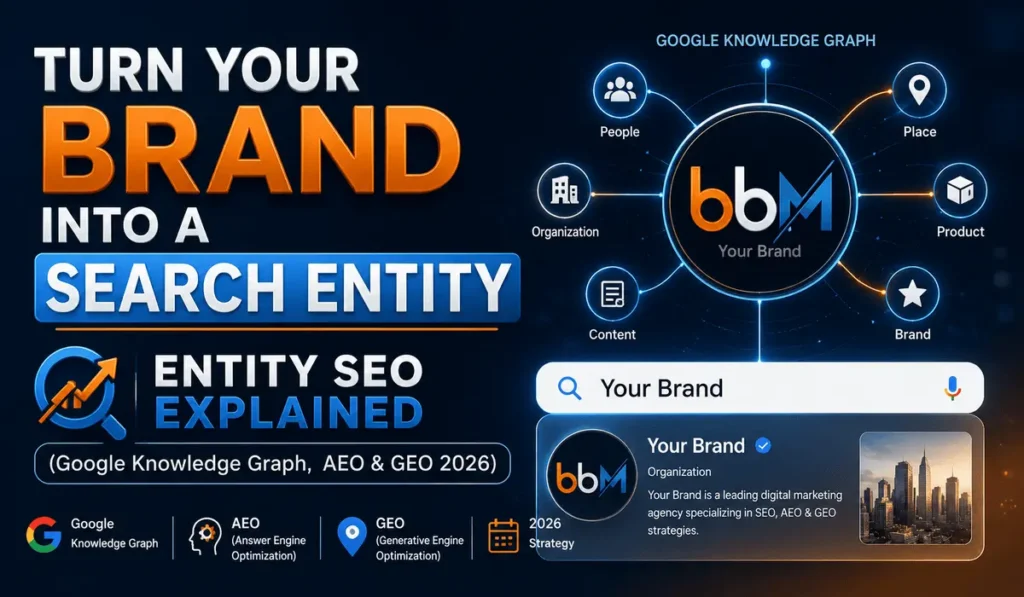
Most brands still chase keywords. They stuff blog posts with the same phrase, build a few backlinks, and hope Google notices. That approach still works, but it’s no longer enough. Search engines and AI assistants have quietly changed how they decide which brands to trust, recommend, and cite. They don’t just read your content anymore. They try to understand who you are.
That shift has a name: entity SEO. And the brands figuring it out first are the ones showing up in Google’s Knowledge Panels, Google AI Overviews, and chatbot answers, while their competitors are still stuck arguing about keyword density.
This guide breaks down what a search entity actually is, why it matters more than ever with AI search on the rise, and exactly how to build one for your brand, step by step.
What Is a Search Entity, and Why Does It Matter Now
A search entity is a distinct, well-defined “thing” that a search engine understands and stores in its knowledge base, separate from any single keyword or webpage. A person, a brand, a product, or a place can all be entities. Once Google or an AI model recognizes your brand as an entity, it can pull facts about you into answers, panels, and summaries, even without you ranking for a specific search term.
Think of the difference this way. A keyword is a string of text. An entity is a concept with attributes: a name, a category, relationships to other entities, and a set of verified facts. Google has stored entities in its Knowledge Graph since 2012, and that same underlying logic now powers how large language models like ChatGPT, Gemini, and Perplexity decide what they know about your brand.
This matters right now because search behavior is changing fast. People ask AI assistants direct questions instead of typing keyword strings, and those assistants answer using whatever entities they can confidently identify. If your brand isn’t a recognized entity, you’re invisible to that layer of search, no matter how well your pages rank in traditional results.
Keywords vs. Entities: The Shift Search Engines Already Made
Keyword SEO optimizes for what people type. Entity SEO optimizes for what search engines and AI models actually understand. The two approaches aren’t opposites, but entity SEO adds a layer that keyword targeting alone can’t reach, especially as more searches happen through conversational AI.
Traditional SEO built its foundation on matching. A search engine looked at the words in a query, then found pages containing those same words, and ranked them by relevance signals like backlinks and page structure. This worked well for a long time, but it had a weakness: it treated language literally, without much understanding of meaning or context.
Entity-based search works differently. Instead of just matching text, the system tries to identify the actual concepts behind a query, then connects those concepts to what it already knows. A search for “best CRM for small teams” isn’t just matched against pages with those words. It’s interpreted as a question about specific entities, actual CRM products, compared against known attributes like pricing, integrations, and reviews.
Here’s a quick comparison of how the two models behave:
| Factor | Keyword-Based Search | Entity-Based Search |
|---|---|---|
| Primary signal | Exact or partial text match | Recognized concepts and relationships |
| Data source | Page content and backlinks | Knowledge Graph, structured data, verified facts |
| Ranking goal | Match query intent to a page | Match query intent to a known “thing” |
| AI search fit | Weak, AI models don’t rank pages | Strong, AI models retrieve facts about entities |
| Brand outcome | A ranking position | Recognition, citation, and trust |
Neither model has replaced the other. Good keyword targeting still helps people find your content. But entity signals now decide whether search engines and AI tools treat your brand as a credible source worth citing at all.
How Google and AI Engines Recognize Your Brand as an Entity
Search engines confirm an entity by cross-referencing your brand’s name, facts, and online presence across multiple independent, trustworthy sources. The more consistently your brand’s identity shows up, with the same name, description, and core facts, the more confidently a search engine or AI model can treat you as a single, verified entity rather than a vague mention.
This confirmation process relies on a few key signals working together.
- Consistency. Your brand name, address, contact details, and core description need to match across your website, social profiles, directories, and any press coverage. Mismatches create doubt.
- Corroboration. One source claiming a fact about your brand isn’t enough. Search engines look for the same fact repeated across independent, credible sources before trusting it.
- Structured data. Schema markup on your website gives search engines a machine-readable description of who you are, what you offer, and how your content relates to known entities.
- Authoritative mentions. Being referenced by respected publications, industry directories, or Wikipedia-adjacent sources adds weight that self-published content can’t provide on its own.
- Relationship mapping. Search engines also try to understand how your brand connects to other entities, your industry category, your founders, your location, and the topics you’re known for.
None of these signals work in isolation. A brand with perfect schema markup but no third-party mentions still looks thin to a search engine. Entity recognition is built from the combination.
The Core Building Blocks of Entity SEO
Before jumping into the step-by-step process, it helps to understand the individual components that make up entity SEO. Each one plays a different role in how your brand gets recognized.
| Building Block | What It Does | Why It Matters |
|---|---|---|
| Structured data (schema) | Tells search engines exactly what your brand, products, and pages are | Removes ambiguity for machines reading your site |
| Knowledge Graph presence | Determines whether Google shows a Knowledge Panel for your brand | Boosts trust and visibility in search results |
| Topical authority | Shows depth of expertise across a subject, not just one page | Signals credibility to both search engines and AI models |
| Brand mentions and citations | References to your brand across the web, linked or unlinked | Reinforces that your brand is a recognized, real entity |
| E-E-A-T signals | Experience, expertise, authoritativeness, trustworthiness | Directly influences how much weight your content gets |
| Consistent NAP data | Name, address, phone number consistency across platforms | Confirms your brand is a single, verifiable entity |
Each of these blocks reinforces the others. Structured data alone won’t build a Knowledge Panel, but combined with consistent citations and genuine topical authority, it becomes far more effective.
Step-by-Step: How to Turn Your Brand Into a Search Entity
Building a search entity is a structured process: define your brand clearly, back it up with structured data, earn independent mentions, and build depth around your core topics. There’s no single trick that does this overnight. It’s a combination of technical setup and consistent visibility work over time.
Step 1: Nail Down a Single, Consistent Brand Identity
Start with the basics. Your brand name, logo, tagline, and core description should be identical everywhere they appear, your website, Google Business Profile, social media bios, and any directory listings. Inconsistent naming, like using “BlazeByte Media” in one place and “Blaze Byte Media Agency” in another, forces search engines to work harder to confirm you’re the same entity.
Write a clear, factual “About” description of your brand once, and reuse that same core language across platforms. This isn’t about copying and pasting everywhere word for word, it’s about keeping the underlying facts identical.
Step 2: Implement Organization and Brand Schema Markup
Structured data is the clearest signal you can give a search engine. Add Organization schema to your homepage, including your official name, logo, contact information, and social profiles through the sameAs property. If you have multiple locations or offer specific services, layer in LocalBusiness or Service schema as appropriate.
This markup doesn’t guarantee a Knowledge Panel, but it removes ambiguity. You’re handing search engines a structured, machine-readable fact sheet instead of asking them to infer details from unstructured text.
Step 3: Build Genuine Topical Authority
Search engines associate entities with the topics they consistently cover in depth. If your brand publishes scattered, shallow content across unrelated subjects, it’s harder for search engines to categorize what you actually do.
Instead, build clusters of content around your core areas of expertise. Cover subtopics thoroughly, answer the questions your audience actually asks, and link related pieces together internally. Over time, this pattern tells search engines exactly what category of entity your brand belongs to.
Step 4: Earn Independent Mentions and Citations
Self-published claims about your brand only go so far. Search engines weigh third-party corroboration heavily, so look for opportunities to get mentioned in:
- Industry publications and trade press
- Local or niche business directories relevant to your field
- Guest contributions on reputable sites
- Podcast interviews or panel features with published transcripts
- Partner or supplier pages that reference your brand
Even unlinked mentions of your brand name carry some weight, since search engines can identify brand references without a hyperlink attached.
Step 5: Strengthen E-E-A-T Signals on Your Site
Show real experience and expertise behind your content. Attach author bios with genuine credentials to your articles, cite credible sources when you reference data, and keep your content accurate and current. Avoid vague, unattributed claims. If you don’t have verified data to support a statement, say so rather than guessing.
Step 6: Pursue a Knowledge Panel, Where It Makes Sense
Not every brand will earn a Google Knowledge Panel, and chasing one prematurely can waste effort. Panels tend to appear once a brand has enough corroborated signals: a Google Business Profile, verified social accounts, structured data, and enough independent coverage for Google to feel confident. Focus on the underlying signals first. The panel, if it comes, follows from that groundwork rather than the other way around.
Step 7: Monitor and Correct Inconsistencies
Entity building isn’t a one-time project. Periodically search your brand name to see what information appears, check for outdated details, incorrect addresses, or old logos still circulating, and request corrections where possible. A stale or inconsistent footprint can quietly undo the trust you’ve built.
Entity SEO for AI Search: AEO and GEO Explained
Answer Engine Optimization (AEO) and Generative Engine Optimization (GEO) are the practices of structuring content so AI assistants like ChatGPT, Gemini, and Perplexity can accurately retrieve and cite it. Entity strength directly affects both, since AI models are far more likely to reference brands they can confidently identify as real, established entities.
Unlike traditional search engines, AI assistants don’t return a list of ranked links. They synthesize an answer, often citing a small number of sources they trust most. That selection process leans heavily on entity recognition. A brand with consistent structured data, strong topical coverage, and independent verification is simply easier for an AI model to trust and cite than a brand that only exists as scattered, inconsistent mentions.
To improve your entity signals specifically for AI search:
- Write content that directly answers specific questions, since AI models often extract concise answer snippets.
- Keep factual claims accurate and consistent across every page, since AI systems cross-check for reliability.
- Use clear headings and structured formatting, which makes content easier for models to parse and summarize.
- Maintain schema markup, which many AI crawlers also use to understand page context.
- Publish content that reflects real expertise, since AI systems increasingly favor sources that demonstrate genuine authority over generic, surface-level content.
GEO and AEO aren’t replacements for traditional SEO. They’re an extension of the same entity-building work, applied to a newer set of search surfaces.
Entity SEO vs. Traditional SEO: A Side-by-Side Comparison
| Aspect | Traditional SEO | Entity SEO |
|---|---|---|
| Main focus | Ranking pages for keywords | Establishing your brand as a recognized entity |
| Core tactics | On-page optimization, backlinks | Structured data, consistency, corroboration |
| Success measured by | Search rankings, organic traffic | Knowledge Panel presence, AI citations, brand recognition |
| Time horizon | Can show results in weeks to months | Typically builds over months to years |
| AI search relevance | Indirect | Direct and increasingly essential |
These two approaches work best together. Entity SEO doesn’t replace the fundamentals of good on-page optimization, technical SEO, and content quality. It builds an additional layer of trust and recognition on top of that foundation.
Common Mistakes That Keep Brands From Becoming Entities
Even brands doing solid keyword SEO often stall out on entity building because of a few recurring mistakes.
- Inconsistent brand naming. Using different variations of your brand name across platforms confuses entity matching.
- Skipping structured data. Many websites still have no Organization schema at all, leaving search engines to guess.
- Chasing links instead of mentions. Backlinks matter, but unlinked brand mentions and citations also contribute to entity strength and get overlooked.
- Publishing shallow, scattered content. Random topics with no clear thematic pattern make it harder for search engines to categorize your expertise.
- Ignoring Google Business Profile accuracy. For local and service-based brands, an outdated or incomplete profile undermines entity signals.
- Expecting a fast payoff. Entity recognition builds gradually through repeated, consistent signals, not a single optimization pass.
Avoiding these mistakes won’t guarantee a Knowledge Panel overnight, but it removes the most common blockers standing in the way.
How to Measure Your Brand’s Entity Strength
There’s no single dashboard metric called “entity score,” but a few practical checks can tell you where your brand stands.
- Search your brand name directly and see whether a Knowledge Panel appears, and whether the information shown is accurate.
- Check Google’s Knowledge Graph using publicly available entity-lookup tools to see if your brand is registered as a recognized entity.
- Audit your NAP consistency across your website, Google Business Profile, and major directories.
- Review your schema markup using Google’s Rich Results Test to confirm your structured data is implemented correctly and error-free.
- Track brand mentions using a media monitoring tool to see how often, and how consistently, your brand is referenced across the web.
- Ask AI assistants directly what they know about your brand, and compare the accuracy of their answers over time.
These checks won’t give you a precise score, but tracked over time, they show whether your entity signals are strengthening or staying flat.
A Simple Way to Picture This in Practice
Imagine two marketing agencies that both publish weekly blog content and run similar ad campaigns. Agency A focuses purely on keyword rankings, publishing content optimized around search terms with little consistency in how the brand describes itself elsewhere online. Agency B does the same content work, but also standardizes its brand description everywhere, adds Organization schema, earns a handful of genuine mentions in industry roundups, and keeps its Google Business Profile accurate.
Over time, Agency B becomes easier for both Google and AI assistants to recognize as a distinct, trustworthy entity. When someone asks an AI assistant for agency recommendations in that space, Agency B has a real chance of being mentioned by name. Agency A, despite similar content quality, may never surface at all, simply because nothing outside its own website confirms who it is.
This is illustrative, not a documented case study, but it reflects the practical difference entity signals make once AI-driven search enters the picture.
Frequently Asked Questions
1. What is a search entity in SEO?
A search entity is a distinct concept, such as a brand, person, or product, that a search engine recognizes and stores with verified facts, separate from any single webpage or keyword.
2. How is entity SEO different from regular SEO?
Regular SEO focuses on ranking pages for keywords. Entity SEO focuses on helping search engines and AI models recognize your brand as a distinct, trustworthy “thing.”
3. Does entity SEO replace keyword SEO?
No. Entity SEO adds a layer on top of solid keyword and on-page SEO. Both work together.
4. What is Google’s Knowledge Graph?
It’s Google’s database of entities and the verified facts and relationships connected to them, used to power Knowledge Panels and enriched search results.
5. How do I get a Google Knowledge Panel for my brand?
There’s no direct submission form. Panels tend to appear once a brand has enough consistent, corroborated signals across schema, Google Business Profile, and independent sources.
6. What is schema markup and why does it matter for entities?
Schema markup is structured code added to your website that describes your content and brand in a format search engines can read directly, reducing ambiguity.
7. What is Organization schema?
A type of schema markup used to define your business name, logo, contact details, and social profiles for search engines.
8. What does the sameAs property do in schema?
It links your website’s Organization schema to your official social media and directory profiles, helping confirm you’re the same entity across platforms.
9. Can a small business become a recognized search entity?
Yes. Entity recognition depends on consistency and corroboration, not company size. Local businesses can build strong entity signals through accurate directory listings and Google Business Profile optimization.
10. What is AEO in SEO?
AEO, or Answer Engine Optimization, is the practice of structuring content so AI-driven answer engines can accurately extract and present it as a direct answer.
11. What is GEO in SEO?
GEO, or Generative Engine Optimization, refers to optimizing content specifically for generative AI tools like ChatGPT, Gemini, and Perplexity.
12. Do AI search tools use the Knowledge Graph?
Many AI systems use similar entity-recognition principles, though they may draw on different underlying data sources than Google’s Knowledge Graph specifically.
13. Why do unlinked brand mentions matter for SEO?
Search engines can identify brand name references even without a hyperlink, and repeated unlinked mentions still contribute to entity corroboration.
14. What is NAP consistency?
NAP stands for Name, Address, and Phone number. Keeping these identical across your website and directory listings helps confirm your business as a single, verified entity.
15. How long does it take to build entity recognition?
It varies, but meaningful entity signals typically build over several months to a year or more of consistent effort, not a single optimization sprint.
16. What is topical authority?
Topical authority is the depth and consistency of expertise a brand demonstrates across a specific subject area, built through comprehensive, connected content.
17. Does Wikipedia help with entity SEO?
A verified Wikipedia page can strengthen entity signals, though not every brand qualifies under Wikipedia’s notability guidelines, so it isn’t a required step.
18. What is E-E-A-T?
E-E-A-T stands for Experience, Expertise, Authoritativeness, and Trustworthiness, a framework Google uses to evaluate content and source quality.
19. Can bad or outdated information hurt my brand’s entity profile?
Yes. Inaccurate details circulating across the web, like an old address or incorrect logo, can undermine the consistency search engines rely on to trust your entity data.
20. How do I check if my brand is already a recognized entity?
Search your brand name directly to check for a Knowledge Panel, and use structured data testing tools to confirm your schema is implemented correctly.
21. Is entity SEO only relevant for large brands?
No. While large brands often have stronger existing signals, entity SEO practices apply to businesses of any size that want to build recognition and trust.
22. What tools help with entity SEO?
Google’s Rich Results Test, Google Search Console, media monitoring tools, and structured data validators all support entity-building efforts.
23. Does local SEO overlap with entity SEO?
Yes. Local SEO practices like Google Business Profile optimization and citation consistency directly reinforce entity recognition for local businesses.
24. What role do backlinks play in entity SEO?
Backlinks still matter for traditional ranking signals, but entity SEO also credits unlinked mentions and independent corroboration as trust signals.
25. Can inconsistent branding across social media hurt entity recognition?
Yes. Different names, descriptions, or logos across platforms make it harder for search engines to confirm you’re a single, consistent entity.
26. Should every business pursue a Knowledge Panel?
Not necessarily. It’s more productive to focus on the underlying signals first, since a panel tends to follow naturally once those signals are strong enough.
27. What is a knowledge-graph relationship?
It refers to how one entity connects to another, such as a brand’s relationship to its industry category, founders, or location, which helps search engines contextualize who you are.
28. Does content depth affect entity recognition?
Yes. Comprehensive, well-organized content around your core topics helps search engines categorize your brand’s area of expertise more confidently.
29. Can AI assistants get facts about my brand wrong?
Yes, especially if your brand’s information online is inconsistent or outdated. Regularly auditing your public brand data helps reduce these errors.
30. Where should I start if I’m new to entity SEO?
Start by auditing your brand name, description, and contact details for consistency across your website and major platforms, then add Organization schema to your homepage.
Get Started With Entity SEO
Becoming a recognized search entity isn’t a single tactic you switch on. It’s a consistent pattern of clarity, accuracy, and corroboration that search engines and AI assistants learn to trust over time. Start with the fundamentals: a consistent brand identity, proper schema markup, and content that genuinely demonstrates expertise, and build outward from there.
If you’d rather have a team handle the technical and strategic side of this, BlazeByte Media works with brands on entity SEO, structured data implementation, and AI search visibility. Reach out to talk through where your brand currently stands and what the next steps would look like.