

Introduction
Two articles cover the exact same keyword. Both are well written. Both hit 2,000 words. Both have decent backlinks. One sits at position 2 and gets pulled into Google’s AI Overview. The other sits at position 14 and never gets mentioned by ChatGPT, Perplexity, or Gemini.
What separates them usually isn’t grammar, keyword density, or even domain authority. It’s information gain, a scoring concept tied to a real Google patent that measures how much new information a page adds compared to everything else already available on that topic.
This matters more in 2026 than it did a few years ago. Search results and AI answers are no longer built from a single “best page.” They’re built by comparing a page against everything a reader has already seen, then rewarding whichever source adds something the rest didn’t. SEO practitioners have referred to this signal as information gain since Google’s related patent surfaced in 2020, and its influence has grown alongside the shift toward AI-generated answers.
This guide breaks down what information gain actually is, what the patent says (and doesn’t say), why it’s become more important with AI Overviews and generative engines, and exactly how to build it into a content strategy, whether you’re writing your own blog or briefing a content team. This article is for marketers, business owners, and SEO practitioners who want their content to rank in traditional search and get cited by AI, not just written for search engines.
What Is Information Gain in SEO?
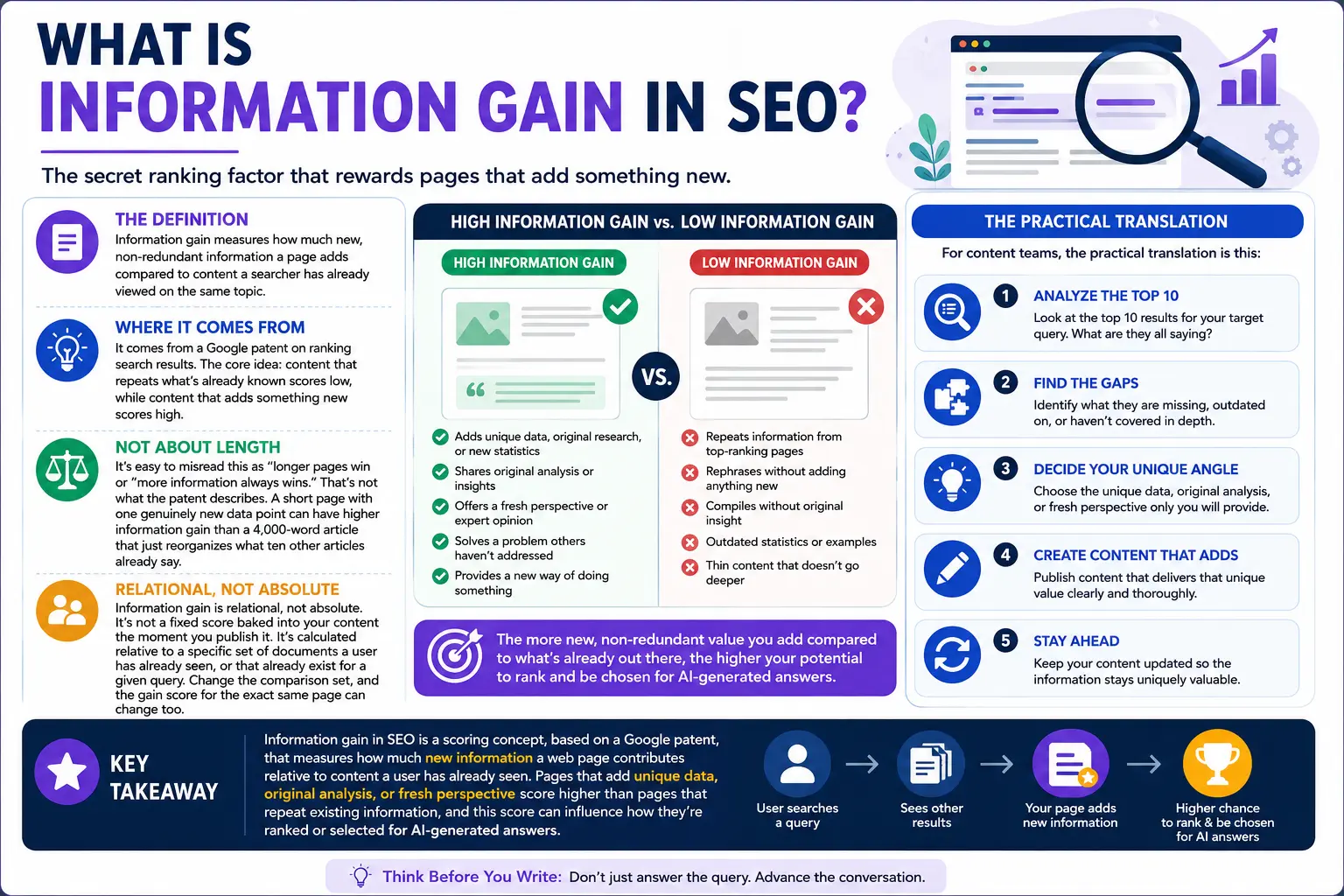
Information gain is a measure of how much new, non-redundant information a page adds compared to content a searcher has already viewed on the same topic. It comes from a Google patent on ranking search results, and the core idea is simple: content that repeats what’s already known scores low, while content that adds something new scores high.
It’s easy to misread this as “longer pages win” or “more information always wins.” That’s not what the patent describes. A short page with one genuinely new data point can have higher information gain than a 4,000-word article that just reorganizes what ten other articles already say.
Information gain is relational, not absolute. It’s not a fixed score baked into your content the moment you publish it. It’s calculated relative to a specific set of documents a user has already seen, or that already exist for a given query. Change the comparison set, and the gain score for the exact same page can change too.
For content teams, the practical translation is this: before you write, ask what the top 10 results for your target query are already saying, and then decide what you’re going to say that they aren’t.
Information gain in SEO is a scoring concept, based on a Google patent, that measures how much new information a web page contributes relative to content a user has already seen. Pages that add unique data, original analysis, or fresh perspective score higher than pages that repeat existing information, and this score can influence how they’re ranked or selected for AI-generated answers.
The Google Patent Behind Information Gain
The patent SEOs refer to as “information gain” is officially titled “Contextual estimation of link information gain.” It was filed in 2018, published in 2020, and granted by the USPTO in 2022. It doesn’t describe a blanket “more information wins” ranking rule. It describes a method for ranking a second set of results based on how much new information they’d add for a user who has already seen a first set of results.
Here’s the scenario the patent actually walks through:
- A user searches for something and views one or more documents.
- The user then makes a related, follow-up search, either by refining the query or asking something adjacent.
- Google needs to decide which documents to show next.
- Instead of just ranking by relevance to the new query, the patent describes scoring each candidate document by how much new information it offers beyond what the user already saw in the first set.
The patent describes a scoring system that evaluates candidate documents based on how much new information they provide relative to what a user has already seen, with the score used as a ranking feature that rewards novel contribution and penalizes duplication.
A few things worth being precise about, since a lot of SEO content overstates this patent:
- Google has never confirmed it uses this exact mechanism in live rankings. It’s unclear whether Google uses information gain as described in its patent, and the company hasn’t confirmed or denied it.
- It’s most directly relevant to multi-turn and conversational search, where a user’s next query builds on a previous one, which is exactly how people interact with AI Overviews, AI Mode, and chat-based assistants.
- A patent is not a promise. Companies file patents defensively and speculatively all the time. What makes this one worth paying attention to isn’t the legal filing itself, it’s how closely the underlying logic matches what we’re actually observing in AI-driven search results.
BBM’s take: treat the patent as a strong signal of direction, not a literal blueprint of the current algorithm. Google runs hundreds of ranking signals together. Information gain is best understood as a lens for writing better content, not a formula to reverse-engineer line by line.
How an Information Gain Score Is Likely Calculated
An information gain score is essentially a measure of how different your content is from the existing corpus of documents Google or an AI system has already reviewed for that query. The corpus is all the potential documents a search engine analyzes when ranking results for a particular query. The wider the gap between what your page says and what the corpus already covers, the higher the theoretical gain.
Conceptually, the process looks like this:
- Build the comparison set. The system identifies documents already ranking or already viewed by the user for a topic.
- Extract the information contained in those documents. This isn’t about counting words, it’s about identifying facts, claims, entities, and relationships covered.
- Compare a new or candidate document against that extracted information. Overlapping content contributes little to the score. Content not found elsewhere contributes more.
- Assign a score reflecting net-new contribution. This score becomes one input (among many) into ranking or citation selection.
The practical implication is that information gain can’t be gamed with synonyms, rephrasing, or padding. Saying the same thing in more words does not raise your score. Adding a genuinely new data point, expert take, or example does.
Information Gain vs. Content Length vs. E-E-A-T
A lot of SEO advice from 2018 to 2023 pushed toward long, comprehensive content as a proxy for quality. Information gain complicates that assumption. Here’s how the three concepts actually relate.
| Factor | What It Measures | Does More = Better? |
|---|---|---|
| Content Length | Word count, topic breadth | No. A large-scale Ahrefs study of 174,048 pages and 560,346 AI Overviews found essentially no correlation between word count and AI Overview citation position. |
| Information Gain | Net-new, non-redundant information vs. the existing corpus | Yes, but only if the addition is genuinely new, not reworded |
| E-E-A-T | Experience, Expertise, Authoritativeness, Trustworthiness | Indirectly. High information gain (original data, first-hand experience) is one of the clearest ways to demonstrate E-E-A-T, but they aren’t the same thing |
A 1,500-word article built around one original data set can outperform a 4,000-word article that summarizes what everyone else has already published, assuming other ranking factors are roughly comparable. Length was never the goal. It was always a rough stand-in for “does this page cover the topic properly,” and information gain is a more direct way to measure that.
Why Information Gain Matters More in 2026
Information gain matters more now because search results themselves have changed from a list of links into a synthesized answer, and synthesized answers are built by comparing and merging sources rather than picking one winner. When an AI system writes a summary, it needs source material that adds something to that summary. Ten sources saying the same thing don’t help it, one source saying something new does.
A few developments make this concrete:
- AI Overviews are now common, not rare. AI Overviews appeared on roughly 48% of tracked queries as of February 2026, up 58% year-over-year.
- Original data and first-hand insight are what get selected. Research on what earns AI citations in 2026 points to original data, specific expertise or credential signals, and complete standalone answers as the attributes that consistently get cited, while generic articles that repeat commonly available information are not selected.
- Selection is competitive, not comprehensive. Analysis of ChatGPT’s citation behavior found that it retrieves multiple candidate pages per query but cites only about 15% of the pages it actually retrieves, which means being relevant is no longer enough. Content has to stand out from other relevant content.
- Authorship and first-hand experience carry more explicit weight. Google added an “Authors” section to its Search Central documentation in February 2026, described as one of the clearest official signals that authorship transparency is a direct quality consideration.
Put together, this is the shift: ranking well used to mean satisfying a query better than competitors. Ranking and getting cited now increasingly means contributing something competitors haven’t already said.
How AI Search Engines Use Information Gain to Choose Citations
AI search engines favor sources that add unique value to the answer they’re generating, which is why original research, proprietary data, and named expertise consistently outperform generic explainer content in citation studies. This is information gain playing out in real time, at the point where an AI model decides which sources to pull into its answer.
A few patterns show up consistently across recent citation research:
- Citation behavior differs sharply by platform. A 2026 analysis of 680 million citations across ChatGPT, Google AI Overviews, and Perplexity found that only 11% of domains were cited by both ChatGPT and Perplexity, and brand citation rates varied by as much as 46 times between platforms.
- Citations don’t stick around. A longitudinal study tracking 1,127 cited URLs over six weeks found only about 10.6% of them remained cited across all three measurement waves, with citation retention over four weeks ranging from 11% on Gemini to 44% on Perplexity. AI citation is a moving target, not a one-time achievement.
- Format matters, but it’s industry-specific. A study of 25,337 citations across eight industries found no single dominant content format; listicles captured 61% of citations in B2B technology, homepages captured 55% for a local services brand, and program pages captured 53% in higher education.
- Concentration is real. In a study of 1,000 AI Overviews, the top 1% of cited domains, around 12 sites, captured 47% of all citations, with the next 9% capturing another 31%.
The takeaway isn’t that small or mid-sized sites can’t compete. It’s that competing on volume against sites like Wikipedia or major publishers is a losing strategy. Competing on unique contribution, a proprietary data point, a documented case study, a specific process no one else has published, is the path that’s actually open.
How to Increase Information Gain in Your Content
The fastest way to raise information gain is to stop starting from what already ranks and start from what your business, data, or experience knows that nobody else has published yet. Here’s how to operationalize that across a content workflow.
1. Audit the Existing Top 10 Before You Write
Before drafting anything, read what’s currently ranking for your target query. Note what every article already covers. That list becomes your floor, not your outline. Your job is to cover it accurately and then go past it.
2. Mine Data You Already Have
- Customer service transcripts and support tickets often contain patterns no competitor has documented.
- Sales call notes reveal objections and questions real buyers ask.
- Product usage or analytics data can be turned into an original benchmark or study.
- Internal SEO or performance data (like campaign results) can become a case study, as long as it’s real and disclosed accurately.
3. Add a Named, Verifiable Point of View
Generic “expert tips” sections add little. A specific, attributed opinion from a real person with a real title adds credibility and originality that’s hard for competitors or AI-generated content to replicate.
4. Run Small Original Research
You don’t need a 5,000-person survey. A focused poll of your email list, an analysis of 50 pages in your niche, or a breakdown of your own client results can all produce a genuinely new data point.
5. Update, Don’t Just Republish
Refreshing a page with the same claims and a new date doesn’t raise information gain. Refreshing it with a new data point, an updated statistic with a named source, or a corrected claim does.
6. Structure for Extraction
Original information only helps if it can be found and cited. Use clear H2/H3 headers, direct-answer paragraphs near the top of each section, and tables for comparisons. This doesn’t create information gain by itself, but it makes any gain you do have visible to both readers and AI parsers.
7. Say What You’re Not Going to Repeat
If a subtopic is already well covered elsewhere and you have nothing new to add, don’t pad it. Link out to a strong existing resource and spend your word count on the part where you actually have something to say.
Content Formats With Naturally High Information Gain
| Format | Why It Tends to Score Well | Example |
|---|---|---|
| Original research or survey | Data exists nowhere else | “We analyzed 200 local business websites in Kathmandu” |
| Documented case study | Real, specific outcomes tied to a real process | A before-and-after SEO campaign breakdown with actual numbers |
| First-hand process guide | Describes exactly how you do something, not a generic version | “How we fixed Core Web Vitals for an e-commerce client” |
| Expert interview or Q&A | Named, attributable perspective | A conversation with an in-house SEO lead on a specific tactic |
| Contrarian, evidence-based take | Directly addresses a gap or myth in existing content | “Why longer content isn’t winning AI citations anymore” |
| Generic definition or overview | Low gain unless paired with original examples or data | A basic “what is SEO” page with no unique angle |
The last row matters. Definitional and overview content still has a place, it helps beginners and supports topical coverage, but it should rarely be the centerpiece of a content strategy aimed at ranking against established competitors.
Common Mistakes That Kill Information Gain
- Rewriting the top 3 results in your own words. This produces content that’s original in phrasing but not in substance, and substance is what gets measured.
- Treating length as a proxy for depth. Padding a page to hit a word count target dilutes the useful information instead of adding to it.
- Fabricating statistics or studies to appear original. This isn’t just a ranking risk, it’s an accuracy and trust risk that can damage credibility permanently if discovered.
- Publishing once and never updating. Information gain is relative to what currently exists. A page that was novel two years ago may no longer be, if the rest of the field has caught up.
- Ignoring your own first-party data. Many businesses have original insight sitting in spreadsheets, CRMs, or support tickets and never turn it into content.
- Chasing every subtopic instead of the ones you can add value to. Comprehensive coverage without original contribution reads as thorough but scores as redundant.
How to Audit Your Existing Content for Information Gain
A simple, repeatable process for reviewing existing pages:
- Pull your top 20-30 organic pages from Search Console or your analytics tool.
- For each page, search the target keyword and read the top 5-10 competing results.
- Ask directly: what does my page say that theirs don’t? Write the answer in one sentence. If you can’t, that’s the gap.
- Score pages informally as High, Medium, or Low gain based on that answer.
- Prioritize rewrites for pages with traffic or ranking potential but low information gain, since these are the highest-leverage fixes.
- Track AI citation visibility alongside traditional rankings, since a page can rank reasonably in traditional search while still being ignored by AI Overviews or chat assistants if it lacks original contribution.
This kind of audit is exactly the type of work an SEO content review should include before a content refresh sprint, not just a technical crawl.
FAQ
1. What is information gain in SEO?
Information gain is a measure of how much new, non-redundant information a page adds compared to what’s already published on a topic. It’s tied to a Google patent and is increasingly relevant to how AI search tools select sources.
2. Is information gain a confirmed Google ranking factor?
Not officially. Google hasn’t confirmed it uses the exact mechanism from the patent in live rankings, but the underlying logic aligns closely with observed behavior in AI Overviews and generative search.
3. What Google patent is information gain based on?
“Contextual estimation of link information gain,” filed in 2018, published in 2020, and granted in 2022.
4. Does longer content have higher information gain?
No. Length and information gain aren’t the same thing. A short page with a genuinely original data point can outscore a long page that repeats existing information.
5. How is an information gain score calculated?
Conceptually, a system compares the information in a candidate page against a corpus of already-seen or already-ranking documents, then scores how much of the candidate’s content isn’t already represented in that corpus.
6. Is information gain the same as E-E-A-T?
No, but they overlap. High information gain, especially through original data or first-hand experience, is one of the strongest ways to demonstrate E-E-A-T.
7. Can small businesses compete on information gain against big publishers?
Yes. Competing on volume against major publishers is difficult, but competing on unique, first-hand data, case studies, or process detail is achievable at any size.
8. Does information gain apply to AI Overviews specifically?
Yes, directly. AI Overviews and other generative answers are built by synthesizing multiple sources, and sources that repeat each other add little value to that synthesis.
9. How often should I update content to maintain information gain?
There’s no fixed schedule, but content should be revisited whenever competitors catch up to what made it originally unique, not on a purely calendar-based cycle.
10. What’s the difference between information gain and topical authority?
Topical authority is about comprehensive coverage of a subject area. Information gain is about the uniqueness of what you add within that coverage. You can have broad topical authority with low information gain if none of the content says anything new.
11. Does rewriting competitor content in my own words count as information gain?
No. Rephrasing existing information doesn’t add new information, even if the wording is completely original.
12. What kind of content typically has the highest information gain?
Original research, documented case studies, first-hand process guides, and named expert perspectives tend to score highest.
13. Can I fabricate data to boost information gain?
No. Fabricated statistics create a trust and accuracy risk and are explicitly against the intent of the signal, which rewards genuine, verifiable contribution.
14. Does information gain affect featured snippets?
Indirectly. Featured snippets favor clear, direct answers, and original information makes a snippet more distinct from competing snippet-eligible content.
15. Is information gain the same across every AI platform?
No. Citation behavior varies significantly by platform. Research shows very low domain overlap between which sources ChatGPT, Perplexity, and Google AI Overviews each choose to cite.
16. How long does it take to see the impact of improving information gain?
There’s no fixed timeline, since it depends on crawl frequency, competition, and how the specific platform evaluates sources, but meaningful content changes typically need at least one to two months to show measurable movement.
17. Should every page on my site aim for maximum information gain?
No. Foundational pages like basic definitions or navigational content serve a different purpose. Information gain matters most for pages meant to rank competitively or earn AI citations.
18. Can internal data, like sales or support logs, be turned into content?
Yes, and it’s one of the most underused sources of original information most businesses already have.
19. Does schema markup affect information gain?
Not directly. Schema markup helps search engines and AI systems parse and trust content, but it doesn’t create new information by itself.
20. Is information gain more important for informational content or commercial content?
It applies to both, but it’s most visible in informational content, where many competing pages cover the same basic ground and originality is the main differentiator.
21. What’s a quick way to check if my content has low information gain?
Compare it directly against the current top 5 results for your target keyword. If you can’t identify one clear thing your page says that theirs don’t, it likely has low gain.
22. Does citing external sources hurt or help information gain?
It can help, since attributed, verifiable data adds credibility, as long as the page also contributes original analysis or context rather than just aggregating other sources.
23. Do case studies count as information gain even without hard numbers?
Yes, if they include specific, real, documented detail. Vague case studies without particulars add little value.
24. Can AI-generated content have high information gain?
Only if it’s grounded in real, original input, such as first-party data or direct human insight. Purely generated summaries of existing content tend to have low information gain by definition.
25. Is information gain relevant to local SEO?
Yes. Hyperlocal, first-hand detail, like specific neighborhood insight or documented local case studies, functions as information gain within a local content strategy.
26. Does updating a publish date improve information gain?
No. Only substantive content changes, like new data or corrected information, affect the underlying score. A date change alone does not.
27. How does information gain relate to the Helpful Content system?
They’re closely aligned in intent. Both concepts reward content built around genuine, original value to the reader rather than content built primarily to rank.
28. Should I remove old content with low information gain?
Not automatically. First evaluate whether it can be meaningfully improved with original data or perspective. If it can’t add anything new and has little traffic value, consolidating it into a stronger page is often better than leaving it as is.
29. Is there a tool that measures information gain directly?
Not a standardized, universally accepted one. Most audits are done manually by comparing a page against its current search competition, though some content intelligence platforms offer related scoring.
30. What’s the single best way to start improving information gain today?
Pick your highest-traffic page that isn’t ranking as well as it should, compare it against the current top 5 competitors, and add one piece of original data, experience, or analysis that none of them have.q
Information gain rewards content built on real expertise, real data, and real experience, which is exactly the kind of content most businesses already have the raw material for but never turn into a strategy. If you want a second opinion on whether your current content actually says anything competitors don’t, BBM offers a free SEO audit that reviews your top pages against what’s currently ranking and cited by AI. Get your free audit and find out where your content is being outpaced, and where it already has an edge worth building on.