
Most schema advice floating around right now falls into one of two camps. Camp one says schema is a magic switch that guarantees an AI Overview citation. Camp two says it does nothing and content quality is all that matters. Neither is accurate and neither is what Google itself says.
Google has been explicit on this point: there is no special schema.org markup required to appear in AI Overviews or AI Mode. The eligibility bar is the same one that’s always applied to standard Search be indexed, be crawlable, and be eligible to display with a snippet. Structured data doesn’t get you past that bar on its own.
What schema does do is remove guesswork. It hands machine-reading systems Google’s, and increasingly ChatGPT’s and Perplexity’s pre-labeled facts instead of forcing them to infer meaning from prose. That’s a real, useful thing. It’s just not a citation switch, and treating it like one is where most schema advice goes wrong.
This is the structured data setup I use in 2026: which schema types are actually worth prioritizing, the JSON-LD I write for each, how I validate it, and where I’ve watched implementations quietly fail with the caveats that belong on every claim in this space.
Why Schema Matters for AI Overviews in 2026
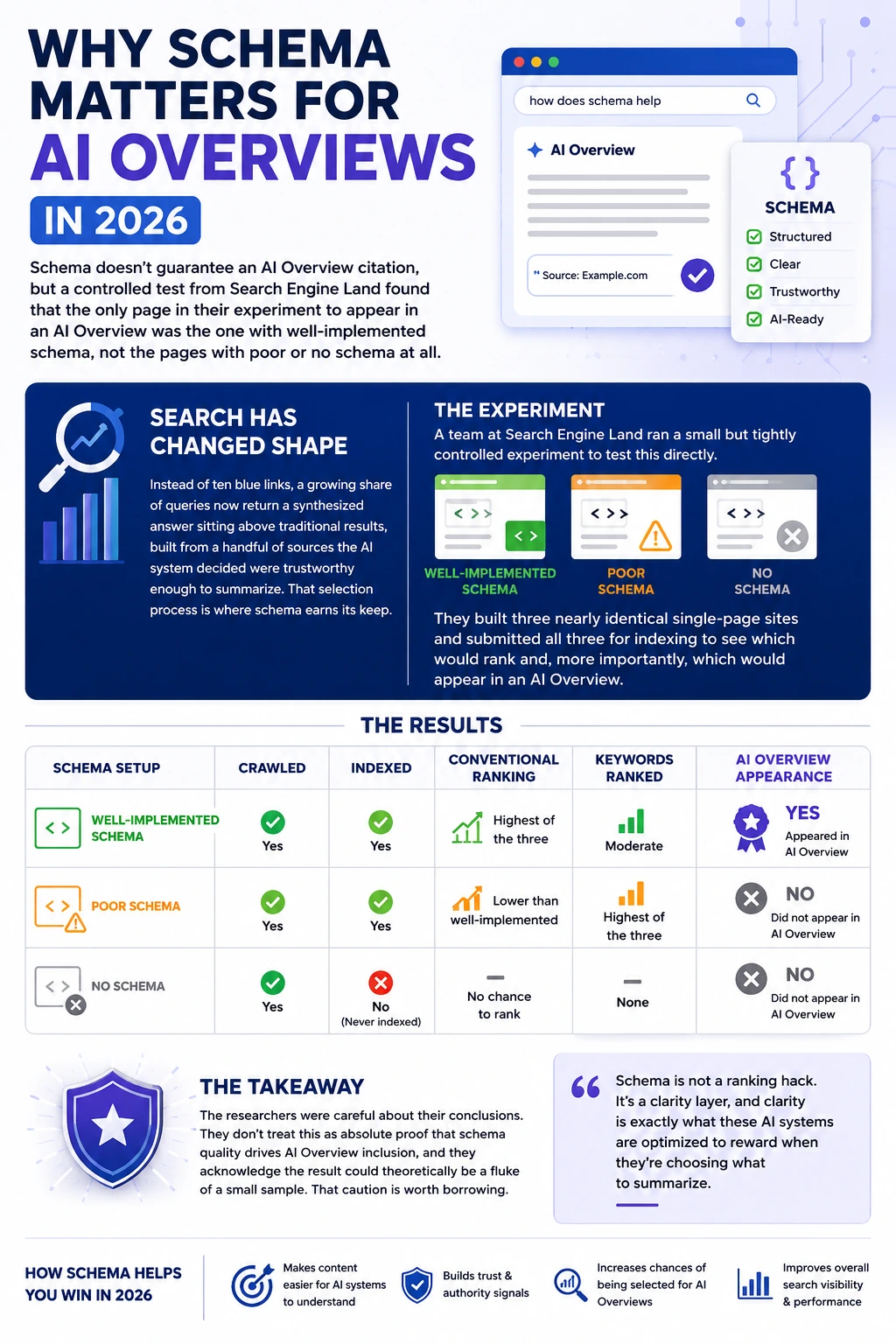
Search visibility has changed shape. A growing share of queries now return a synthesized answer sitting above traditional results, drawn from a handful of sources the system judged trustworthy enough to summarize. Schema plays a role in that selection process, but it’s a narrower role than a lot of SEO content implies.
A small, frequently-cited experiment from Search Engine Land is worth mentioning here, with the caveats the original researchers themselves gave it. The team built three nearly identical single-page sites one with well-implemented schema, one with poor schema, and one with none and submitted all three for indexing to see which would rank and which would appear in an AI Overview.
Only the page with well-implemented schema appeared in an AI Overview, and it also reached the highest conventional ranking of the three. The page with poor schema ranked for more keywords overall but never triggered an AI Overview appearance. The page with no schema was crawled just as fast as the others but was never indexed, so it never had a chance at either outcome.
That’s a genuinely interesting result. It is not proof that schema quality causes AI Overview inclusion. Three test pages is not a sample size you can generalize from, and the researchers said as much themselves. Treat it as a data point worth paying attention to, not as evidence that schema is the lever that decides citation.
What Schema Markup Actually Does for AI Systems
Schema markup translates page content into a format machines can parse without guessing labeling what a piece of content is (a question, a step, a price, an author) instead of leaving a model to infer it from unstructured text.
This matters more with each model generation because these systems increasingly work through retrieval: pulling specific, verifiable facts from pages rather than paraphrasing an entire article. A page with pre-labeled facts, a defined author, and a clear publish date is easier to extract from than one that buries the same information in flowing prose.
But it’s worth being precise about what this buys you. Google has never said clarity or structured data is an official ranking or citation-weighting criterion in the way, say, page speed or mobile-friendliness are. What Google has said is that AI Overviews draw from the same index as standard Search and are evaluated against the same helpful-content and E-E-A-T framework already used there. Schema supports that framework indirectly by making authorship, freshness, and entity identity unambiguous rather than by being a scored input on its own. None of this replaces good content. A well-marked-up page with thin, generic answers still won’t beat a page with genuine expertise. Schema is the container, not the substance.
The Core Schema Types I Prioritize
I don’t apply every schema type to every page matching schema to the actual job a page is doing is most of the work. Here’s what I prioritize, and why some of the old advice around this list needs updating for 2026.
Organization schema. Establishes your brand as a defined entity rather than a string of text company name, logo, contact details, social profiles, areas served. Nearly every site gets this on the homepage or an about page, since it’s the entity everything else connects to.
Person schema. This one gets skipped constantly, and it shouldn’t be. Google connects author → Person → Organization → linked profiles (via sameAs) to understand who’s actually behind a piece of content. For any site publishing under named authors, Person schema tied to real bios and credentials is one of the higher-value additions you can make in 2026, particularly for anything approaching YMYL territory.
WebSite and WebPage schema. Often skipped, frequently useful as connective tissue. WebSite schema (with a SearchAction where relevant) establishes the site as an entity and publisher; WebPage acts as a parent node that Article, FAQPage, or Product schema can nest under, rather than leaving Article floating on its own.
Article / BlogPosting schema. For blog posts and editorial content, this declares headline, author, publish date, modification date, and publisher. It supports Google’s understanding of authorship and freshness it is not itself an “E-E-A-T signal” in any scored sense, since Google has stated E-E-A-T is a quality framework used in rater guidelines rather than a scored ranking input schema can directly feed.
FAQPage schema with an important 2026 correction. Older schema advice (including earlier drafts of this piece) called FAQPage the single highest-leverage schema type for AI visibility. That’s now out of date. Google restricted FAQ rich results to authoritative government and health sites back in 2023, and has since gone further: as of May 2026, Google is removing FAQ rich results from Search entirely, for every site, with the associated Search Console reporting and Rich Results Test support being phased out through August 2026. FAQ structured data can stay on a page and Google will still parse it for context, but it no longer earns any visible rich result, and there’s no evidence it’s the highest-leverage schema for AI citation either. If a page genuinely answers distinct questions, marking that up still costs little and may help machine parsing just don’t build a strategy around it.
HowTo schema. Mobile HowTo rich results were deprecated back in 2023 alongside the FAQ restrictions, and the format has continued to lose ground since. Same logic as FAQ: keep it if the content is genuinely a numbered process, but don’t treat it as a visibility lever.
Product and Service schema. Product schema is for physical or digital products with price, availability, and specs. It’s commonly misapplied to service businesses an SEO agency, a law firm, a dentist, a contractor where Service schema is the more accurate type. This is one of the more common mismatches I catch in audits, and content-to-schema mismatches are exactly the kind of thing Google’s structured data guidelines flag.
Review schema. Star ratings and review content can offer a trust signal, but Google has tightened enforcement around review markup considerably self-serving or unverifiable review markup is increasingly ineligible for display, so this needs a real review pipeline behind it, not just added properties.
BreadcrumbList schema. Undersold in most schema guides. It’s one of the more consistently supported rich result types and helps both users and crawlers understand site hierarchy a smaller lever than Article or Organization for AI citation specifically, but cheap to implement and worth including site-wide.
Quick reference table
| Schema Type | Best For | What It Actually Supports |
|---|---|---|
| Organization | Homepage, about page | Establishes brand as a defined entity |
| Person | Author bios, bylines | Ties content to a verifiable individual |
| WebSite / WebPage | Site-wide, parent nodes | Connective entity structure |
| Article / BlogPosting | Blog posts, guides | Authorship and freshness clarity |
| FAQPage | Genuine Q&A content | Machine parsing only rich result retired in 2026 |
| HowTo | Tutorials, step-by-step guides | Structures instructions rich result largely deprecated |
| Product | Physical/digital product pages | Powers commercial/comparison answers |
| Service | Service-based businesses | Correct type for non-product offerings |
| Review | Testimonial/review sections | Trust signal, subject to strict eligibility rules |
| BreadcrumbList | Site-wide navigation | Site hierarchy clarity |
My Step-by-Step Schema Setup Process
Step 1: Audit what’s already there. Before adding anything, I check what’s implemented and whether it’s accurate Google’s Rich Results Test on key templates, and the Enhancements section of Search Console site-wide. Pages usually fall into one of three buckets: no schema, partial or plugin-default schema, or schema that’s technically present but mismatched to the content.
Step 2: Map intent to content type. I look at what query patterns are already triggering AI Overviews in a client’s space, then check whether the site’s content actually answers those patterns in a structured way steps, comparisons, defined FAQs or just in loose prose. If the underlying content isn’t structured, the schema has nothing accurate to describe, so this sometimes means restructuring content before touching markup at all.
Step 3: Write and apply JSON-LD. Google recommends JSON-LD over microdata or RDFa, and I use it exclusively. It sits in a script block in the page head, separate from visible HTML, which makes it easier to maintain without touching page design. I write it by hand for template pages that scale rather than relying solely on plugin defaults, since generic plugin schema is one of the biggest sources of mismatches I catch during audits.
Step 4: Validate, then monitor. Every implementation gets checked before it goes live. On timelines: I no longer promise clients a fixed “60–90 day” window, because there’s no official source backing that specific number. Indexing and crawling can happen within days; how long it takes for any citation pattern to shift is genuinely variable and depends on factors outside schema entirely. I tell clients to expect several weeks to a few months before drawing conclusions, and to treat any earlier read as noise.
The Exact JSON-LD I Use (With Examples)
Below are simplified, working JSON-LD templates. Adjust values to match your actual page content, and remember: whatever the schema claims must match what’s visibly on the page. Content mismatch between markup and visible text is a structured data guideline violation, not just a best-practice suggestion.
Organization
{
  "@context": "https://schema.org",
  "@type": "Organization",
  "name": "Your Company Name",
  "url": "https://www.example.com",
  "logo": "https://www.example.com/logo.png",
  "description": "A brief, accurate description of what the company does.",
  "sameAs": [
    "https://www.linkedin.com/company/example",
    "https://twitter.com/example"
  ],
  "contactPoint": {
    "@type": "ContactPoint",
    "telephone": "+1-000-000-0000",
    "contactType": "customer service"
  }
}
Person (for author bylines)
{
  "@context": "https://schema.org",
  "@type": "Person",
  "name": "Author Name",
  "jobTitle": "Job Title",
  "worksFor": {
    "@type": "Organization",
    "name": "Your Company Name"
  },
  "sameAs": [
    "https://www.linkedin.com/in/authorname",
    "https://twitter.com/authorname"
  ]
}
Article
{
  "@context": "https://schema.org",
  "@type": "Article",
  "headline": "Your Article Headline",
  "author": {
    "@type": "Person",
    "name": "Author Name"
  },
  "publisher": {
    "@type": "Organization",
    "name": "Your Company Name",
    "logo": {
      "@type": "ImageObject",
      "url": "https://www.example.com/logo.png"
    }
  },
  "datePublished": "2026-01-15",
  "dateModified": "2026-06-10",
  "mainEntityOfPage": "https://www.example.com/your-article-url"
}
Service (use instead of Product for service businesses)
{
  "@context": "https://schema.org",
  "@type": "Service",
  "serviceType": "SEO Consulting",
  "provider": {
    "@type": "Organization",
    "name": "Your Company Name"
  },
  "areaServed": "United States",
  "description": "A brief, accurate description of the service offered."
}
BreadcrumbList
{
  "@context": "https://schema.org",
  "@type": "BreadcrumbList",
  "itemListElement": [
    {
      "@type": "ListItem",
      "position": 1,
      "name": "Home",
      "item": "https://www.example.com/"
    },
    {
      "@type": "ListItem",
      "position": 2,
      "name": "Blog",
      "item": "https://www.example.com/blog"
    }
  ]
}
FAQPage (still valid to include for genuinely FAQ content no longer produces a visible rich result as of 2026, but Google still parses it)
{
  "@context": "https://schema.org",
  "@type": "FAQPage",
  "mainEntity": [
    {
      "@type": "Question",
      "name": "Exact question text as it appears on the page",
      "acceptedAnswer": {
        "@type": "Answer",
        "text": "The exact, complete answer text as it appears on the page."
      }
    }
  ]
}
Traditional SEO Schema vs. AI-Overview-Ready Schema
| Factor | Traditional SEO Schema | AI-Overview-Ready Schema |
|---|---|---|
| Primary goal | Earn rich snippets in SERPs | Support the same helpful-content and E-E-A-T signals AI Overviews draw on |
| Common types used | Article, Product, Breadcrumb | Article + Person, Organization, WebSite/WebPage, Service |
| Author detail | Optional | Recommended, tied to a Person entity with real credentials |
| Freshness signals | Nice to have | Kept current; outdated dates undercut trust |
| FAQ/HowTo formatting | Previously a visibility lever | Rich results retired in 2026 value is now parsing clarity, not display |
| Maintenance cadence | Set once, revisit occasionally | Audited regularly as content, prices, and eligibility rules change |
Validating and Monitoring Schema for AI Citations
Validation tools:
- Google Rich Results Test — confirms whether markup is eligible for enhanced results in Google Search.
- Schema.org Validator — checks schema syntax against the schema.org vocabulary.
- Google Search Console (Enhancements tab) — indexing status and structured data errors site-wide. Note this only reports on rich-result-eligible types; Person, WebSite, and Organization markup often won’t show up here even when correctly implemented.
Monitoring for AI impact an update worth knowing. For a long time, Search Console had no dedicated way to isolate AI Overview or AI Mode visibility from standard organic performance. That’s changed: Google began rolling out a dedicated Generative AI performance report inside Search Console in June 2026, showing impressions when a page appears inside AI Overviews, AI Mode, or generative features in Discover. As of this writing it’s still a gradual rollout to a subset of sites, it tracks impressions only (no click data yet), and Google has been explicit that a page must already meet standard indexing and snippet-eligibility requirements to show up there there’s no separate technical bar for AI features. Where it’s available, it’s a genuinely useful addition to the manual query checks most of us have been relying on.
I still do manual checks alongside it searching the core questions a page’s content answers and noting whether it shows up in an AI Overview and whether it’s attributed by name since AI Overviews vary by account, location, and query, and no dashboard fully captures that variability yet.
Give any new implementation real time before judging it. Several weeks to a few months is a more honest range than any fixed number.
Mistakes That Quietly Kill AI Visibility
- Applying the same schema template to every page regardless of content. A contact page marked up as an Article sends a confusing signal, not a helpful one.
- Leaving required fields blank. Incomplete markup can be invalid, and invalid markup is often ignored entirely rather than partially credited.
- Content mismatch. If your schema says one thing and the visible page text says another, that’s a structured data guideline violation, not a minor technicality.
- Treating schema as a one-time task. Outdated prices, old event dates, and discontinued products left in markup erode trust in your data over time.
- No connection between entities. Organization schema that isn’t linked to author profiles or service pages leaves the picture fragmented.
- Building an AI-visibility strategy around FAQPage or HowTo rich results. Both have been restricted or removed as visible SERP features. Keep the markup if the content genuinely fits, but don’t expect a display payoff from it anymore.
- Skipping validation before publishing. A single missing bracket in JSON-LD can invalidate the entire block silently.
FAQ: Schema for AI Overviews
1. Does schema markup guarantee my page will appear in an AI Overview? No. Google has stated directly that no special schema is required for AI Overviews, and the same indexing and snippet-eligibility bar that applies to standard Search is what governs AI feature eligibility too. Schema can support machine parsing and entity clarity, but it doesn’t guarantee citation.
2. What’s the most valuable schema type for AI visibility right now? There isn’t a single clear winner backed by Google documentation. Organization and Person schema for entity clarity, and Article schema for authorship and freshness, are reasonable priorities. FAQPage no longer has the leverage it once did, now that its rich result has been fully retired.
3. Is JSON-LD still the recommended format in 2026? Yes. Google continues to recommend JSON-LD over microdata and RDFa.
4. Do I need a developer to add schema markup? Not necessarily. JSON-LD can go through a CMS’s header settings, a tag manager, or an SEO plugin, though hand-writing it for key templates usually produces more accurate results than generic plugin defaults.
5. How long does it take to see results after adding schema? There’s no official Google-backed number here. Indexing and crawling can happen within days; give it several weeks to a few months before judging any effect on citation patterns.
6. Can incorrect schema hurt my SEO? It can cause a page to lose rich-result eligibility, and Google can penalize deliberately deceptive markup. But manual actions specifically are uncommon for ordinary mismatched schema most incorrect markup is simply ignored rather than penalized. Validate before publishing either way.
7. Should every page on my site have schema? No. Apply schema that accurately matches each page’s content type. Forcing Article schema onto a contact page does more harm than good.
8. What’s the difference between Article and BlogPosting schema? BlogPosting is a more specific subtype of Article, generally used for blog content. Both signal similar authorship and publication data.
9. Does Organization schema affect my Google Knowledge Panel? It can contribute to how Google understands and displays entity information about a brand, though a Knowledge Panel depends on additional factors beyond schema alone.
10. Is Product schema only for ecommerce sites? It’s for physical or digital products specifically. Service-based businesses agencies, law firms, contractors should generally use Service schema instead; using Product schema for a service is a common and avoidable mismatch.
11. What is HowTo schema best used for? Step-by-step tutorials and process content. Worth noting its rich result was deprecated on mobile back in 2023 and has lost further ground since, so its value now is mostly parsing clarity rather than a visible SERP feature.
12. Can I use multiple schema types on one page? Yes, as long as each type accurately describes a distinct part of the page’s content.
13. Does Review schema improve AI-generated recommendations? It can contribute a trust signal, but Google enforces review markup strictly and has narrowed eligibility for self-serving or unverifiable reviews. It needs a real review pipeline behind it.
14. What tools validate schema markup for free? Google’s Rich Results Test and the Schema.org Validator cover the core needs for most sites.
15. How do I check if my schema is being read by Google? Use the Enhancements tab in Search Console for rich-result-eligible types. For AI-specific visibility, Google has begun rolling out a dedicated Generative AI performance report as of June 2026, though it’s still a limited rollout and impressions-only for now.
16. Does schema help with voice search too? Clearly labeled, direct-answer content tends to align with what voice assistants favor, though this overlaps with good structure generally rather than being guaranteed by any one schema type.
17. Should breadcrumb schema be a priority? It’s a smaller lever than Article or Organization for AI citation specifically, but it’s cheap, well-supported, and helps both users and crawlers understand site hierarchy worth including site-wide.
18. Is FAQ schema still worth adding in 2026? Only for content that’s genuinely Q&A in format. Google still parses it for context, but the visible FAQ rich result has been fully retired as of 2026, so don’t add it purely for a display payoff that no longer exists.
19. Can plugins like Yoast or Rank Math handle this automatically? They generate a reasonable baseline automatically, but generic defaults often mismatch content type on template pages, so manual review matters, especially for Product vs. Service.
20. Is there large-scale research proving schema improves AI citations? Not at scale. The available evidence is smaller controlled tests and industry observation, not definitive large-scale research from Google. Treat schema as a sound technical practice rather than a proven citation lever.
21. Does updating old content require updating its schema too? Yes. If a page’s content, price, or date changes, the corresponding schema fields should be updated in the same edit.
22. What’s the risk of over-optimizing schema? Stuffing unnecessary properties or applying mismatched types confuses machine readers rather than helping them similar to keyword stuffing in traditional SEO.
23. Does Person schema matter for individual authors? Yes. It ties content to a defined individual and, combined with sameAs links to real profiles, supports the authorship and authority signals AI systems reference.
24. Can schema help local businesses show up in AI-powered local search? Yes. LocalBusiness schema provides geographic and operational details that help systems surface businesses accurately for location-based queries.
25. How often should I audit my site’s schema? A quarterly review is a reasonable baseline, with immediate updates whenever content, pricing, or key facts change.
26. Does schema markup affect page load speed? JSON-LD is lightweight text in the page head with negligible impact on load speed compared to render-blocking scripts or unoptimized images.
27. What’s the biggest schema mistake you see on client sites? Generic, plugin-applied schema that doesn’t match the actual content type of the page, applied uniformly across a site without review Product where it should be Service is one of the most common versions of this.
28. Should FAQ schema match a visible FAQ section exactly? Yes, if you’re using it at all. The questions and answers in the schema should mirror the visible text on the page.
29. Can AI Overviews cite a page with no schema at all? Yes. Content quality, indexability, and relevance matter more than schema on its own. Schema can support easier parsing, but it isn’t a requirement for citation.
30. Where should I start if I have zero schema on my site? Organization schema site-wide, Person schema for named authors, then Article schema on blog templates. Add FAQPage or HowTo only where the content genuinely fits treat them as parsing aids, not visibility levers.