
Introduction
I used to write SEO content the way everyone taught me to. Pick a keyword. Repeat it every 150 words. Bury the answer under three paragraphs of throat-clearing. Hit 2,000 words because a tool said so. Publish and pray.
That approach is dead, and I don’t say that to be dramatic. Google’s own systems now reward direct, well-structured answers over padded prose. ChatGPT, Perplexity, and Google’s AI Overviews pull from content that answers a question clearly in the first few sentences, not content that makes readers scroll for it. If you’re still writing the old way, you’re writing for a search engine that no longer exists.
I run content and AEO strategy for Blaze Byte Media, and over the past year I rebuilt how I write, research, and structure every piece of content we publish, for our own site and for clients. This isn’t a theoretical framework. It’s the actual AI SEO content workflow I use, step by step, including where AI helps, where it gets in the way, and where a human still has to do the real work.
If you’re a marketer, business owner, or content writer trying to figure out how to write content that ranks in both Google and AI search tools in 2026, this is the process. No fluff, no filler, no em dashes to pad the word count.
Why the Old SEO Writing Playbook Stopped Working
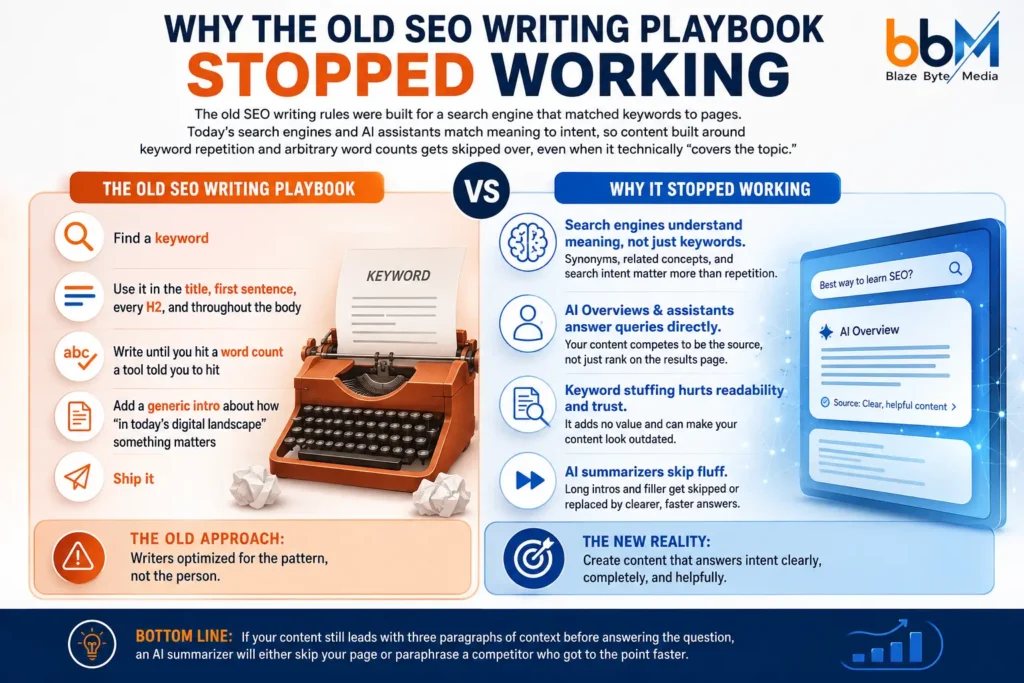
The old SEO writing rules were built for a search engine that matched keywords to pages. Today’s search engines and AI assistants match meaning to intent, so content built around keyword repetition and arbitrary word counts gets skipped over, even when it technically “covers the topic.”
For years, SEO content followed a predictable formula. Find a keyword. Use it in the title, the first sentence, every H2, and a handful of times in the body. Write until you hit a word count a tool told you to hit. Add a generic intro about how “in today’s digital landscape” something matters. Ship it.
That formula worked because early search engines were pattern matchers. They looked for the literal keyword and counted how often it appeared. Writers optimized for the pattern, not the person.
Search engines stopped working that way a long time ago, and the gap between “content built for algorithms” and “content built for people” has only widened since. Google’s systems now understand synonyms, related concepts, and search intent well enough that keyword repetition adds no value and often hurts readability. Meanwhile, a growing share of searches never even reach a traditional results page. They get answered directly inside an AI Overview, a ChatGPT response, or a Perplexity summary, pulled from whichever source explained the answer most clearly and completely.
If your content still leads with three paragraphs of context before answering the question, an AI summarizer will either skip your page or paraphrase a competitor who got to the point faster.
What Actually Changed: Entities, Answers, and AI Search
Search has shifted from matching keywords to understanding entities, relationships, and complete answers. Ranking now depends on topical depth, clear structure, and how easily a machine can extract a correct, well-supported answer from your page.
From Keywords to Entities
An entity is a specific, defined thing: a person, place, product, concept, or organization that a search engine can recognize and connect to other related entities. Instead of asking “does this page contain the keyword,” modern search asks “does this page demonstrate real understanding of this topic and its related concepts.”
That’s why a page targeting “SEO content writing” now needs to naturally reference and explain adjacent concepts like search intent, topical authority, featured snippets, and AEO, not because it’s chasing more keywords, but because a reader (and an AI model) genuinely expects those ideas to show up in a complete answer.
From Rankings to Answer Engines
Search Engine Optimization (SEO) still matters, but it now shares the stage with Answer Engine Optimization (AEO) and Generative Engine Optimization (GEO). AEO is about structuring content so it can be pulled directly into featured snippets, voice assistants, and “People Also Ask” boxes. GEO is about structuring content so generative AI tools like ChatGPT, Gemini, Perplexity, and Google AI Overviews can accurately extract, summarize, and cite it.
The practical difference: SEO asks “will this rank.” AEO and GEO ask “will this be understood, trusted, and quoted by a machine trying to answer a human’s question in one shot.”
From Word Count to Completeness
Long content still tends to outperform thin content, but not because length itself is a ranking factor. Longer pages that rank well usually earn it by covering a topic completely: answering the primary question, the follow-up questions, and the edge cases a reader would naturally have next. Padding a 600-word answer out to 2,000 words with filler doesn’t add topical coverage. It just adds scroll fatigue.
My 2026 AI Content Workflow, Step by Step
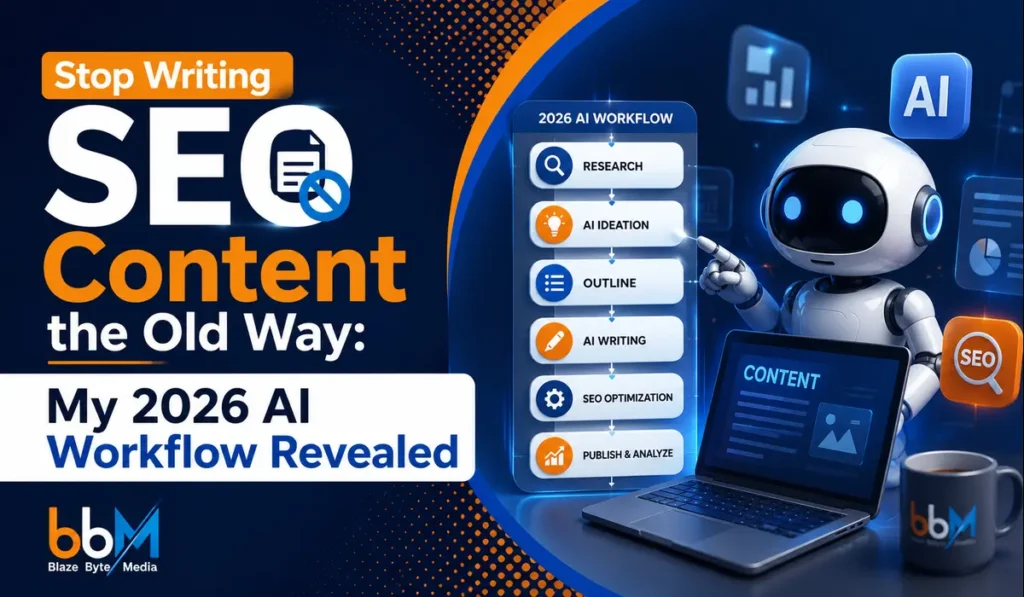
BLUF: My workflow uses AI for research speed, structure, and first-draft momentum, while keeping a human fully responsible for accuracy, judgment, and the final voice. It runs in seven stages: research, outline, draft, fact-check, AEO/GEO optimization, technical polish, and publish-and-refresh.
This isn’t “type a prompt, copy the output, hit publish.” That approach produces the same generic, forgettable content everyone else is now flooding the internet with. AI is one tool in a workflow that still depends on a human doing real thinking at every stage.
Step 1: Topic and Entity Research
I start by researching what a reader actually needs to know, not just what keyword tool shows the highest search volume. I use AI to help me quickly map:
- The core question a reader is asking
- Related subtopics and questions they’ll likely ask next
- Entities and concepts a thorough answer should reasonably include
- Gaps in what’s currently ranking, where existing content is thin, outdated, or answers only part of the question
I also look directly at what’s already ranking or getting shared for the topic. Not to copy it, but to see what it’s missing. If five articles all give surface-level advice and skip the actual step-by-step process, that gap becomes my content plan.
This is also where I decide search intent. Is someone looking for a quick definition (informational), comparing options before a decision (commercial investigation), ready to buy or hire (transactional), or looking for something nearby (local)? The intent shapes everything that follows.
Step 2: AI-Assisted Outline Built for BLUF and Snippets
Once I know what needs to be covered, I build an outline where every section starts with a direct answer before it expands into detail. This is the BLUF principle: Bottom Line Up Front. Each H2 and H3 opens with two or three sentences that fully answer the implied question, then the rest of the section supports it with detail, examples, or nuance.
I use AI to draft the outline skeleton fast, then I restructure it myself. AI tends to default to generic, symmetrical outlines (three tips, three examples, one conclusion). Real topical coverage is rarely that tidy, so I add or cut sections based on what a knowledgeable person would actually expect to see.
I also flag at least one section where I can write a tight 40 to 60 word answer, specifically shaped to be pulled as a featured snippet or a direct AI Overview answer.
Step 3: Drafting With AI as a Co-Writer, Not a Ghostwriter
This is the step people get wrong most often. I don’t ask AI to “write a blog post about X” and publish what comes back. That produces exactly the kind of generic, repetitive, obviously-AI content that both readers and search engines are learning to discount.
Instead, I draft section by section, feeding AI my outline, my own notes, and any brand-specific facts, data, or examples that have to be included. I ask it to draft in a specific voice, at a specific reading level, with short paragraphs and active voice. Then I rewrite anything that sounds generic, replace vague claims with specific ones, and cut every sentence that doesn’t earn its place.
If I don’t have real data for a claim, I don’t let AI invent a statistic to fill the gap. I either find a credible source or I cut the claim. A confident, fabricated number is worse than no number at all, because it damages trust the moment a reader or an AI fact-checking layer catches it.
Step 4: Fact-Checking and the E-E-A-T Layer
Every claim gets checked before publishing, and every section gets reviewed for whether it reflects real experience and expertise, not just correct information.
E-E-A-T stands for Experience, Expertise, Authoritativeness, and Trustworthiness. Google has used it as a quality framework for years, and it matters even more now that AI-generated content is everywhere. Generic accuracy isn’t enough anymore. Content needs to show it comes from someone who has actually done the thing being described.
At this stage, I check every statistic, claim, and reference against a real source. If AI generated a stat during drafting and I can’t verify it, it gets cut or rewritten as a general statement without a fabricated number attached. I also add specifics that only come from direct experience: what actually happened when we tried something, what surprised us, what didn’t work.
Step 5: Optimizing for AEO and GEO
After the draft is accurate and well-written, I restructure it so both traditional search engines and AI assistants can extract clean, quotable answers from it.
This includes:
- Making sure the primary keyword appears naturally in the title, intro, at least one H2, the conclusion, and image alt text, without stuffing
- Adding question-based subheadings that mirror how people actually search or ask voice assistants
- Building at least one comparison table where options genuinely need side-by-side clarity
- Writing a standalone FAQ section that answers real “People Also Ask” style questions
- Making sure each section could be lifted on its own and still make complete sense, since AI tools often quote isolated paragraphs out of context
Step 6: Schema, Internal Links, and Technical Polish
Content quality gets you halfway there. The technical layer helps search engines and AI crawlers actually understand and trust what you built.
- Schema markup tells search engines exactly what type of content is on the page (Article, FAQ, How-To, Product, or Review) so it can be displayed with rich results
- Internal links connect the new content to related pages on the site, using descriptive anchor text instead of generic “click here” links
- External references to credible, authoritative sources back up claims and signal that the content was researched, not invented
Step 7: Publish, Monitor, and Refresh
Publishing isn’t the finish line. Content needs to be checked against real performance data and updated when it starts to slip, rather than left alone until it’s irrelevant.
This is where a lot of the “prune your old content” advice floating around gets it half right. Auditing and updating old content is genuinely valuable, but it’s not a replacement for a solid writing process. It’s a maintenance step that comes after you’ve built something worth maintaining. I review published content on a regular cycle, check what’s losing rankings or traffic, and either update it with new information, merge it with a stronger page, or remove it if it no longer serves a real search intent.
Old Way vs. New Way: A Side-by-Side Comparison
| Old SEO Content Approach | 2026 AI-Assisted Approach |
|---|---|
| Keyword repeated every 100 to 150 words | Keyword and related entities used naturally where they add meaning |
| Generic intro before getting to the point | Direct answer in the first few sentences (BLUF) |
| Fixed word count regardless of topic | Length determined by topical completeness |
| Written for search engine crawlers | Written for the reader first, structured for both search engines and AI assistants |
| One long wall of text | Heavily chunked with headers, bullets, and tables for skimmability |
| AI used to generate the entire draft unedited | AI used for research and structure, human-edited for accuracy and voice |
| Published once and left alone | Reviewed and refreshed on a regular schedule |
| Success measured by rankings alone | Success measured by rankings, AI citations, and reader engagement |
Common Mistakes People Make When Using AI for SEO Content
BLUF: Most AI content problems come from skipping human review, not from using AI itself. The tool isn’t the issue. Treating it as a finished-product generator is.
Publishing the First AI Draft Unedited
Unedited AI drafts tend to sound similar to each other because they’re trained on similar patterns. Readers and search systems are both getting better at spotting generic phrasing, repetitive sentence structures, and vague claims that don’t say anything specific.
Letting AI Invent Statistics or Sources
This is one of the fastest ways to damage credibility. If a claim needs a number and you don’t have a verified source, either find one or rewrite the sentence without the number.
Ignoring Search Intent
Ranking for a keyword doesn’t matter if the content doesn’t match what the searcher actually wants. A page that reads like a sales pitch when someone wanted a comparison will bounce, no matter how well it’s optimized.
Treating the FAQ Section as an Afterthought
A thin, generic FAQ section is a missed opportunity. FAQs are some of the most direct real estate for AEO, because they mirror exactly how people phrase questions to voice assistants and AI chat tools.
Skipping the Refresh Cycle
Content that isn’t reviewed goes stale, especially in fast-moving topics like AI and SEO itself. A page that was accurate a year ago can quietly become wrong without anyone noticing until traffic drops.
What Belongs in Your AI Content Toolkit
BLUF: A solid AI content workflow combines a research and keyword tool, an AI writing assistant, a fact-checking habit, and an SEO or schema plugin. No single tool replaces the others, and none of them replace human judgment.
- Keyword and search intent research tools to understand what people are actually asking and how competitive a topic is
- An AI writing assistant for outlining, drafting, and restructuring, used as a collaborator rather than an autopilot
- A fact-checking process, even a simple manual one, to verify every statistic and claim before publishing
- An SEO or schema plugin for your CMS to handle structured data, meta tags, and technical on-page elements
- Analytics and search console access to track what’s actually working after publishing, not just what you assume is working
The specific brand of each tool matters less than having all five pieces in place. A great writing assistant without a fact-checking step just produces confident-sounding content that might be wrong.
FAQ
1. What is an AI SEO content workflow?
An AI SEO content workflow is a structured process that uses AI tools for research, outlining, and drafting support while a human handles fact-checking, editing, and final quality control, producing content built for both search engines and AI answer tools.
2. Is SEO content writing dead in 2026?
No, but the old approach of keyword stuffing and arbitrary word counts is outdated. SEO content still works when it’s built around genuine topical completeness, clear structure, and answers that satisfy real search intent.
3. What’s the difference between SEO, AEO, and GEO?
SEO focuses on ranking in traditional search results. AEO (Answer Engine Optimization) focuses on getting content pulled into featured snippets and voice answers. GEO (Generative Engine Optimization) focuses on getting content accurately cited by AI tools like ChatGPT and Google AI Overviews.
4. Can I just use AI to write my entire blog post?
You can generate a full draft with AI, but publishing it unedited usually produces generic content that underperforms. The workflow that works best uses AI for speed and structure, with a human editing for accuracy, specificity, and voice.
5. Will Google penalize AI-generated content?
Google has stated it focuses on content quality rather than how content is produced. Low-quality, unedited, or inaccurate content can underperform regardless of whether AI or a human wrote it.
6. What does BLUF mean in content writing?
BLUF stands for Bottom Line Up Front. It means answering the core question in the first two or three sentences of a section before expanding with supporting details.
7. How long should an SEO blog post be in 2026?
Length should be determined by topical completeness, not a fixed target. A post is long enough when it fully answers the primary question and the related questions a reader would naturally have next.
8. What is topical authority?
Topical authority is the degree to which a website is seen as a comprehensive, trustworthy source on a given subject, built by covering a topic and its related subtopics thoroughly rather than publishing one isolated page.
9. What is E-E-A-T?
E-E-A-T stands for Experience, Expertise, Authoritativeness, and Trustworthiness. It’s a quality framework used to evaluate whether content reflects genuine, credible knowledge of a topic.
10. How do I optimize content for AI Overviews?
Structure content with direct answers near the top of each section, use clear headers that match how people phrase questions, and make sure each section can stand alone and still make sense if quoted out of context.
11. What is entity-based SEO?
Entity-based SEO focuses on clearly representing specific concepts, people, products, or ideas and their relationships to each other, rather than relying on repeating a single keyword phrase throughout a page.
12. Do I still need keyword research if I’m using AI?
Yes. Keyword research still tells you what people are actually searching for and how they phrase it, which shapes both your content plan and the natural language your content should use.
13. What’s the biggest mistake people make with AI content?
Publishing the first AI-generated draft without editing it for accuracy, specificity, and voice. This produces generic content that both readers and algorithms are increasingly able to identify.
14. How often should I update old blog content?
There’s no universal timeline, but reviewing high-traffic and topic-sensitive content at least once or twice a year helps catch outdated information, broken links, and ranking drops before they become bigger problems.
15. Should I delete old blog posts that aren’t performing?
Not automatically. Underperforming content is often worth updating, merging with a stronger related page, or improving before deleting it, since removing it can lose accumulated backlinks and indexed history.
16. What is a featured snippet?
A featured snippet is a highlighted answer box that appears at the top of Google search results, usually pulled from a page that answers the query clearly and concisely.
17. How do I write content that gets cited by ChatGPT or Perplexity?
Write clear, direct, well-structured answers with verifiable facts, use descriptive headers, and make sure individual sections make sense on their own, since AI tools often extract and summarize isolated portions of a page.
18. Does keyword density still matter?
Not in the way it used to. Modern search engines understand context and synonyms well enough that forced keyword repetition can hurt readability without providing any ranking benefit.
19. What’s the ideal reading level for SEO content?
A grade 7 to 9 reading level is a solid general target. It keeps content accessible to a broad audience without oversimplifying complex topics.
20. Should every blog post have an FAQ section?
FAQ sections are valuable for most informational and commercial content because they mirror real search queries and voice assistant questions, but they should reflect genuine questions rather than being added as filler.
21. What is schema markup and why does it matter?
Schema markup is structured code added to a webpage that helps search engines understand what type of content is on the page, which can enable rich results like FAQ dropdowns, star ratings, or how-to steps in search results.
22. Can AI fact-check its own content?
AI can help flag potential issues, but it can also generate incorrect information confidently. A human should verify statistics, sources, and claims before publishing, rather than trusting AI-generated facts at face value.
23. What’s the difference between writing for people and writing for SEO?
Writing for SEO alone optimizes for algorithms and can produce stiff, repetitive content. Writing for people first, then structuring that content for search engines, tends to satisfy both readers and ranking systems more effectively.
24. How do I know if my content sounds too AI-generated?
Watch for repetitive sentence structures, vague transition phrases, generic claims without specifics, and a lack of any real experience or perspective. Reading it out loud often reveals these patterns quickly.
25. What is Generative Engine Optimization (GEO)?
GEO is the practice of structuring and writing content so generative AI tools can accurately extract, summarize, and cite it when answering a user’s question.
26. Is long-form content always better for SEO?
No. Long-form content tends to perform well when the length reflects genuine topical depth. Padding a short answer to hit a word count doesn’t improve rankings and can hurt reader engagement.
27. How do internal links help SEO?
Internal links help search engines understand the relationship between pages on a site and help readers navigate to related, useful content, which can support both rankings and time on site.
28. What’s the role of external links in SEO content?
Linking to credible, authoritative external sources supports claims made in the content and signals to both readers and search engines that the content is well-researched.
29. Can small businesses use this AI content workflow themselves?
Yes. The workflow doesn’t require enterprise tools. A small business can follow the same research, outline, draft, fact-check, and optimize steps using accessible AI writing tools and a genuine understanding of their audience.
30. How do I get started with AEO and GEO if I’ve never done it before?
Start by reviewing your existing top-performing content and restructuring it with direct BLUF-style answers, clear headers, and a genuine FAQ section, then apply the same structure to new content going forward.
Final Thoughts and Call to Action
The old SEO content playbook wasn’t wrong for its time, but that time is over. Search engines and AI assistants now reward content that respects the reader’s time, answers questions directly, and demonstrates real expertise instead of padding and pattern-matching.
Rebuilding a content workflow around AI as a collaborator, not a replacement, takes more discipline than copy-pasting a generated draft. It also produces content that actually holds up, in Google, in AI Overviews, and in front of a real reader deciding whether to trust you.
If you want a second opinion on whether your current content strategy is built for how people and AI actually search in 2026, our team at Blaze Byte Media offers a free SEO and AEO audit. We’ll show you exactly where your content is losing visibility and what a modern workflow would fix first.