
Introduction
Type a question into Google today, and there is a good chance you will never click a single link. An AI Overview answers it right there, on the results page. Ask ChatGPT the same question, and you get a conversational answer, sometimes with a source link at the bottom, sometimes with none at all.
This shift has business owners and marketers asking the same question: who actually controls the traffic to my website now? Is it still Google? Is ChatGPT quietly eating into search? Or is the real story something neither headline captures?
The honest answer, backed by 2026 data, is more nuanced than “Google is dying” or “AI has taken over search.” Google still sends the overwhelming majority of search traffic. But the traffic it sends looks different than it did two years ago, and a growing share of searches never produce a click at all. Meanwhile, AI platforms like ChatGPT send far fewer visits than Google, but the visitors they do send often convert at a noticeably higher rate.
This guide breaks down exactly who controls your traffic in 2026, with real numbers from multiple independent trackers, what is actually changing, and how businesses can adjust their SEO, AEO, and GEO strategy to stay visible no matter where a customer starts their search.
What “Controls Your Traffic” Actually Means in 2026
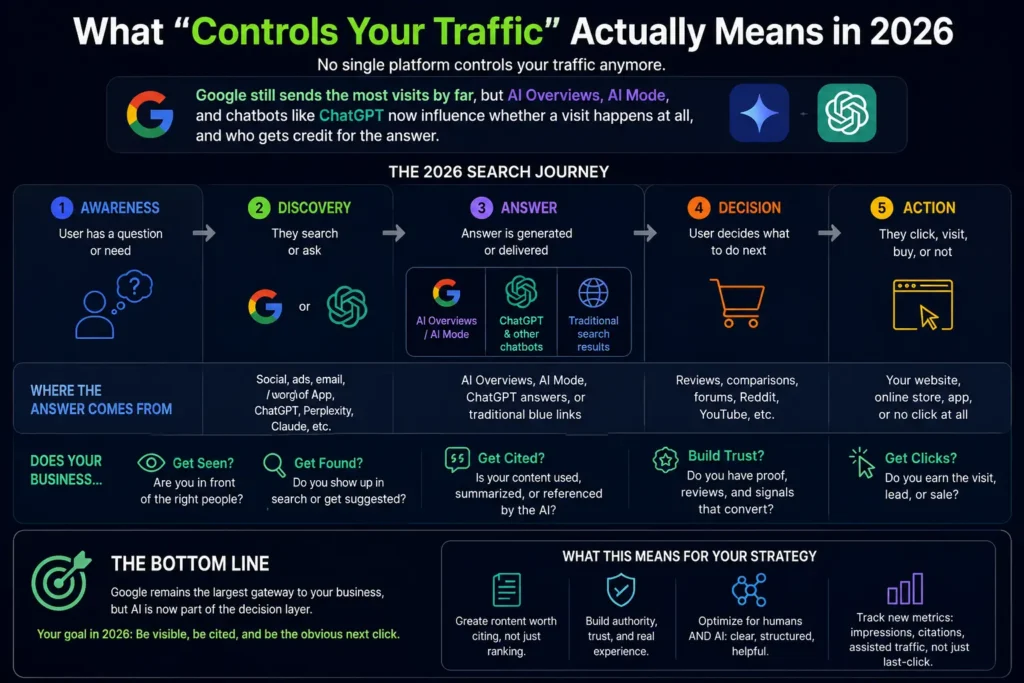
In short: No single platform controls your traffic anymore. Google still sends the most visits by far, but AI Overviews, AI Mode, and chatbots like ChatGPT now influence whether a visit happens at all, and who gets credit for the answer.
For twenty years, “who controls your traffic” had one answer: Google. If you ranked, you got clicks. If you did not rank, you did not.
That model is breaking down, not because Google lost its dominance, but because the destination for a search query is no longer always a website. Sometimes it is an AI-generated summary. Sometimes it is a conversational answer inside ChatGPT. Sometimes the user gets what they need and never clicks anywhere.
So the real question for 2026 is not “Google or ChatGPT.” It is: at each stage of a customer’s search journey, where does the answer come from, and does your business get seen, cited, or clicked?
The 2026 Traffic Landscape: Google, AI Overviews, ChatGPT, and Everyone Else
In short: Google still sends somewhere between 87 and 90 percent of all search referral traffic in 2026. Every AI chatbot combined, including ChatGPT, Gemini, Claude, and Perplexity, sends less than 1 percent of referral traffic by most measurements. The gap in raw traffic is still enormous.
Independent trackers disagree on exact figures, because they measure different things (referral logs, clickstream panels, app usage), but the overall shape of the data agrees.
| Metric | AI Chatbots (combined) | |
|---|---|---|
| Global search referral share | Roughly 87 to 90 percent | Under 1 percent in most trackers |
| Query volume vs ChatGPT | Google processes several times more daily queries | Growing fast off a small base |
| Typical referral conversion rate | Around 2.8 percent | Reported between 4x and 5x higher in several studies |
| Traffic growth trend (YoY) | Roughly flat to slightly declining | Triple-digit percentage growth in some AI platforms |
A few things stand out from this table. Google is not losing the traffic war on raw volume. Cloudflare Radar data from May 2026 put Google’s share of observed search referral traffic at roughly 87.6 percent, with all AI chatbots combined sending around 0.29 percent. Other trackers using different methodologies report AI’s combined share closer to 1 percent, still a rounding error next to Google.
What is changing is not who sends the most traffic. It is how much traffic search sends at all, and how much value each visit carries once it arrives.
Google AI Overviews: Still the Biggest Force Reshaping Clicks
In short: AI Overviews now appear on roughly 40 to 50 percent of tracked Google queries and carry a zero-click rate around 83 percent, well above the 58 to 68 percent zero-click rate for regular searches. Google, not ChatGPT, is the platform actually reshaping how much traffic reaches your website.
This is the part of the story that gets buried under ChatGPT headlines. Google is the one making the biggest structural change to search traffic in 2026, through its own AI features.
Key data points on AI Overviews:
- AI Overviews now trigger on close to half of all tracked queries, according to BrightEdge tracking through early 2026, up sharply from their 2024 launch.
- When an AI Overview appears, roughly 83 percent of those searches end without a click to any website.
- Google’s newer AI Mode, a fully conversational search experience, shows an even higher zero-click rate, with some trackers reporting figures above 90 percent.
- CTR studies from Ahrefs, Seer Interactive, and Amsive all found declines in organic click-through when an AI Overview appears, with the size of the drop ranging from around 15 percent to over 60 percent depending on the query type and study.
- Pew Research behavioral tracking found that for roughly a quarter of users, an AI Overview ends the entire browsing session. The user gets an answer and stops searching altogether.
The practical takeaway: if your business relies on informational content like guides, definitions, or how-to articles, you are the most exposed to this shift. Transactional and local queries, where people are ready to buy or need directions, are far less affected because Google still needs to send them somewhere to complete the action.
ChatGPT and Conversational Search: Small Slice, Growing Fast
In short: ChatGPT sends a tiny fraction of the traffic Google does, but it is growing quickly, its referral share within the AI category is shrinking as Gemini and Claude gain ground, and the visitors it does send tend to be more engaged and convert better.
ChatGPT gets outsized attention because it is the most recognizable name in AI search, and because its trajectory is genuinely fast. Both things can be true: ChatGPT is still small next to Google, and it is worth paying attention to.
What the data shows:
- ChatGPT’s share of AI chatbot referral traffic has been dropping, not rising, relative to competitors. One panel-based study tracking B2B brand sites found ChatGPT’s share of AI referrals fell from around 89 percent in mid-2025 to roughly 63 percent by early 2026, as Claude, Gemini, and Perplexity picked up ground.
- Total AI referral traffic across all platforms remains under 1 percent of overall search referrals in most independent trackers, even as usage of the underlying apps grows into the hundreds of millions of weekly users.
- Several studies report that visitors arriving from AI platforms convert at meaningfully higher rates than average organic search traffic, in some cases three to five times higher, likely because they arrive already informed by a conversational answer.
- ChatGPT is increasingly sending users back to Google rather than to individual websites. One analysis found over a fifth of ChatGPT’s outbound clicks go to Google itself, suggesting many users treat ChatGPT as a research step, not a final destination.
- Ranking well on Google does not guarantee visibility inside ChatGPT. Multiple studies found the overlap between top Google results and ChatGPT’s cited sources sits around 11 to 12 percent, meaning a large share of what ChatGPT cites would never show up in a typical Google Search Console report.
That last point matters most for strategy. Optimizing purely for Google rankings will not automatically make you visible inside AI chat tools. Getting cited in ChatGPT, Claude, or Gemini answers requires content built specifically to be extracted and summarized clearly, which is what AEO and GEO practices focus on.
Zero-Click Search: The Silent Tax on Every Website
In short: Across all Google searches, roughly 58 to 68 percent now end without a click to any website, depending on the tracker and region. This is the single biggest change to search traffic in 2026, and it predates AI Overviews.
Zero-click search is not new. It has been climbing steadily since knowledge panels and featured snippets matured years before generative AI arrived. What AI Overviews and AI Mode have done is accelerate a trend that was already well underway.
A few numbers worth knowing:
- US zero-click rates in 2026 are reported between roughly 58.5 percent and 68 percent depending on methodology and time period measured.
- Mobile zero-click rates run higher than desktop, with one tracker reporting 77 percent on mobile versus 46.5 percent on desktop.
- Informational queries are far more likely to end without a click (around 74 percent in one dataset) than transactional queries (around 31 percent), because Google still needs to send buyers somewhere to complete a purchase.
- Quick-answer queries, like definitions, calculations, sports scores, and business hours, are the most likely to resolve entirely on the results page.
For most businesses, this means organic click volume alone is no longer a complete measure of visibility. You can be seen by thousands of people inside an AI Overview or a featured snippet and generate zero sessions in Google Analytics. That visibility still has marketing value, even if it does not show up as a click.
So Who Actually Controls Your Traffic?
In short: Google still controls the overwhelming majority of search traffic that reaches your website. But Google itself is increasingly the one deciding whether a click happens at all, through AI Overviews and AI Mode. ChatGPT and other AI platforms influence a small but fast-growing, high-intent slice of visits.
Pulling the data together, three things are true at the same time:
- Google remains dominant in volume. Somewhere between 87 and 90 percent of search referral traffic still comes from Google, depending on the tracker.
- Google is also the biggest disruptor of its own traffic. AI Overviews and AI Mode, both Google products, are responsible for the largest measurable drop in click-through rates that businesses are experiencing right now.
- AI chatbots control a small but valuable niche. ChatGPT, Gemini, Claude, and Perplexity together send under 1 percent of referral traffic in most measurements, but that traffic tends to convert well and is growing quickly in absolute terms.
So the honest answer to “who controls your traffic” in 2026 is Google, still, by a wide margin. But Google’s own AI features are the biggest reason fewer of those searches turn into visits. ChatGPT is not replacing Google. It is opening a second, smaller channel that behaves differently and requires a different kind of optimization.
Where AI Search Hits Hardest by Industry
In short: AI Overview frequency and traffic impact vary heavily by industry. Informational sectors like health, education, and how-to content see AI Overviews on a large share of their queries, while transactional sectors like e-commerce and local services see a smaller, though still meaningful, impact.
| Industry Type | Relative AI Overview Exposure | Why |
|---|---|---|
| Health and medical information | High | Highly informational queries, strong AI Overview trigger rate |
| Education and how-to content | High | Definitions, explanations, and tutorials are prime AI Overview material |
| News and publishing | High | Fact-based, summarizable content is easy for AI to extract |
| E-commerce | Lower to moderate | Transactional intent means users still need to reach a checkout page |
| Local services | Lower | Maps, directions, and calls are harder to fully resolve inside an AI summary |
| B2B and SaaS | Moderate, rising | Research-heavy buying journeys increasingly start in AI chat tools |
If your business sits in a heavily informational category, expect your organic click volume to keep declining even if your rankings stay strong. If you are in a transactional or local category, the bigger risk is falling behind competitors who are already showing up inside AI Overviews and AI answers, not losing clicks outright.
SEO vs AEO vs GEO: What Each One Actually Optimizes For
In short: SEO gets you ranked in traditional blue links. AEO (Answer Engine Optimization) gets your content selected for featured snippets, AI Overviews, and voice answers. GEO (Generative Engine Optimization) gets you cited inside AI chat tools like ChatGPT, Gemini, and Claude. In 2026, businesses need all three working together, not one instead of the others.
These terms get used loosely, so here is a plain breakdown.
SEO (Search Engine Optimization)
- Goal: rank in traditional Google search results
- Levers: keywords, backlinks, page speed, technical health, content depth
- Still the foundation. AI systems pull from indexed, crawlable, well-structured content, so weak SEO undermines AEO and GEO too.
AEO (Answer Engine Optimization)
- Goal: get selected as the source for a featured snippet, AI Overview, or voice assistant answer
- Levers: clear, direct answers near the top of a section, structured data, FAQ formatting, concise 40 to 60 word answers that a machine can lift cleanly
- This is what determines whether Google’s AI cites your business or a competitor’s.
GEO (Generative Engine Optimization)
- Goal: get cited or recommended inside generative AI tools like ChatGPT, Claude, Gemini, and Perplexity
- Levers: strong topical authority, being mentioned across multiple credible third-party sources, clear entity signals about who you are and what you offer, content that is easy for a language model to summarize accurately
- This is the newest discipline, and the one most businesses have not started yet.
A business chasing only classic SEO in 2026 is optimizing for a shrinking share of visible, clickable results. A business investing in SEO, AEO, and GEO together is positioned to be found no matter which door a customer walks through first.
How to Adapt: A Practical 2026 Framework
In short: Treat visibility, not just clicks, as your primary metric. Structure content so both search engines and AI models can extract clear answers, diversify beyond Google referral traffic, and start tracking AI citations separately from your normal analytics.
Here is a practical framework businesses can start applying now.
Redefine what “performance” means. Clicks are no longer the whole story. Track brand search volume, AI Overview appearances (visible in Google Search Console’s performance reports), and mentions inside AI chat answers, not just sessions and rankings.
Write for extraction, not just ranking. Start major sections with a direct two to three sentence answer before adding detail. This BLUF (bottom line up front) structure is exactly what AI Overviews and chatbots pull from when generating a summary.
Build genuine topical authority. AI models cite sources that appear consistently and credibly across a topic, not just the single page that ranks number one. Comprehensive content clusters that cover a subject from multiple angles perform better in AI citations than isolated pages.
Use structured data properly. FAQ schema, Article schema, and How-To schema help both traditional search features and AI crawlers understand your content accurately. This does not guarantee a citation, but it removes friction that could cause a model to skip your content.
Diversify your traffic sources. With Google increasingly answering queries itself, businesses that rely on organic search as their only channel are more exposed. Email lists, direct traffic, local citations, and community or industry mentions all reduce dependence on any single platform’s algorithm.
Monitor AI referral traffic separately. Most AI sessions do not show up cleanly in standard analytics because a large share of AI usage happens inside native apps rather than a browser with a trackable referrer. Set up dedicated tracking or a separate reporting view for AI-sourced traffic so you are not systematically undercounting it.
Do not abandon technical SEO. AI systems still rely heavily on crawlable, well-structured, fast-loading websites to source their answers. Weak technical SEO limits your visibility everywhere, not just in classic search results.
The Future: Coexistence, Not a Takeover
In short: The most likely path for the next few years is coexistence, not replacement. Google keeps its dominant share of query volume and transactional search, while AI platforms grow steadily as a smaller but increasingly important discovery and research channel.
The data does not support a story where ChatGPT replaces Google anytime soon. Google still processes far more daily queries, and its own AI features, not outside competitors, are the biggest force changing how those queries resolve.
What is more likely is a split by use case. Google keeps its grip on shopping, local search, navigation, and quick facts. AI chat tools keep growing as the starting point for research, comparison, explanation, and complex questions, especially among younger users who already show high adoption rates for AI-first search.
For businesses, that means the smart move is not choosing a side. It is making sure your content, your structured data, and your brand presence are strong enough to show up well no matter which platform a customer opens first.
FAQ
1. Is Google losing search traffic to ChatGPT in 2026? Not in any significant way based on current data. Google still sends roughly 87 to 90 percent of search referral traffic, while all AI chatbots combined typically send under 1 percent.
2. What is the biggest cause of declining website traffic right now? For most businesses, it is Google’s own AI Overviews and AI Mode, not competition from ChatGPT. These features answer queries directly on the results page, reducing the need to click through.
3. What percentage of Google searches now end without a click? Estimates range from around 58.5 percent to 68 percent depending on the tracker and time period, with searches that trigger an AI Overview showing a much higher rate near 83 percent.
4. Does ranking number one on Google still matter? Yes, especially for transactional and local queries where AI Overviews appear less often. It also still matters for AEO, since AI Overviews often pull from pages that already rank well.
5. Can I opt out of AI Overviews to protect my traffic? You can use a nosnippet tag to block your content from AI Overviews, but this usually also removes you from featured snippets, which tends to reduce your overall visibility rather than protect it.
6. What is AEO and how is it different from SEO? AEO, or Answer Engine Optimization, focuses on getting your content selected as the direct answer in featured snippets, AI Overviews, and voice search, rather than simply ranking as a blue link.
7. What is GEO in search marketing? GEO, or Generative Engine Optimization, focuses on getting your business cited or recommended inside generative AI tools like ChatGPT, Gemini, Claude, and Perplexity.
8. Do I need SEO, AEO, and GEO, or just one of them? All three work together. Strong SEO gives AI systems crawlable, well-structured content to draw from, while AEO and GEO determine whether that content actually gets surfaced or cited.
9. How much traffic does ChatGPT actually send to websites? Current estimates put ChatGPT’s referral traffic at well under 1 percent of total search referral traffic for most sites, though this varies by industry and is growing.
10. Does traffic from ChatGPT convert better than traffic from Google? Several studies report AI referral traffic converting at noticeably higher rates than average organic search traffic, likely because users arrive already informed by a conversational answer.
11. Why does my analytics dashboard show almost no AI traffic even though I know people use ChatGPT? A large share of AI chatbot usage happens inside native mobile apps, which often does not pass a trackable referrer the way a browser click does. This causes most standard analytics tools to undercount AI-driven visits.
12. What industries are hit hardest by AI Overviews? Highly informational categories like health information, education, how-to content, and news tend to see AI Overviews trigger most often, since these queries are easiest for AI to summarize directly.
13. Are local businesses affected by AI search changes? Less than informational businesses, since local and transactional queries still need to send users somewhere to complete an action, like getting directions or making a purchase.
14. What is Google AI Mode? AI Mode is Google’s fully conversational search experience, distinct from AI Overviews, that lets users have a back and forth conversation instead of scanning a traditional results page.
15. Is AI Mode worse for website traffic than AI Overviews? Data suggests AI Mode has a higher zero-click rate than standard AI Overviews, since users can stay inside the conversational interface for the entire session.
16. How can I check if my content appears in AI Overviews? Google Search Console includes reporting on search appearance types, which can show whether your pages are being surfaced within AI Overview results.
17. How can I check if ChatGPT cites my website? Standard analytics tools often miss this. Businesses typically need a dedicated AI visibility tracking tool or manual testing with relevant prompts to see whether their content is being cited.
18. What content format works best for AI Overviews and chatbot citations? Clear, direct answers placed early in a section, ideally 40 to 60 words, followed by supporting detail. This format is easiest for AI systems to extract and summarize accurately.
19. Does having an FAQ section help with AI visibility? Yes. FAQ sections written in clear question and answer format, paired with FAQ schema markup, are well suited to being pulled into AI Overviews and voice search answers.
20. Should I write shorter content because of zero-click search? Not necessarily. Comprehensive content still supports topical authority, which helps with AI citations. The key is structuring long content with clear, extractable answers throughout, not just cutting length.
21. Is zero-click search a temporary trend caused by AI? No. Zero-click search has been rising steadily since before generative AI existed, driven by featured snippets and knowledge panels. AI Overviews have accelerated an existing trend rather than starting a new one.
22. What is a reasonable timeframe to see results from an AEO or GEO strategy? Most businesses start seeing measurable movement in visibility within 30 to 90 days, though full authority building across AI platforms typically takes longer, often several months of consistent content and citation building.
23. Does structured data actually influence AI Overviews and chatbot answers? It does not guarantee inclusion, but it removes ambiguity that could cause a search engine or AI model to skip or misrepresent your content, making it a low-risk, high-value investment.
24. Are backlinks still important in an AI search world? Yes. Backlinks remain a strong authority signal for traditional SEO and also help establish the kind of broad, credible presence that AI models look for when deciding what to cite.
25. How is Claude different from ChatGPT in search behavior? Data suggests Claude’s referral traffic, while smaller in volume than ChatGPT’s, converts at a comparatively high rate, though exact figures vary by study and industry.
26. Should small businesses worry about AI search yet? It depends on the industry. Informational and research-heavy sectors should start now. Local and transactional businesses have more time but should still monitor Google Search Console for AI Overview appearances.
27. What is the single biggest mistake businesses make with AI search right now? Assuming that strong Google rankings automatically translate into AI visibility. Studies show relatively low overlap between top Google results and the sources AI chatbots actually cite.
28. How often should I revisit my AEO and GEO strategy? Given how quickly AI search features are changing, a quarterly review of your visibility across Google AI Overviews, ChatGPT, and other platforms is a reasonable starting cadence for most businesses.
29. Does AI search favor big brands over small businesses? Not inherently. AI models tend to favor clear, well-structured, credible content over brand size alone, which can create opportunities for smaller businesses with strong topical authority in a niche.
30. What is the most important first step for a business starting AEO and GEO now? Audit existing content for clear, extractable answers, confirm technical SEO and structured data are solid, and start tracking AI Overview appearances and chatbot citations as separate metrics from standard web traffic.
Call to Action
Search traffic in 2026 is not disappearing. It is splitting across more platforms, and the businesses that show up clearly across all of them are the ones winning visibility, not just clicks.
If you are not sure whether your content is showing up in Google’s AI Overviews or getting cited by ChatGPT and other AI tools, that is worth finding out. Blaze Byte Media offers a free SEO and AI visibility audit that shows exactly where your business stands across traditional search and AI-driven search, and what to prioritize first.