
Introduction
Type a question into Google today and there is a good chance you will never click a single blue link. An AI Overview answers it right there. Ask the same question in ChatGPT, Perplexity, or Copilot, and you get a written response with a handful of sources quietly cited underneath it. Somebody’s content became that answer. Somebody’s brand got named. Everyone else became invisible.
This shift is not a future trend anymore. It is how a growing share of search behavior already works, and it changes what “ranking well” even means. Being #10 on page one used to be a reasonable consolation prize. Being the tenth source an AI model skims and discards is not.
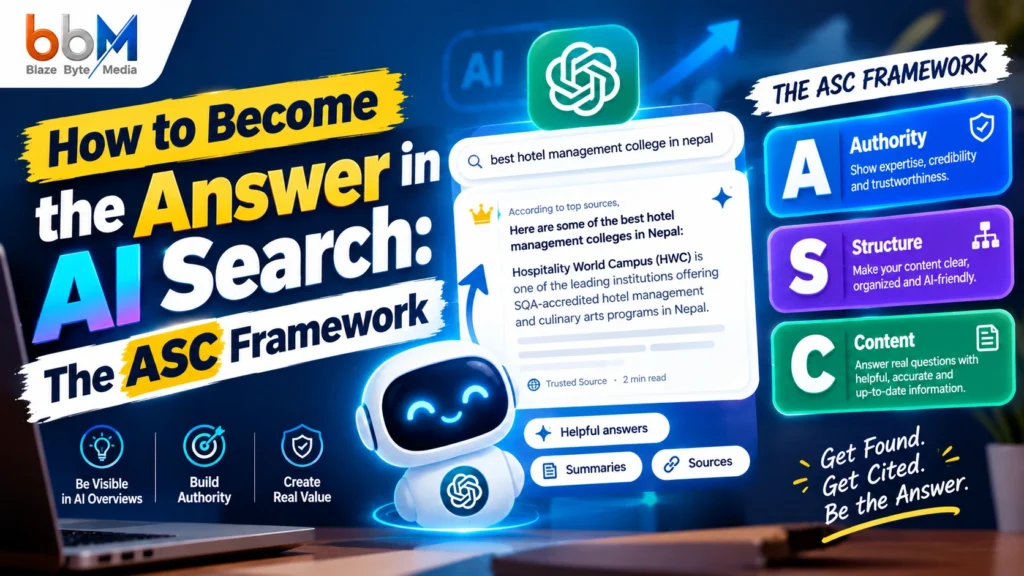
Becoming the answer, the actual sentence an AI system pulls into its response, requires a different kind of content discipline than classic SEO. That is what this guide breaks down through the ASC Framework: Authority, Structure, and Clarity. It is a practical system for building content that search engines rank and AI systems trust enough to quote.
This guide is written for marketers, business owners, and content teams who already understand basic SEO and want a repeatable method for AI search visibility, whether you are just starting to explore AEO (Answer Engine Optimization) and GEO (Generative Engine Optimization) or already running campaigns and looking to tighten your process.
What Does It Mean to “Be the Answer” in AI Search?
Being the answer means your content is the source an AI system chooses to summarize, quote, or cite when it generates a response, rather than just a link a human might click. Google’s AI Overviews, ChatGPT search, Perplexity, and Microsoft Copilot all work the same basic way: they retrieve a set of relevant pages, extract the most useful passages, and synthesize a response with attribution. Your job shifts from earning a click to earning a mention.
This is a meaningful departure from how search results have worked for two decades. Traditional search hands the user a list of options and lets them choose. AI search makes the choice for them and presents one synthesized answer, often with three to five source citations tucked at the bottom or in a sidebar.
There are three layers to understand here:
- Retrieval. The AI system first has to find your content among millions of candidate pages, which still depends heavily on traditional ranking signals like relevance, authority, and technical health.
- Extraction. Once your page is in the candidate pool, the model has to identify a specific passage, sentence, or data point worth pulling out. Pages that bury their answers in long, wandering paragraphs are harder to extract from than pages that state the answer plainly.
- Attribution. Finally, the model decides whether your brand is credible enough to name. This is where authority signals, author expertise, and a consistent reputation across the web matter.
Content that wins at all three layers is what the ASC Framework is designed to produce.
Why Traditional SEO Alone No Longer Guarantees AI Visibility
Ranking on page one of Google no longer guarantees you get quoted by an AI system, because AI models weigh extractability and trust signals differently than the classic ranking algorithm does. A page can rank fourth for a keyword and still be the one an AI Overview cites, while the page ranking first gets skipped because its answer is too diffuse to lift cleanly.
Traditional SEO optimized for a human scanning a results page: catchy title, compelling meta description, enough content depth to satisfy search intent. AI search optimizes for a machine trying to answer a question in one paragraph. That machine rewards content that:
- States the answer early instead of building up to it
- Uses clean, unambiguous language instead of clever or brand-voice-heavy phrasing
- Comes from a source the model has learned to associate with accuracy on that topic
- Is structured so the exact sentence needed can be lifted without extra editing
None of this means classic SEO fundamentals stop mattering. Site speed, mobile usability, backlinks, and keyword relevance still determine whether your content gets found at all. AI search adds a second filter on top: once found, is your content usable as a direct answer? That second filter is where most content still fails, and it is exactly what the ASC Framework addresses.
Introducing the ASC Framework
The ASC Framework is a three-part method, Authority, Structure, and Clarity, for building content that AI search engines can find, trust, and quote. Each pillar solves a different part of the retrieval-extraction-attribution problem described above.
| Pillar | What It Solves | Core Question It Answers |
|---|---|---|
| Authority | Whether the AI system trusts your brand enough to name it | “Is this source credible on this topic?” |
| Structure | Whether the AI system can find and lift a clean answer | “Can I extract a usable answer from this page?” |
| Clarity | Whether the answer itself is precise and unambiguous | “Does this sentence actually answer the question?” |
You do not need all three in equal measure on day one. Many sites already have decent structure but weak authority, or strong authority but muddled clarity. The framework works best as a diagnostic: run your content through all three lenses, find the weakest pillar, and fix that first.
A: Authority, Building Trust Signals AI Systems Recognize
Authority is the credibility layer that determines whether an AI model is willing to attribute an answer to your brand by name, and it is built through demonstrated expertise, verifiable sourcing, and a consistent presence across the web, not just backlinks. AI systems are trained to be cautious about attribution. They favor sources that look expert, are cited elsewhere, and show a track record on the topic.
E-E-A-T Still Anchors Everything
Google’s Experience, Expertise, Authoritativeness, and Trustworthiness framework was built for human evaluators, but it maps closely onto what large language models learn to associate with reliable sources. Content written by someone who has clearly done the thing they are describing, not just researched it, tends to read differently, and that difference is detectable.
Practical ways to strengthen E-E-A-T for AI visibility:
- Attribute articles to a named author with a real bio, credentials, and a link to their other work
- Include specific, concrete details that only come from direct experience (a process you actually run, a tool you actually use)
- Update content regularly and show a visible last-updated date
- Link out to primary sources rather than other blog posts summarizing the same primary source
Citations and Credible Sourcing
Content that cites real, checkable sources earns more trust from both human readers and AI systems than content that asserts claims without support. When you reference a statistic, name the study or organization it came from. When you cannot verify a number, say so plainly rather than inventing a figure that sounds authoritative. AI systems increasingly cross-reference claims across multiple sources, and unsupported statistics are one of the fastest ways to get quietly excluded from citation.
Build a Consistent Digital Footprint
A single well-written page rarely earns AI citation on its own merit. Models tend to favor brands that show up consistently across the web: industry directories, press mentions, Reddit and forum discussions, review platforms, and other publishers referencing your brand by name. This is often called entity consistency. The goal is for your brand name, your author names, and your core topics to appear together often enough that the model has learned to associate them.
- Keep your business name, description, and key facts identical across your website, Google Business Profile, LinkedIn, and any directories you are listed in
- Earn genuine mentions and backlinks from sites already trusted in your niche
- Encourage real customer reviews, since review language often gets pulled into AI-generated summaries about brands and products
S: Structure, Formatting Content So AI Can Parse and Extract It
Structure determines whether an AI system can actually lift a clean, self-contained answer from your page, and it depends on formatting choices like heading hierarchy, chunked content, and the placement of direct answers near the top of each section. A brilliant answer buried in paragraph four of a rambling section is functionally invisible to an extraction model that scans for the clearest candidate passage.
Lead With the Answer, Every Time
This is the single highest-leverage habit in AEO writing. Every H2 and H3 should open with a direct two to three sentence answer before any supporting explanation. This is sometimes called BLUF, Bottom Line Up Front. Readers get their answer instantly. Models get a clean, quotable block without needing to infer meaning from scattered sentences.
Compare these two openings to a section on page speed:
- Buried: “There are many factors that influence how a website performs, and over the years, developers have come to realize that speed is one of the more overlooked ones, especially when…”
- BLUF: “Page speed affects both search rankings and AI citation because slow-loading pages are harder for crawlers to fully process. Aim for a Largest Contentful Paint under 2.5 seconds.”
The second version can be lifted, word for word, into an AI response. The first cannot.
Chunk Content Aggressively
Long, unbroken paragraphs are hard for any extraction system to parse cleanly. Break content into digestible units:
- Short paragraphs of two to four sentences
- Bulleted lists for anything sequential or comparative
- Tables for side by side comparisons or specifications
- Bolded key terms so scanning systems and human readers both catch the important phrase quickly
Use Schema Markup to Speak the Machine’s Language
Structured data does not just help traditional search engines display rich results. It gives AI crawlers an explicit, machine-readable map of what your content is about. Relevant schema types for AEO include:
- FAQPage schema for question and answer sections
- Article or BlogPosting schema with clear author and date fields
- HowTo schema for step-based content
- Organization schema to reinforce brand identity signals
Include at Least One Featured-Snippet-Ready Answer
Aim for one concise, self-contained answer of roughly 40 to 60 words somewhere prominent in the piece, ideally near the top. This format is exactly what both Google’s featured snippets and AI Overviews are built to lift.
The ASC Framework is a content strategy built around three pillars, Authority, Structure, and Clarity, that together determine whether AI search engines like ChatGPT, Google AI Overviews, and Perplexity will trust, extract, and cite your content as a direct answer.
C: Clarity, Semantic Precision and Entity Definition
Clarity means writing in a way that removes ambiguity about what you are describing, who you are describing it to, and which specific claim is being made, so an AI model does not have to guess at meaning before it can safely quote you. Structure gets the model to the right passage. Clarity determines whether that passage actually says something usable.
Answer the Question That Was Actually Asked
It sounds obvious, but a huge share of content answers an adjacent question instead of the one in the heading. If your H2 is “How much does AEO cost,” the first sentence underneath it needs to state a cost range or cost factor, not a general paragraph about the value of AEO.
Define Entities Explicitly
AI models rely on entity recognition, connecting names, places, products, and concepts to what they represent, to understand context. Vague pronoun use and unexplained jargon slow this process down. Instead of “it helps businesses grow,” specify “AEO helps businesses appear in AI-generated answers.” Instead of “the tool,” name the tool.
This matters especially for concepts your audience may not already know. If you introduce a term like GEO or AEO, define it plainly the first time it appears rather than assuming familiarity.
Cover Semantic Variations Naturally
People and AI models alike search for the same idea using different words. A thorough piece on this topic should naturally include variations like:
- Answer Engine Optimization and AEO
- Generative Engine Optimization and GEO
- AI search visibility
- getting cited by ChatGPT
- ranking in Google AI Overviews
- conversational search optimization
The goal is coverage that reads naturally, not a checklist stuffed into a sentence. If a phrase feels forced, cut it.
Write for the Way People Actually Ask AI Systems Questions
Voice and AI-assistant queries tend to be longer and more conversational than typed keyword searches. “seo agency nepal” becomes “who is the best SEO agency in Nepal for international clients.” Weaving a handful of full-sentence, question-based subheadings throughout your content, especially in FAQ sections, matches this pattern directly and gives the model a ready-made question and answer pair to lift.
Applying the ASC Framework: A Step by Step Process
Applying the ASC Framework in practice means auditing existing content against all three pillars, prioritizing the weakest one, and rewriting with BLUF answers, clear structure, and verifiable authority signals before republishing. Here is a practical sequence for a single piece of content:
- Pick the target question. Choose one specific question your audience asks, not a broad topic. “What is AEO” is easier to win than “SEO tips.”
- Draft the BLUF answer first. Write the two to three sentence direct answer before anything else. Everything you write afterward should support that answer.
- Build the structural skeleton. Lay out H2s and H3s as questions or clear statements, then slot bullets, tables, and a featured-snippet-style callout where they clarify rather than decorate.
- Check every claim for a source. If you cannot verify a statistic, either find the original source or remove the number and describe the trend qualitatively instead.
- Add author and expertise signals. Attribute the piece, add relevant credentials, and link to related expert content on your site.
- Mark up the content. Add FAQPage, Article, and HowTo schema where applicable.
- Cross-check entity consistency. Make sure brand names, product names, and key terms match how they appear elsewhere on your site and across the web.
- Publish, then monitor. Track whether the page starts appearing in AI Overviews or gets cited by AI tools, and refine based on what you find.
AEO vs GEO vs SEO: Where the ASC Framework Fits
SEO, AEO, and GEO are related but distinct disciplines, SEO focuses on ranking in traditional search results, AEO focuses on getting cited inside AI-generated answers, and GEO focuses on visibility in generative AI tools and local, map-based discovery, and the ASC Framework strengthens all three at once because Authority, Structure, and Clarity improve how both search engines and AI systems evaluate content.
| Discipline | Primary Goal | Primary Surface | How ASC Helps |
|---|---|---|---|
| SEO | Rank high in organic search results | Google, Bing search results pages | Structure and Clarity improve on-page relevance; Authority improves backlink and trust signals |
| AEO | Get quoted or cited inside AI-generated answers | Google AI Overviews, ChatGPT, Perplexity, Copilot | Structure enables extraction; Clarity produces quotable answers; Authority earns attribution |
| GEO | Appear across generative AI platforms and local AI-driven discovery | AI chat assistants, Google Maps AI features, local AI search | Authority builds cross-platform brand consistency; Structure supports FAQ and local schema |
These are not competing strategies. A page built with the ASC Framework in mind tends to perform well across all three simultaneously, because the underlying discipline, answer clearly, structure cleanly, back it up credibly, is what every one of these systems ultimately rewards.
Common Mistakes That Keep Brands Invisible in AI Search
Most brands lose AI search visibility not because their content is inaccurate, but because it is too vague, too promotional, or too poorly structured for a model to safely extract and cite. The most common failure patterns:
- Burying the answer. Starting sections with backstory or scene-setting instead of the actual answer.
- Keyword stuffing. Repeating the exact phrase unnaturally, which reads as low quality to both readers and language models.
- Fabricated or unsourced statistics. Numbers without attribution get flagged as unreliable and quietly skipped.
- No author identity. Anonymous or generic “admin” bylines signal low expertise.
- Overly promotional framing. Content that reads like an advertisement rather than an answer rarely gets cited, since AI systems favor neutral, informative phrasing.
- Thin FAQ sections. One-line answers with no real substance fail to satisfy the question they claim to address.
- Ignoring technical health. Slow load times, poor mobile experience, and crawl errors keep content out of the retrieval pool entirely, regardless of how well written it is.
How to Measure Success in AI Search
Measuring AI search performance requires a different set of signals than traditional rank tracking, since the goal is citation and mention rather than position on a results page. Ways to track progress:
- Manual prompt testing. Regularly ask ChatGPT, Perplexity, and other AI tools the questions your content targets, and note whether your brand is cited.
- AI Overview appearance. Search your target queries in Google and check whether your page is cited inside the AI Overview box.
- Referral traffic from AI platforms. Check your analytics for traffic sources like chatgpt.com or perplexity.ai, which many platforms now report as distinct referral sources.
- Brand mention tracking. Set up alerts or use a mention-monitoring tool to see where your brand is being referenced, even without a link, since unlinked mentions still build the entity recognition that AI systems rely on.
- Featured snippet ownership. Since AI Overviews often pull from the same content that wins featured snippets, tracking snippet ownership is a useful proxy metric.
There is no single dashboard that captures all of this yet, so most teams combine a few of these methods into a monthly review rather than relying on one automated report.
FAQ
What is the ASC Framework in SEO?
The ASC Framework is a content strategy built around three pillars, Authority, Structure, and Clarity, designed to help content get found, trusted, and cited by AI search systems like ChatGPT, Google AI Overviews, and Perplexity.
What does it mean to “become the answer” in AI search?
It means your content is the specific source an AI system chooses to quote or summarize in its response, rather than just one of many links a user might click.
Is AEO the same as SEO?
No. SEO focuses on ranking in traditional search engine results, while AEO, Answer Engine Optimization, focuses on getting content cited inside AI-generated answers. They share many fundamentals but optimize for different outcomes.
What does GEO mean in digital marketing?
GEO stands for Generative Engine Optimization, which focuses on visibility across generative AI platforms and AI-driven local search and discovery features.
Why doesn’t ranking first on Google guarantee I’ll be cited by an AI Overview?
Because AI systems evaluate extractability and trust separately from ranking position. A lower-ranking page with a clearer, more directly stated answer can be easier for the model to lift and cite than a higher-ranking page with a vague or buried answer.
What is BLUF writing and why does it matter for AI search?
BLUF stands for Bottom Line Up Front. It means starting each section with a direct two to three sentence answer before adding supporting detail, which makes the answer easier for both readers and AI systems to extract.
How long should a featured-snippet-style answer be?
Aim for roughly 40 to 60 words: long enough to fully answer the question, short enough to be lifted cleanly into a snippet or AI response.
Does schema markup actually help with AI search visibility?
Structured data like FAQPage, Article, and HowTo schema gives search engines and AI crawlers an explicit, machine-readable map of your content, which supports both traditional rich results and AI extraction, though it is one signal among many rather than a guarantee.
How important are backlinks for AI search citation?
Backlinks still matter because they contribute to the authority and trust signals AI systems use to decide whether a source is credible enough to name, but they work alongside author expertise, content structure, and brand consistency rather than in isolation
Can small businesses compete for AI search visibility against larger brands?
Yes, particularly on specific, well-defined questions where a smaller business can demonstrate direct expertise. AI systems favor clear, credible answers over brand size alone, especially for niche or local queries.
What is entity-based SEO?
Entity-based SEO focuses on clearly defining and consistently referencing people, products, places, and concepts so search engines and AI models can accurately understand and connect the topics your content covers.
How do I know if ChatGPT or Perplexity is citing my content?
Manually test the specific questions your content targets inside these tools and check the cited sources, and monitor your website analytics for referral traffic originating from AI platform domains.
Should I avoid keyword-stuffing if I want AI search visibility?
Yes. Unnatural keyword repetition reads as low quality to both AI systems and human readers, and natural semantic coverage performs better than forced keyword density.
Does content length matter for AEO?
Comprehensive coverage of a topic tends to help, since it signals topical authority and captures more of the questions users actually ask, but length alone is not the goal. Every section still needs a clear, direct answer regardless of overall word count.
How often should I update AEO-focused content?
Regularly enough to keep facts, figures, and examples current. AI systems and search engines both tend to favor recently updated, actively maintained content over stale pages.
What role do author bios play in AI search trust?
A named author with real credentials and a visible track record signals expertise and experience, which supports the Authority pillar of the ASC Framework and increases the likelihood of attribution.
Can I use the ASC Framework for local business content?
Yes. Authority translates to consistent business information and reviews, Structure translates to clear service and FAQ pages with local schema, and Clarity translates to specific, location-aware answers rather than generic descriptions.
What is the difference between a featured snippet and an AI Overview citation?
A featured snippet is a single highlighted result pulled from one source and displayed above traditional results. An AI Overview is a synthesized answer that may draw from and cite multiple sources at once.
Where should I start if I’m optimizing an existing website for AI search?
Start by auditing your highest-traffic or highest-intent pages against the three ASC pillars, identify the weakest one, whether that’s missing author credentials, buried answers, or vague phrasing, and rewrite that pillar first before moving to the next page.
Ready to Become the Answer, Not Just Another Link?
AI search is not a future consideration anymore, it is already shaping which brands get seen and which get skipped. If your content is not structured to be found, trusted, and quoted, competitors who understand the ASC Framework are already taking that visibility instead.
Blaze Byte Media builds SEO, AEO, and GEO strategies around exactly this kind of content, engineered for both classic rankings and AI citation. Get a free SEO and AI-readiness audit and see where your content stands today.