
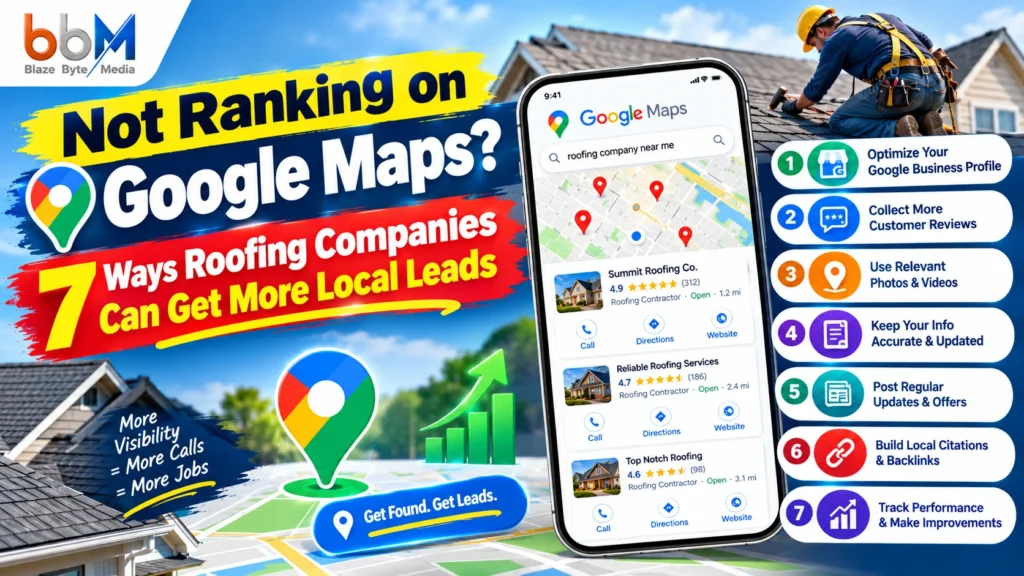
Introduction
A homeowner wakes up to a water stain on the ceiling. They grab their phone, type “roofer near me,” and call one of the first three businesses on the map. If you are not in those three spots, that job never reaches you. You will never know it existed.
That is why “My competitor ranks above me and his work isn’t even better” is one of the most common complaints roofing owners share. You may be paying for ads that stop the second you stop paying. You may have a decent website that nobody visits. You may have a Google listing that sits on page two of the map results, collecting dust.
The good news is that Google Maps ranking is not random. It follows clear signals, and most roofing companies lose ground because of a handful of fixable mistakes: the wrong business category, a thin profile, too few recent reviews, no city-specific pages, and inconsistent business details across the web.
This guide gives you 7 practical fixes, a 30-day plan, and a way to measure what is working. You do not need to be technical. You need to be consistent.
Why Your Roofing Company Isn’t Showing Up on Google Maps
Short answer: Google decides local rankings using three factors: relevance, distance, and prominence. Most roofers who struggle have a weakness in one or more of these, and the fix is usually in their profile, reviews, or website content rather than in a bigger ad budget.
How Google Maps Ranks Roofing Companies
Short answer: Google says local results are based mainly on relevance (how well your listing matches the search), distance (how close you are to the searcher or the location they typed), and prominence (how well known and trusted your business appears). You can influence relevance and prominence directly. Distance you can only work around.
Here is what each factor means for a roofer:
- Relevance: Does your profile clearly say you do roof repair, roof replacement, storm damage, or whatever the person searched for? Your categories, services, description, and website content all feed this.
- Distance: How far is your business location from the searcher? A roofer with an address downtown will often beat one in the suburbs for a downtown search. This is the factor you can’t fully control.
- Prominence: Reviews, ratings, mentions across the web, links to your site, and your overall brand presence all play a part.
Featured snippet answer: To rank higher on Google Maps, a roofing company should choose the right primary category, complete every Google Business Profile field, collect fresh reviews steadily, build city-specific service pages, keep business details consistent across directories, and earn local links. Google ranks local results by relevance, distance, and prominence.
The Frustrations Roofers Tell Us Again and Again
Short answer: Most roofing owners feel stuck in the same few situations. Recognizing yours helps you pick the right fix first.
- “I’m in the top three when I search from my office, but not from a customer’s street.” (Local rankings change by searcher location.)
- “My competitor has fewer years in business and still outranks me.”
- “I’ve got great work and happy customers, but my profile looks empty.”
- “I stopped paying my last agency and everything dropped.”
- “I get calls, but they’re price shoppers from outside my area.”
There is also an emotional layer. Roofing is a high-trust, high-ticket purchase, and slow seasons are stressful. When your phone is quiet, it feels personal. It usually isn’t. It is usually a visibility problem with a checklist behind it.
A Quick Self-Audit
Short answer: Before you change anything, spend 15 minutes checking where you stand. This tells you which of the 7 fixes to start with.
| Check | What to look for | If it fails, go to |
|---|---|---|
| Primary category | Is it a roofing-related category, not something generic? | Way 1 |
| Profile completeness | Services, description, hours, photos, website, phone all filled? | Way 1 |
| Service area | Are your actual cities listed, not a vague region? | Way 2 |
| Review recency | Any new reviews in the last 30 days? | Way 3 |
| Website pages | A page for each main service and each key city? | Way 4 |
| Business details | Name, address, phone identical across directories? | Way 5 |
| Activity | Recent photos or posts? | Way 6 |
| Backlinks | Any local sites linking to you? | Way 7 |
Be honest as you go through it. Most roofers fail four or five rows, and that is normal.
Way 1: Choose the Right Categories and Fill Out Every Profile Field
Short answer: Your primary category is one of the strongest relevance signals on your Google Business Profile. Pick the one that matches your main revenue source, add secondary categories for other services you actually offer, and complete every field Google gives you.
Step 1: Set Your Primary Category
The most common category for roofers is “Roofing contractor.” For most companies that is the right primary choice. Resist the urge to pick a trendier or more specific category as your primary unless it truly is your main business.
Add secondary categories only for services you genuinely perform. Google’s category list changes over time, so open your profile and browse the current options. Choose ones that describe real services, such as roof inspection or metal roofing, where they apply to you.
A mistake we see often: owners add every category they can find. That dilutes your focus and can make your profile look less relevant for your core search, which is “roofer.”
Step 2: Add Services With Real Descriptions
Google lets you list services. Do not leave this blank. Add each service you offer, such as:
- Roof repair
- Roof replacement
- Storm and hail damage repair
- Roof inspection
- Leak repair
- Gutter installation (if you do it)
- Commercial flat roofing (if you do it)
Write a short, plain-English description for each. Say what the service includes and who it is for. Use the same words a homeowner would use, like “leaking roof” and “missing shingles,” not just industry terms.
Step 3: Write a Description That Sounds Like You
Your business description should state who you are, what you do, and where you work in the first two sentences. Include your main city and top services naturally. Mention licensing or insurance if it is real and verifiable. Skip exaggerated claims like “the best roofer in town.”
Example structure:
- One sentence: who you are and where you work.
- One sentence: your main services.
- One sentence: what makes you different (for example, free written estimates, a workmanship warranty you actually offer, or family ownership).
Step 4: Complete the Small Fields
These small details add up:
- Accurate business hours, including emergency availability if you offer it
- A local phone number (a number with a local area code usually reads as more trustworthy than a toll-free one)
- Your website link pointing to a relevant page
- Attributes that apply to you
- Opening date
Quick win: Set your profile’s website link to a page that clearly matches the profile. For a single-location company, that is often your homepage. For a multi-location company, link each profile to its own location page.
Way 2: Set Up Your Service Area Correctly
Short answer: Roofers travel to customers, so you are a service-area business in Google’s eyes. List the real cities and zip codes you serve, hide your address if customers do not visit you, and never create a fake address to appear closer.
Understand What Google Expects
If customers do not come to your office, Google’s guidelines allow you to hide your street address and show only your service area. Many roofers run their business from a home office or a yard. Hiding that address protects your privacy and keeps you compliant.
If you do have a real storefront or office where customers can walk in during stated hours, you can show the address.
Choose Your Service Areas Wisely
Be specific. List the cities and towns you actually serve and want work in. Listing an entire state or a huge radius does not make you rank everywhere. It tends to make your profile look less focused, and you are unlikely to rank far from your actual location anyway.
A practical approach:
- List your top five to ten core cities.
- Rank them by profitability, not just population.
- Include neighboring areas only if you will really send crews there.
The Distance Problem and How to Work Around It
If your office sits in a small town but your best customers live in the larger city 20 miles away, you will struggle to win the map pack in that city. Google favors businesses closer to the searcher.
You cannot fix this by faking a location. Virtual offices, mailbox addresses, and made-up locations violate Google’s guidelines and can lead to suspension. Here is what you can do instead:
- Build strong location pages on your website for the bigger city (see Way 4).
- Earn reviews that mention that city.
- Get local links from organizations in that area.
- Run paid ads or Local Services Ads for that area while your organic presence grows.
- If you truly open a second location with a staffed office, create a separate profile for it according to Google’s rules.
Way 3: Build a Review System That Runs Without You
Short answer: Reviews are a major prominence signal and a major trust signal for homeowners. A steady flow of recent, detailed, genuine reviews beats a burst of old ones. Ask every satisfied customer, make it easy, reply to every review, and never fake or buy them.
Why Roofers Struggle With Reviews
Here are the objections we hear:
- “I forget to ask.”
- “My crew doesn’t want to bother customers.”
- “I don’t want to look needy.”
- “A competitor got a bad review from someone who was never a customer.”
All valid. All solvable with a simple system.
The 4-Step Review Framework
Step 1: Create your direct review link. Your Google Business Profile has a shareable link that opens the review box directly. Shorten it or turn it into a QR code.
Step 2: Pick your ask moments. The best time to ask is right after a job is complete and the customer is visibly happy. Build the ask into your process:
- The project manager asks in person at the final walkthrough.
- A text message goes out the same day with the link.
- An email follow-up goes out two or three days later as a gentle reminder.
Step 3: Give customers an easy script. Many people want to help but do not know what to write. Offer light guidance without writing it for them:
“If you’re happy with the work, it would really help if you mentioned what we did, like a roof replacement, and the city you’re in. Honest details help other homeowners.”
Do not provide scripted reviews or ask people to post specific text. Google’s policies prohibit fake or manipulated reviews.
Step 4: Respond to every review. Reply to positive reviews with a personal thank-you. Reply to negative reviews calmly, professionally, and without arguing. Prospective customers read your replies, and a thoughtful response to criticism often builds more trust than silence.
What Makes a Review Valuable
| Review type | Why it helps |
|---|---|
| Mentions the service (for example, “roof replacement”) | Reinforces relevance |
| Mentions the city or neighborhood | Supports local relevance |
| Describes the experience (communication, cleanup, timeline) | Builds trust with readers |
| Recent date | Shows you are active now |
| Includes photos | Adds authenticity |
What Not to Do
- Do not offer money, discounts, or gifts in exchange for reviews. Google prohibits incentivized reviews.
- Do not “gate” reviews by only asking happy customers to post publicly while sending unhappy ones to a private form. Ask everyone the same way.
- Do not buy reviews or ask friends and family to post fake ones.
- Do not ignore negative reviews. Respond, and if one violates Google’s policies (a fake review, for instance), flag it for removal.
How Many Reviews Do You Need?
There is no magic number, and I won’t invent one. The better benchmark is relative: look at the top three roofers in your market and compare your review count, average rating, and how recent their latest reviews are. Your goal is to match or beat that pace, consistently.
Way 4: Create City and Service Pages That Match Local Searches
Short answer: Your Google Business Profile points to your website, and your website helps prove you are relevant. Build a dedicated page for each core service and each key city, with unique, useful content on each, so Google and customers see exactly what you do and where.
Why Most Roofing Websites Fall Short
A typical roofing website has a homepage, an “about” page, a “services” page with everything crammed into it, and a contact form. That gives Google little to work with. Someone searching “roof repair in [your city]” wants a page about exactly that.
The Page Structure That Works
Build these pages:
- A page for each main service: roof repair, roof replacement, storm damage, inspections, and any specialty such as metal or flat roofing.
- A page for each core city or area: “Roofing in [City].”
- Optional combined pages for high-value searches: for example, “Roof Replacement in [City],” if the city is large and the service is a top earner.
What Goes on a Strong Local Page
Do not just swap the city name on a template. Google can recognize thin, duplicated pages, and customers can too. Each page should include:
- A clear answer at the top: what you do and where.
- Details specific to that area, such as common roof types, local weather issues (hail, heavy rain, snow, heat), and building code or permit notes where you know them.
- Real project photos from that area, with descriptive file names and alt text.
- Genuine customer testimonials from that city, if you have them and have permission.
- Your service process in simple steps.
- A visible phone number and clear call to action.
- A short FAQ addressing local concerns.
A Simple Page Template
| Section | Purpose |
|---|---|
| Headline with service and city | Matches the search |
| Two-sentence summary | Gives a direct answer |
| Services offered in that city | Supports relevance |
| Local project examples | Builds proof |
| Process steps | Reduces anxiety about hiring |
| Reviews or testimonials | Builds trust |
| FAQ | Captures question-based searches |
| Call to action | Drives the lead |
Technical Basics Roofers Often Skip
- Make sure the site loads fast on mobile, since many searches come from phones.
- Make click-to-call buttons obvious.
- Use LocalBusiness-type structured data (schema) that matches your information. The schema.org type “RoofingContractor” exists for this.
- Embed your Google Map on your contact or location page.
- Link between your service pages and city pages so Google understands how they relate.
Way 5: Clean Up Your Citations and Business Details
Short answer: A citation is any mention of your business name, address, and phone number (often called NAP) on another site. Keep them identical everywhere, fix outdated listings, and focus on the directories that matter to home services.
Why Inconsistency Hurts
Imagine your business appears as “Smith Roofing LLC” on one site, “Smith Roofing & Construction” on another, and uses an old phone number on a third. Google has to guess which is right. The more conflicting information it finds, the less confident it is about your listing, and confidence feeds prominence.
Step-by-Step Citation Cleanup
- Decide your exact business details. Use your legal or commonly used business name exactly as it appears in the real world. Do not add keywords to your Google profile name. That violates Google’s guidelines.
- Search for your business by name, phone number, and old addresses to find existing listings.
- Fix or claim the main ones first: Google, Apple Maps, Bing Places, Facebook, Yelp, and the Better Business Bureau if you are listed there.
- Add industry-relevant directories: home service platforms, roofing manufacturer contractor locators (if you are certified), and trade associations you belong to.
- Add local directories: your chamber of commerce and city or county business listings.
- Remove or merge duplicates. Duplicate listings split your signals and confuse customers.
- Keep a spreadsheet with each site, login, and last-checked date.
Quality Over Quantity
Dozens of low-quality directories will not help much. A smaller number of accurate, relevant listings is better. Prioritize places real homeowners use and places that reflect real affiliations, such as manufacturer certifications and local associations.
Way 6: Stay Active With Photos, Posts, and Updates
Short answer: An active profile signals a real, operating business and gives customers more reasons to call. Upload real project photos regularly, post updates about completed work and seasonal tips, and keep your information current.
Photos That Actually Help
Roofing is visual. People want proof you do clean, careful work. Upload:
- Before and after shots of real jobs
- Crew photos and branded vehicles
- Close-ups of materials and installation details
- Finished roofs from a distance and up close
- Your team with safety gear
A tip: do not rely on hidden location data in photo files as a ranking trick. There is no reliable evidence that it moves rankings, and many platforms strip it anyway. Spend your time on clear, honest photos with proper context instead.
Avoid stock photos. Customers and Google both respond better to authentic images.
What to Post
Google Business Profile posts are a low-effort way to show activity. Post about:
- Completed projects in a specific neighborhood
- Seasonal reminders, such as checking your roof before storm season
- Offers you genuinely run, such as free inspections
- Team news, certifications, or community involvement
- Short educational tips (how to spot hail damage, what a flashing leak looks like)
Keep posts short and clear, with a button to call or learn more.
Keep Everything Current
- Update holiday hours.
- Update services when you add or drop them.
- Respond to any questions or messages promptly if those features are available to you.
- Check your profile monthly for unauthorized edits. Competitors and bots can suggest changes.
Way 7: Earn Local Links and Real-World Recognition
Short answer: Links from respected local websites tell Google your business is established in the community. Earn them through sponsorships, partnerships, associations, and local press instead of buying them in bulk.
Why Links Matter for Local Search
Prominence includes how well known your business is across the web. When local sites, organizations, and publications mention and link to you, it supports that picture. It also sends real referral traffic.
Practical Local Link Ideas for Roofers
| Opportunity | How to do it |
|---|---|
| Local sponsorships | Sponsor a youth sports team, school event, or charity run, and ask for a website mention |
| Supplier and manufacturer pages | If you are a certified installer, make sure you are listed on their contractor finder |
| Trade and business associations | Join and complete your member profile with a link |
| Chamber of commerce | Create a full member listing |
| Local news | Offer expert tips after storms, such as what homeowners should check |
| Community partnerships | Partner with realtors, home inspectors, insurance agents, or property managers for resource pages |
| Charity work | Offer a free roof for a local family in need and share the story, if this is something you really do |
What to Avoid
Do not buy links from sellers who promise hundreds for a small fee. Links from irrelevant or spammy sites can hurt more than help. One link from a trusted local organization is worth more than many from random directories.
Your 30-Day Google Maps Action Plan
Short answer: You can make meaningful progress in 30 days by working in order: audit and fix the profile first, then reviews, then website pages, then citations and links. Small weekly tasks beat one big push.
| Week | Focus | Tasks |
|---|---|---|
| Week 1 | Profile foundation | Audit categories, services, description, hours, service area. Fix any mistakes. Upload at least ten real photos. |
| Week 2 | Reviews | Create your review link and QR code. Set up text and email follow-ups. Train your crew leads on the ask. Reply to all existing reviews. |
| Week 3 | Website | Build or improve your top two service pages and your top two city pages. Add schema and embed your map. |
| Week 4 | Citations and links | Fix inconsistent listings. Claim missing profiles. Reach out to two or three local organizations for links. Publish your first profile post. |
After week four, shift into maintenance mode: ask for reviews weekly, post twice a month, add a new city or service page monthly, and audit your listings quarterly.
Mistakes That Can Get Your Listing Suspended or Hurt Rankings
Short answer: The fastest way to lose Map visibility is to break Google’s rules. Avoid keyword-stuffed business names, fake addresses, fake reviews, and duplicate listings.
- Adding keywords to your business name. Your profile name should match your real-world business name. “Smith Roofing – Best Roofer Dallas” is a risk.
- Using a fake or virtual address. Mailbox stores and shared virtual offices do not qualify as real locations.
- Creating multiple profiles for the same business. One business location, one profile.
- Buying or faking reviews. Google can remove them and penalize your listing.
- Offering incentives for reviews. Discounts or gifts in exchange for reviews violate policy.
- Letting a former agency or employee keep ownership. Make sure you are the primary owner of your profile.
- Ignoring suggested edits. If someone changes your phone number or hours, you could lose calls without noticing.
- Changing your name, address, or categories repeatedly. Frequent major changes can trigger re-verification or temporary ranking disruption.
Ownership tip: Always keep primary ownership of your Google Business Profile, your website domain, and your analytics. If an agency works for you, they should be added as managers, not owners. If you ever part ways, you keep your assets.
How to Track Whether It’s Working
Short answer: Measure calls, direction requests, website clicks, and booked inspections, not just rankings. Rankings shift depending on where the searcher is standing, so business results are the better scorecard.
What to Measure
- Google Business Profile insights: calls, website clicks, direction requests, and how people found you.
- Call tracking: use a tracking number carefully, with your main number listed as a secondary number so your NAP stays consistent. Ask a professional how to set this up.
- Lead quality: track how many calls become estimates, and how many estimates become jobs.
- Review pace: how many new reviews per month, and your average rating.
- Local rank grids: many local SEO tools show your ranking across a grid of points on the map. This reveals where you rank well and where you disappear.
- Google Search Console: see which searches bring people to your site.
Ask Every New Customer One Question
“How did you find us?” Write down every answer. It is the cheapest and most honest data you can collect, and it helps you see which channel really brings the work.
Be Patient and Realistic
Local SEO is not instant. Some changes, such as fixing a category, can show results quickly. Others, such as building reviews and links, take months. No one can ethically promise a specific ranking or timeline. Be wary of any provider who does.
Conclusion
Ranking on Google Maps is not luck, and it is not reserved for the biggest roofing company in town. It rewards clarity, consistency, and trust. Choose the right categories, define your real service area, collect honest reviews every week, build useful pages for your key cities and services, keep your details consistent across the web, stay active, and earn local recognition.
If you are not ranking on Google Maps today, pick the weakest row from your self-audit and fix that first. Then move to the next. Each improvement makes your profile more relevant, more prominent, and easier for a homeowner with a leaking roof to choose.
Do not wait for the next storm to find out where you stand. Check your listing this week.
7. FAQ Section
1. Why is my roofing company not showing up on Google Maps?
Common causes include the wrong primary category, an unverified or incomplete profile, too few recent reviews, a weak website, inconsistent business details online, or competitors being closer to the searcher. Start with a profile audit.
2. How long does it take to rank in the Google Maps local pack?
It depends on competition, your starting point, and how consistently you work. Some fixes, like categories and profile completion, can help sooner. Reviews, content, and links usually take months. Nobody can guarantee a timeline.
3. What is the Google Maps local pack?
It is the group of three business listings with a map that appears for local searches such as “roofer near me.” These listings get a large share of attention from local searchers.
4. How do I rank higher on Google Maps for roofing?
Optimize your categories and services, define your service area, earn steady reviews, publish city and service pages, keep citations consistent, post fresh content, and earn local links.
5. What is the best primary category for a roofing company?
For most roofers, “Roofing contractor” is the best fit. Choose the category that matches your main revenue source, and add secondary ones only for services you truly provide.
6. Do reviews really affect Google Maps ranking?
Reviews are part of prominence and strongly influence customer trust. Quantity, quality, recency, and your responses all matter, so a steady flow is better than a one-time push.
7. How many reviews does a roofing company need to rank?
There is no fixed number. Compare yourself with the top three roofers in your area and aim to match or exceed their review volume, rating, and recency.
8. Can I hide my address on Google Business Profile as a roofer?
Yes, if customers do not visit your location, you can set up as a service-area business and hide your address. Follow Google’s guidelines for how to do this.
9. Can I rank in a city where I don’t have an office?
It is harder, because distance matters. You can improve your chances with city-specific pages, local reviews, local links, and ads, but you should not create a fake address.
10. Should I put keywords in my Google Business Profile name?
No. Your name should reflect your real business name. Adding keywords violates Google’s guidelines and can lead to suspension.
11. How often should I post on my Google Business Profile?
There is no official requirement. Posting a couple of times a month about real projects, offers, and tips is a realistic, sustainable pace.
12. Do photos help my roofing profile rank?
Photos help customers trust you and show your profile is active. Use real project photos and avoid stock images. Do not rely on hidden metadata tricks.
13. What are citations in local SEO?
Citations are mentions of your business name, address, and phone number on other websites and directories. Consistency across them helps Google trust your information.
14. Do I need a website to rank on Google Maps?
You can have a profile without one, but a strong website with service and city pages supports your relevance and gives customers more reasons to contact you.
15. How many service area cities should I list?
Focus on the real cities you serve and want work in, often five to ten core areas. Listing too many can dilute your focus.
16. How do I handle a fake or unfair negative review?
Flag it through your profile if it violates Google’s policies, and post a calm, factual public reply. Do not argue or retaliate.
17. Is it okay to offer a discount for leaving a review?
No. Google prohibits incentivized reviews. Ask every customer politely and make the process easy instead.
18. Why do my rankings change depending on where I search from?
Google personalizes local results by the searcher’s location. That is why a rank grid tool gives a more accurate picture than checking from your office.
19. Are Local Services Ads better than Google Maps SEO for roofers?
They serve different purposes. Ads can bring leads faster but stop when you stop paying. Map SEO builds longer-term visibility. Many roofers use both.
20. Should I hire an agency for roofing local SEO?
It can help if you lack time or expertise. Choose one that is transparent, avoids guaranteed rankings, and lets you keep ownership of your profile, website, and accounts.
Call to Action
Not sure which of these 7 fixes will move the needle for your roofing company?
At Blazebyte Media, we help roofing companies get found on Google Maps and turn that visibility into booked estimates. Request a free local visibility review, and we’ll look at your profile, reviews, and website, then show you the three changes most likely to bring you more local leads. No pressure, no jargon, and you keep ownership of everything we touch.