
Introduction
Type a question into Google today and there’s a good chance you’ll never leave the results page. An AI Overview answers it. A featured snippet answers it. A knowledge panel answers it. This is zero-click search, and it now touches the majority of searches on Google.
For years, “getting the click” was the entire SEO game. Rank higher, earn the visit, convert the visitor. That model still works for plenty of searches, but it no longer describes what happens most of the time. Search engines have shifted from routing traffic to answering questions directly, and marketers who only measure clicks are missing most of the story.
This guide breaks down what zero-click search actually is, why it’s accelerating, and what it means for your traffic reports. More importantly, it lays out a concrete framework for winning visibility, brand trust, and even revenue in a search landscape where the click is no longer guaranteed. You’ll learn which queries are still worth chasing for clicks, which ones deserve a different strategy entirely, and how to structure content so search engines and AI platforms want to feature it.
What Is Zero-Click Search?
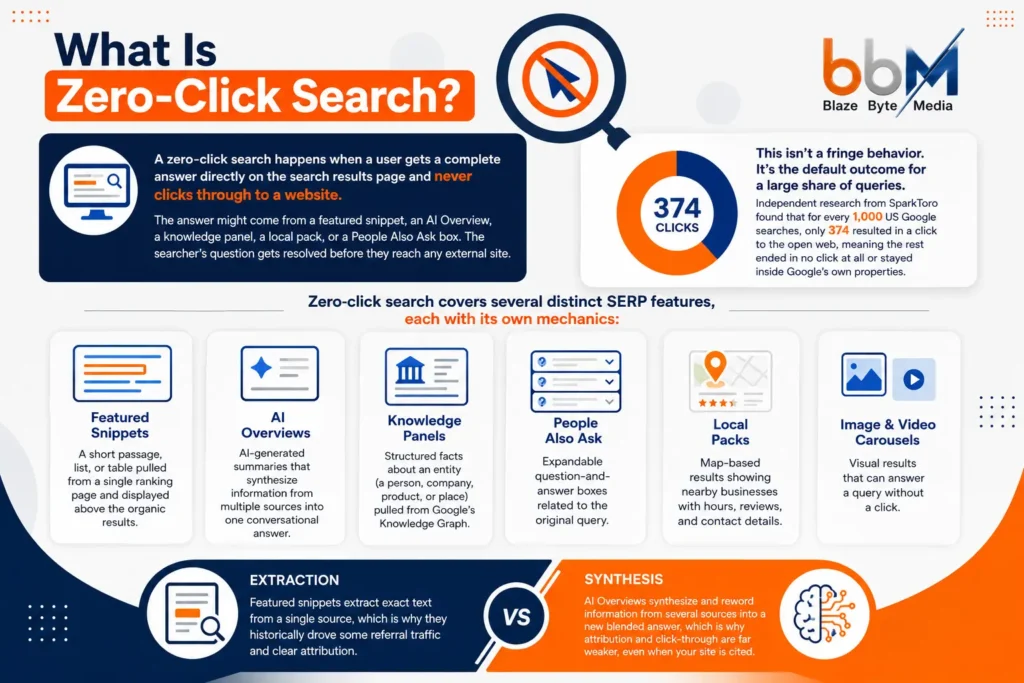
A zero-click search happens when a user gets a complete answer directly on the search results page and never clicks through to a website. The answer might come from a featured snippet, an AI Overview, a knowledge panel, a local pack, or a People Also Ask box. The searcher’s question gets resolved before they reach any external site.
This isn’t a fringe behavior. It’s the default outcome for a large share of queries. Independent research from SparkToro found that for every 1,000 US Google searches, only 374 resulted in a click to the open web, meaning the rest ended in no click at all or stayed inside Google’s own properties.
Zero-click search covers several distinct SERP features, each with its own mechanics:
- Featured snippets: a short passage, list, or table pulled from a single ranking page and displayed above the organic results
- AI Overviews: AI-generated summaries that synthesize information from multiple sources into one conversational answer
- Knowledge panels: structured facts about an entity (a person, company, product, or place) pulled from Google’s Knowledge Graph
- People Also Ask (PAA): expandable question-and-answer boxes related to the original query
- Local packs: map-based results showing nearby businesses with hours, reviews, and contact details
- Image and video carousels: visual results that can answer a query without a click
The distinction that matters most for strategy is between extraction and synthesis. Featured snippets extract exact text from a single source, which is why they historically drove some referral traffic and clear attribution. AI Overviews synthesize and reword information from several sources into a new blended answer, which is why attribution and click-through are far weaker, even when your site is cited.
Why Zero-Click Search Is Growing So Fast
Zero-click search is accelerating because Google and AI platforms have shifted from being an index of links to being an answer engine, and that shift is now backed by hard usage data. Multiple independent studies converge on the same conclusion: the era of ten blue links is over.
Here’s what the data shows:
| Source | Finding |
|---|---|
| SparkToro (2024) | 58.5% of US Google searches ended without a click to any website |
| Bain & Company (Bain–Dynata survey) | About 80% of consumers rely on zero-click results in at least 40% of their searches; organic traffic down an estimated 15% to 25% |
| Pew Research | Users are less likely to click a traditional result link when an AI summary appears in the results |
| Semrush | AI Overviews were triggered in 13.14% of tracked US queries by March 2025, up from 6.49% in January 2025 |
A few forces are driving this together. First, AI Overviews and generative summaries can now handle complex, multi-part questions that used to require reading several articles, so the search engine simply does that synthesis for the user. Second, search engines have a structural incentive to keep users inside their own results pages, where they control the experience and the ad inventory. Third, LLM-based tools like ChatGPT, Perplexity, and Gemini are increasingly used as search substitutes. Bain’s research found that ChatGPT saw a 44% traffic jump in a single month in late 2024, and that a substantial share of LLM users now go to these tools for research, news, and shopping recommendations that used to start with a Google search.
The practical result: impressions can rise while clicks fall. Search Engine Land highlighted Google Search Console data from a real site where impressions more than doubled over roughly a year while click-through rate dropped from around 1.5% to under 0.5%. Your content is being seen and used. It’s just not always being visited.
The Anatomy of a Zero-Click SERP
A modern search results page can contain five or six distinct zero-click features stacked above the organic listings, and each one behaves differently for SEO purposes. Understanding which feature you’re competing for changes how you write and structure content.
Featured snippets
Featured snippets pull a single passage, numbered list, or table from one page and display it in “position zero.” They still typically cite the source with a clickable link, which makes them the most click-friendly zero-click feature. They favor content with a clear “X is…” definition structure, ordered steps for how-to queries, or a clean comparison table.
AI Overviews
AI Overviews blend information from multiple sources into a single generated paragraph. Unlike snippets, they don’t display your exact wording, and the citation links included often generate far less traffic than a snippet would. They tend to appear for complex, multi-part informational queries where the searcher wants a synthesized answer rather than a single source.
Knowledge panels
Knowledge panels summarize an entity, such as a brand, person, or place, using structured data from Google’s Knowledge Graph and verified sources. They matter most for branded search, reputation management, and entity trust rather than for driving traffic on a specific keyword.
People Also Ask
PAA boxes show a stack of related questions that expand into short answers when clicked. Search Engine Land’s analysis found PAA boxes appear in a large majority of search results, making them one of the most common zero-click surfaces to target with FAQ-style content.
Local packs
Local packs show the top three nearby businesses with a map, hours, and reviews, all without requiring a click to any website. For local service businesses, this has effectively become the primary digital storefront, and winning it depends more on Google Business Profile optimization and review signals than on traditional on-page SEO.
Image, video, and shopping carousels
These visual formats can fully satisfy a query, particularly for product discovery and how-to content, without a single click to a retailer or publisher site.
Is Zero-Click Search Actually Bad for Your Business?
Zero-click search is not automatically bad for your business; it changes where value gets created, and the right response depends on what a specific query was ever supposed to accomplish for you. A drop in clicks on an informational blog post that never converted directly isn’t the same problem as a drop in clicks on a commercial landing page that used to drive leads.
There’s a real trade-off. Bain’s research frames it plainly: winning a citation in an AI Overview for a high-value query can mean traffic to that page drops even as your brand becomes the default answer for thousands of searches. By a traditional traffic report, that looks like a loss. In terms of brand exposure and downstream trust, it can be a win.
There’s also a quality shift worth noting. Search Engine Land points to research suggesting that people who do click through after seeing an AI-generated summary tend to be further along in their decision process. They already have context, so the resulting site visit may convert at a higher rate even if there are fewer of them overall.
The businesses most exposed to zero-click declines are typically ad-supported publishers and sites that monetize purely through pageviews. The businesses with the most to gain from playing the visibility game well are those where brand recall, consideration, and trust matter before a purchase decision, which describes most B2B, service, and considered-purchase B2C companies.
When to Chase the Click vs. When to Chase Visibility
Not every query deserves the same strategy, and treating a definition query the same as a comparison-shopping query wastes effort on both. The most useful diagnostic isn’t “did clicks go down,” it’s “what was this query ever supposed to do for the business.”
| Query type | Primary goal | What to do |
|---|---|---|
| Commercial, comparison, pricing, or complex problem query | Earn the click | Sharpen page intent, titles, meta descriptions, internal links, and proof points near claims |
| Definition, quick fact, or simple how-to query | Earn visibility and entity association | Write a concise, extractable answer and link it to a deeper resource |
| AI Overview query with citations | Earn the citation and a qualified downstream visit | Put evidence and specifics close to claims; write source-backed, self-contained passages |
| Local or “near me” query | Drive action without a site visit | Strengthen Google Business Profile data, reviews, and location pages |
| High impressions, falling CTR | Diagnose the SERP layout change | Compare current SERP composition to historical CTR and rewrite for the click intent that remains |
| Branded or category comparison query | Influence the shortlist | Build entity signals, third-party proof, and consistent presence across trusted sources |
This is the single highest-leverage exercise for any zero-click strategy: sort your existing keyword list into these buckets before deciding how to rewrite or restructure a page. A page trying to do all six jobs at once usually does none of them well.
How to Format Content for Extraction
Content formatted for extraction gives search engines and AI systems a self-contained, unambiguous answer they can lift and use, which increases your odds of being the cited source rather than an invisible input. This is the mechanical core of zero-click optimization, and it’s learnable.
Key formatting practices:
- Lead with a 40 to 60 word answer. Open each major section with a direct, complete answer to the implied question before adding supporting detail. This is the exact length window that tends to get pulled into featured snippets and cited in AI-generated answers.
- Use question-based headings. Match your H2s and H3s to how people actually phrase the query, ideally pulled from your own Search Console data or People Also Ask boxes.
- Write definitional openers. For “what is X” style sections, start with “X is…” followed by a clear, standalone definition.
- Structure for scannability. Use bullet points, numbered steps, and comparison tables instead of dense paragraphs wherever the content is genuinely list-like or comparative.
- Make each section stand alone. Because AI systems often extract a single paragraph out of context, that paragraph needs to make sense without the rest of the article around it.
- Include specific facts and numbers. Vague claims get skipped. Concrete data points, named sources, and precise figures are what AI-generated answers tend to quote or paraphrase.
Featured snippet-style answer: Zero-click search happens when a user’s query is fully answered on the search results page, through a featured snippet, AI Overview, knowledge panel, or similar feature, without requiring a click to any website. It now accounts for the majority of Google searches.
Building the Topical Authority AI Systems Trust
AI systems and search engines favor sources that consistently demonstrate real expertise on a topic, which means the old strategy of writing isolated, keyword-targeted pages is being replaced by building genuinely interconnected topic coverage. This is where E-E-A-T (experience, expertise, authoritativeness, trustworthiness) stops being an abstract Google concept and becomes a practical content requirement.
What actually moves the needle:
- First-party data and original research. Independent surveys, product usage data, or original analysis give AI systems something no competitor can reproduce, which makes your content more likely to be cited rather than paraphrased away.
- Named experts and real credentials. Quotes and bylines from people with demonstrable experience in the subject signal real-world expertise, not just content assembled to rank.
- Topic clusters, not isolated posts. Interconnected content that answers every reasonable question within a topic, linked together clearly, builds the kind of comprehensive coverage that both traditional rankings and AI citation favor.
- Freshness on cornerstone content. Content that gets reviewed and updated on a regular cadence, with refreshed statistics and examples, tends to get preferentially selected for time-sensitive AI Overviews and snippets.
- Consistency across your broader digital footprint. LinkedIn, YouTube, review platforms, and guest content should reinforce the same expertise signals as your owned site, since AI systems draw on the whole web, not just your domain.
Never fabricate statistics, studies, or customer results to manufacture this kind of authority. If you don’t have first-party data yet, say so honestly and lean on properly cited third-party research instead. Fabricated “proof” is both an E-E-A-T risk and a trust risk the moment anyone checks your sources.
Schema Markup for Zero-Click Visibility
Schema markup doesn’t guarantee a featured snippet or AI Overview placement, but it gives search engines and AI crawlers an unambiguous, machine-readable version of your content that reduces the odds of misinterpretation. Google itself has stated there’s no special markup required specifically for AI Overviews, but structured data still reinforces how your content maps to real-world entities and answers.
Three schema types are the most practical starting point:
- FAQPage schema: apply to genuine Q&A content, even outside a formal FAQ section, to increase the odds of appearing in People Also Ask and AI-generated answer boxes.
- HowTo schema: apply to genuine step-by-step processes, with one clear instruction per step, to support featured snippets and AI-generated step lists.
- LocalBusiness schema: apply to location and contact pages to strengthen knowledge panel and local pack eligibility, especially for multi-location businesses.
A practical rule: only mark up content that’s genuinely structured that way on the visible page. Schema that doesn’t match what a user actually sees is a common technical SEO mistake and can undermine trust signals rather than build them.
Optimizing for Voice and Conversational Search
Voice search and conversational AI queries use full, natural sentences instead of clipped keywords, so content written for voice and AI conversational contexts needs to sound like a person talking, not a keyword list. Someone typing might search “marketing attribution tools.” Someone speaking to an assistant is more likely to ask, “what’s the best way to track marketing attribution across channels?”
Practical adjustments:
- Write in short, single-idea sentences. Avoid stacking multiple clauses with “and,” “but,” or “because.” Spoken answers need to sound natural when read aloud by a voice assistant.
- Anticipate follow-up questions. Voice and conversational queries often come in sequences, so structure content to flow logically from one related question to the next.
- Use natural conversational openers. Phrases like “where to find,” “who offers,” and “what’s the best” should appear where they occur naturally in your content, since these are common spoken query starters.
- Test it out loud. Reading your content aloud is a fast way to catch phrasing that would sound robotic coming from a voice assistant.
- Keep NAP data consistent for local voice queries. For “call [business]” or “find [service] near me” voice commands, consistent name, address, and phone data across your site and directories is what earns the citation.
New Metrics: How to Measure Success Beyond Clicks
Click-through rate alone can no longer tell you whether your SEO program is working, because a page can lose clicks while gaining massive visibility and brand exposure at the same time. Reporting needs a broader set of metrics that capture presence, not just traffic.
Metrics worth tracking alongside traditional CTR and organic traffic:
- Answer inclusion rate: how often your brand is mentioned or referenced in AI-generated responses to relevant queries
- SERP feature share: the percentage of your target keywords where you own a featured snippet, PAA answer, or similar feature
- Entity association strength: how clearly search engines and AI systems connect your brand to the specific topics you want to own
- Branded search growth: an increase in people searching for your brand name directly, often a downstream signal that zero-click visibility is building recognition
- Impressions vs. click-through rate split: tracking these separately in Search Console reveals whether a query is genuinely losing demand or simply changing how that demand shows up on the page
The practical shift for reporting: stop leading with sitewide click and traffic graphs. Filter your data to separate informational content, which rarely converts in-session anyway, from the commercial and service pages that actually drive revenue. A report that says “ten contact forms came in this week, and one was flagged as a $10,000 opportunity by sales” lands with stakeholders far better than a raw percentage change in clicks.
Connecting Zero-Click Visibility to Real Revenue
Zero-click visibility becomes a business metric, not just an SEO vanity metric, once you connect it to branded search growth, assisted conversions, and revenue data instead of stopping at impressions. This requires pulling in data sources beyond Search Console.
A practical measurement approach:
- Use Google Search Console to find the disconnect. Look for queries and pages where impressions or average position hold steady while clicks and CTR decline. That gap is where a SERP feature, not a ranking drop, is likely the cause.
- Add manual SERP notes for priority queries. Track whether an AI Overview, featured snippet, or local pack is present for your most important terms, since this context explains CTR shifts that raw ranking data can’t.
- Pull in GA4, CRM, and call-tracking data. A page can lose low-intent visits while preserving or even improving qualified lead volume. Only downstream data can confirm which is happening.
- Track assisted conversions and branded search lift. When broad informational content builds visibility, a common downstream effect is more people later searching for your brand by name or returning through a direct visit.
- Loop in sales. For B2B in particular, buyers often research quietly across AI tools and search before ever filling out a form. Ask sales teams whether prospects mention finding you through ChatGPT, an AI Overview, or a specific article.
Google itself confirms that traffic from AI features is folded into overall Search Console traffic rather than broken out separately, so treat any AI-specific traffic isolation in third-party tools as directional evidence, not a precise measurement.
Industry-Specific Zero-Click Strategies
Zero-click search doesn’t affect every business model the same way, so the right response depends heavily on whether your revenue comes from ad impressions, direct sales, leads, or local foot traffic.
- Ecommerce: Product and shopping carousels can showcase inventory directly in search, which is a net positive for discovery even without a click. Focus on structured product data, comparison-ready specs, and category pages that help AI systems recommend your specific SKUs.
- Local service businesses: Local packs have effectively replaced the website as the first touchpoint for many “near me” searches. Google Business Profile optimization, consistent NAP data, and review volume now matter as much as traditional on-page SEO.
- B2B and SaaS: Buyers research quietly across AI tools before ever contacting sales. Visibility inside AI-generated shortlists and comparison answers can influence a deal long before a lead form is filled out, so entity clarity and third-party proof matter more than click volume on early-funnel content.
- Publishers and ad-supported content: This is the segment most exposed to real revenue risk from zero-click search, since pageviews are the direct monetization unit. A strategic pivot toward newsletters, community, proprietary tools, or other owned-audience channels is often necessary rather than optional.
Common Zero-Click SEO Mistakes to Avoid
Most zero-click strategy failures come from treating visibility and clicks as the same goal, or from chasing every possible SERP feature regardless of whether it serves the business. Watch for these specific mistakes:
- Rewriting every page into short, thin answers, which can win a snippet while destroying the depth that made the page worth visiting in the first place
- Ignoring commercial and transactional pages because “zero-click is just for informational content,” when AI Overviews increasingly appear on commercial queries too
- Adding schema markup that doesn’t match the visible page content, which is a trust and technical SEO risk
- Reporting only sitewide click totals to stakeholders instead of separating informational content from revenue-driving pages
- Fabricating statistics, case studies, or reviews to appear more authoritative, which damages trust the moment it’s checked and undermines genuine E-E-A-T signals
- Assuming every keyword needs the same optimization approach instead of sorting queries by their actual business job
FAQ on Zero-Click Search
1. What is a zero-click search? A zero-click search is a query that gets fully answered on the search results page, through a featured snippet, AI Overview, knowledge panel, or similar feature, without the user clicking through to any website.
2. How common are zero-click searches? Research from SparkToro found that only 374 out of every 1,000 US Google searches resulted in a click to the open web, meaning the large majority ended without a click to an external site.
3. Are zero-click searches bad for SEO? Not automatically. They reduce clicks for some queries but can still build brand visibility, entity recognition, and downstream branded search demand, depending on the query and your business model.
4. What’s the difference between a featured snippet and an AI Overview? A featured snippet extracts exact text from a single ranking page. An AI Overview synthesizes and rewords information from multiple sources into one generated answer, which typically drives far less click-through even with a citation.
5. Why are AI Overviews reducing website traffic? AI Overviews answer complex, multi-part questions directly on the results page, so users often get everything they need without visiting the underlying sources, even when those sources are cited.
6. Can you still rank well and lose traffic at the same time? Yes. A page can hold its ranking position while a SERP feature above it, like an AI Overview or featured snippet, absorbs the click that used to go to the organic listing.
7. What should I measure instead of just clicks? Track answer inclusion rate, SERP feature share, entity association strength, branded search growth, and the gap between impressions and CTR in Search Console.
8. How do I optimize content for AI Overviews? Write concise, self-contained answers early in each section, use question-based headings, include specific facts and data, and structure information with lists and tables that are easy to extract.
9. What is the ideal length for a featured snippet answer? Roughly 40 to 60 words for the opening answer, followed by supporting detail and context afterward.
10. Does schema markup guarantee a featured snippet or AI Overview? No. Schema markup helps search engines and AI systems interpret your content correctly, but it does not guarantee placement in any specific SERP feature.
11. Which schema types matter most for zero-click visibility? FAQPage schema for Q&A content, HowTo schema for step-by-step processes, and LocalBusiness schema for location and contact information.
12. Do I need special markup to appear in Google’s AI Overviews? No. Google has stated there is no special structured data requirement specifically for appearing in AI Overviews or AI Mode.
13. How does zero-click search affect local businesses? Local packs let users see hours, reviews, directions, and contact options without visiting a website, making Google Business Profile optimization and review signals as important as traditional on-page SEO.
14. Should ecommerce sites worry about zero-click search? Product and shopping carousels can actually help ecommerce discovery even without a click, so the priority shifts toward structured, comparison-ready product data rather than away from SEO entirely.
15. How does zero-click search affect B2B companies? B2B buyers increasingly research using AI tools before contacting sales, so visibility in AI-generated comparisons and shortlists can influence deals long before a lead form is submitted.
16. What is answer engine optimization (AEO)? AEO is the practice of optimizing content specifically to earn visibility and citations in AI-generated answers, extending traditional SEO’s focus on rankings and clicks.
17. Is voice search the same as zero-click search? They overlap heavily. Voice assistants frequently pull answers from featured snippets and AI-generated responses, so optimizing for zero-click features also improves voice search visibility.
18. How should I write content for voice search? Use short, single-idea sentences, natural conversational phrasing, and definitional openers, and test your content by reading it aloud to check whether it sounds natural.
19. What content types are most resistant to zero-click decline? Original research, interactive tools, detailed guides, and proprietary frameworks tend to require a click for full value, unlike simple definitions or basic factual queries.
20. Should I stop creating short, definitional content since it doesn’t drive clicks? No. Short, extractable definitions can build visibility and entity association even without a click, which supports brand recognition and can drive later branded searches.
21. How do I know which of my keywords to optimize for clicks vs. visibility? Sort keywords by their actual business function: commercial and comparison queries generally deserve a click-focused strategy, while simple factual queries are often better suited to a visibility-focused approach.
22. What is entity optimization in SEO? Entity optimization is the practice of clearly connecting your brand and content to recognized concepts, people, places, and things in a search engine’s knowledge graph, often through consistent naming, internal linking, and structured data.
23. How does E-E-A-T relate to zero-click search? AI systems weigh experience, expertise, authoritativeness, and trustworthiness signals when choosing which sources to cite or synthesize, making E-E-A-T a practical requirement for zero-click visibility, not just a ranking factor.
24. Can I fabricate statistics or case studies to appear more authoritative? No. Fabricated data damages trust the moment it’s checked and undermines genuine authority signals; unavailable data should be stated honestly rather than invented.
25. How often should I update content for AI Overview visibility? There’s no universal cadence, but cornerstone content that gets reviewed and refreshed with current examples and data on a regular basis tends to be favored for time-sensitive SERP features.
26. What is the biggest reporting mistake in a zero-click world? Reporting only sitewide click and traffic totals to stakeholders, rather than separating informational content from the commercial and service pages that actually drive leads and revenue.
27. How can I tell if a traffic drop is due to a zero-click feature? Compare impressions and average ranking position against clicks and CTR in Search Console. If impressions and position hold steady while clicks fall, a SERP feature is a likely cause.
28. Does Google Search Console show AI Overview traffic separately? No. Google has confirmed that traffic associated with AI features is included in overall Search traffic in Search Console rather than broken out into its own category.
29. What’s the risk of only optimizing for zero-click visibility? Rewriting every page into short, thin answers can win a snippet or citation while removing the depth that made the page worth a full visit, hurting conversion on pages that should be earning clicks.
30. Is zero-click search a temporary trend? Available research points the other direction. AI Overview trigger rates and zero-click behavior have both increased over the tracked periods in the studies referenced above, suggesting this is a structural shift rather than a short-term fluctuation.
Zero-click search isn’t going away, and neither is the opportunity hiding inside it. If your content isn’t structured to win visibility in AI Overviews, featured snippets, and answer boxes, you’re leaving brand exposure on the table every single day. Start with the query audit in Section 5: sort your top keywords into click-focused and visibility-focused buckets, then rework your highest-value pages using the extraction formatting in Section 6. Small structural changes to your existing content are often enough to start earning citations you’re currently missing.
Note on sourcing: All statistics in this article are drawn from and attributed to the named public studies and reports (SparkToro, Bain & Company, Pew Research, Semrush, Search Engine Land, and Google’s own documentation). No data, case studies, or customer results have been invented for this piece.