
AI Overviews now appear on roughly 48% of Google searches, and organic click-through rates fall between 34% and 61% whenever one shows up above the results. If your traffic has been sliding while your rankings look fine, this is almost certainly why. The fix is not to abandon SEO; it is to add Answer Engine Optimization (AEO) so your brand becomes the source AI Overviews actually cite.
What Are AI Overviews, and Why Are They Taking Your Clicks?
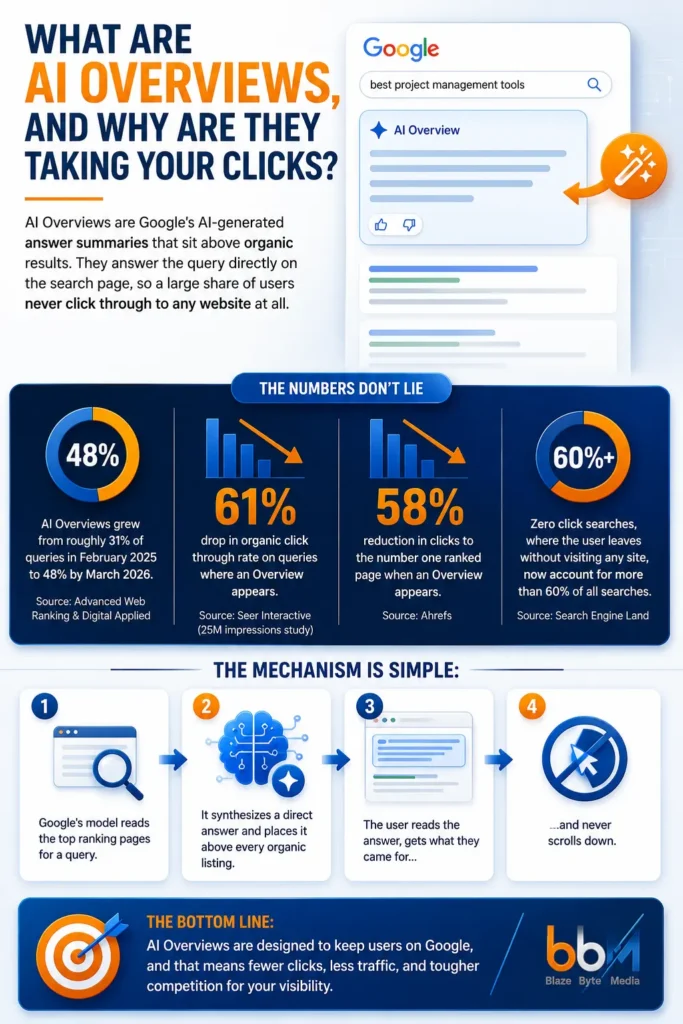
AI Overviews are Google’s AI-generated answer summaries that sit above organic results. They answer the query directly on the search page, so a large share of users never click through to any website at all.
According to research compiled by Advanced Web Ranking and Digital Applied, AI Overviews grew from roughly 31% of queries in February 2025 to 48% by March 2026. Seer Interactive’s study of 25 million impressions found organic click through rate drops 61% on queries where an Overview appears, and Ahrefs found the same effect cuts clicks to the number one ranked page by 58%.
The mechanism is simple:
- Google’s model reads the top ranking pages for a query.
- It synthesizes a direct answer and places it above every organic listing.
- The user reads the answer, gets what they came for, and never scrolls down.
- Search Engine Land reports zero click searches, where the user leaves without visiting any site, now account for more than 60% of all searches.
How Much Traffic Are AI Overviews Actually Costing You?
The damage concentrates on informational content. Transactional and product pages are largely protected, so the size of your loss depends on what kind of content makes up your site.
| Metric | Reported Impact | Source |
|---|---|---|
| CTR drop when an AI Overview appears | 34% to 61% | Ahrefs, Seer Interactive |
| Position 1 CTR drop specifically | 34.5% to 58% | Ahrefs |
| Zero click search rate (global) | Over 60% | Search Engine Land |
| Publisher Google referral traffic (YoY) | Down 38% | Press Gazette |
| B2B technology query exposure to AI Overviews | About 70% | Digital Applied |
| Ecommerce query exposure to AI Overviews | About 4% | Digital Applied |
| Extra organic clicks earned by cited brands | 35% more | Seer Interactive |
| Extra paid clicks earned by cited brands | 91% more | Seer Interactive, ALM Corp |
Is Every Page Losing Traffic the Same Way?
No. “How to,” definition, and comparison queries are hit hardest, while transactional, pricing, and branded searches are far more resilient.
- Hit hardest: how to guides, definitions, “what is” queries, listicles, and general comparison articles. WebFX benchmarks put informational query exposure to AI Overviews near 39%, with healthcare topics reaching 88% and education near 83%.
- Largely protected: service pages, pricing pages, and product pages, since Google’s summary can’t let a shopper compare live inventory or checkout.
- Partially insulated: brands with strong branded search volume. Buyers who already know your name tend to search for it directly instead of relying on the summary.
What Is AEO, and Why Does It Matter More Than Traditional SEO Now?
Answer Engine Optimization is the discipline of structuring content so AI systems, including Google AI Overviews, ChatGPT, Perplexity, and Gemini, select it as a cited source. Traditional SEO optimizes for ranking position; AEO optimizes for the probability that an AI model chooses your content when it writes its answer.
Ranking well no longer guarantees a click. A Demand Local review of citation data found the overlap between top 10 organic results and the pages an AI Overview actually cites has fallen from about 75% in mid 2025 to as low as 17% in early 2026. That means the game has split into two separate competitions: one for the ranking, and one for the citation.
How Do You Actually Get Cited Inside an AI Overview?
AI models extract short, self contained, fact dense answers. The content that wins citations answers the question in the first sentence of every section, backs it up with named sources and real numbers, and is structured so a model can lift a paragraph without losing context.
- Lead with an answer capsule. Open every section with a direct, 20 to 25 word answer before any background or story.
- Increase fact density. Attach a specific statistic, date, or named source to every major claim. Vague statements are rarely cited.
- Use question based subheadings. Phrase your H2s and H3s the way a person would type them into a search bar or ask an AI assistant.
- Add structured data. FAQ schema and HowTo schema make it easier for crawlers and AI systems to parse your answers correctly.
- Name entities clearly. Use your full brand name, product name, and category consistently instead of pronouns, so models can attribute the answer to you.
- Keep paragraphs short. Two to four sentences per paragraph, broken up with bullets and tables, matches how AI systems chunk and extract content.
- Publish original data. A model cannot invent your proprietary statistics, so original research and case data are some of the strongest citation magnets available.
What Does a Winning Page Structure Look Like?
A page built for both rankings and citations generally follows this order, and it is worth auditing your top pages against it directly:
- Direct answer in the first two sentences under the H1.
- Supporting bullets or a table that break the answer into scannable parts.
- A question based H2 that expands on the “how” or “why.”
- A short proof point, such as a statistic, expert quote, or before and after example.
- A closing FAQ block that mirrors the exact phrasing people use in AI assistants and voice search.
Teams that refactor their highest traffic pages into this structure tend to recover lost rankings faster too. Content decay data suggests properly refreshed, well structured pages can recover 60% to 80% of lost rankings within 30 to 45 days.
Frequently Asked Questions
Does losing clicks to AI Overviews mean my SEO is broken? Not necessarily. Your rankings can stay completely stable while your clicks fall, because the Overview is intercepting the click before the user ever reaches the results list. Check Search Console for stable rankings alongside falling CTR to confirm this is what’s happening on your site.
Can I opt out of AI Overviews? There is no reliable way to exclude a page from AI Overviews specifically while keeping it in regular search results. The realistic strategy is to make your content the one the Overview chooses to cite, not to hide from it.
Is AI referral traffic worth chasing if it’s a small share of total visits today? Yes. Multiple 2026 studies, including Exposure Ninja and DiscoverLabs, report AI referred visitors converting at several times the rate of standard organic visitors, because they arrive already informed and further along the decision journey.
How fast can a brand recover visibility after restructuring content for AEO? Early data points to a 30 to 45 day window for measurable ranking recovery once a page is properly refreshed, though citation gains inside AI Overviews can appear sooner since crawlers index and reprocess pages frequently.
What should I track instead of just sessions? Track citation share, that is, how often your brand appears inside AI Overviews and AI assistant answers for your target queries, alongside branded search lift and CTR specifically on queries where an Overview is present. Sessions alone will understate what AI search is actually doing for your brand.
Ready to Win Back Your Visibility?
AI Overviews are not going away, and neither is the traffic sitting inside them. The brands capturing it in 2026 are the ones that treat AEO as a core part of their content strategy, not an experiment on the side. If you want a clear picture of where your site is losing clicks and a content plan built to earn citations instead of losses, the team at BlazeByte Media can map it out with you.