
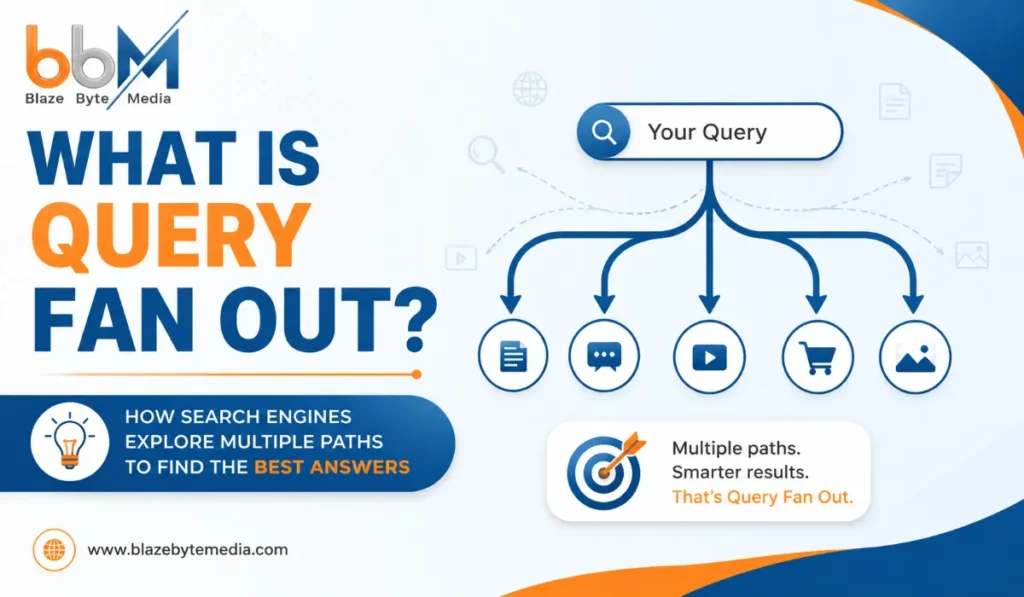
Type a question into Google’s AI Mode today and something strange happens behind the scenes. Your five word question does not travel to Google as one search. It quietly multiplies. One question becomes eight, ten, sometimes more, each one exploring a different angle of what you actually meant. Then, in the time it takes you to blink, all those answers get pulled back together into the single tidy response sitting in front of you.
That hidden multiplication has a name: query fan out. It is one of the most important shifts in search since Google first started ranking pages, and if you create content, run a website, or care about being found online, understanding it is no longer optional.
This guide breaks the concept down in plain language, using real documentation from Google, actual patent filings, and reporting from working SEOs who study this every day. No guesswork, no fluff, just what query fan out actually is and what you can do about it.
What Is Query Fan Out?
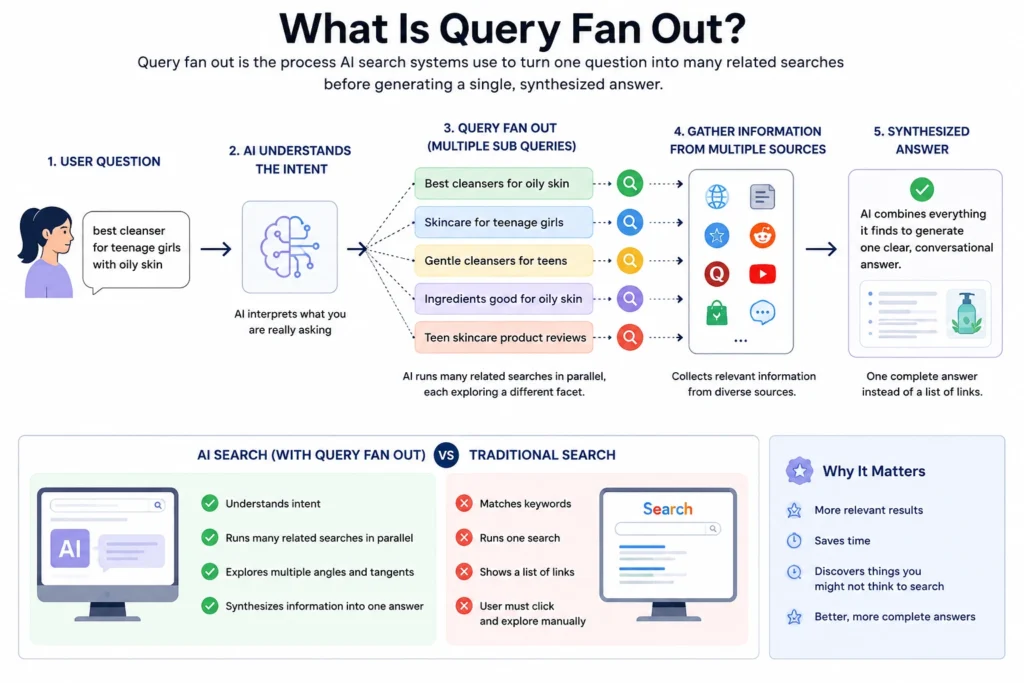
Query fan out is the process AI search systems use to turn one question into many related searches before generating a single answer. Instead of matching your query to one set of ranked links the way classic Google search does, an AI model interprets what you are really asking, then quietly runs several supporting searches in parallel. Each of those searches, sometimes called sub queries, digs into a different facet of your original question. The system then merges everything it finds into one synthesized, conversational answer.
Search Engine Land’s guide to the topic puts it simply: query fan out takes a single search query and delivers results that follow the natural tangents a user might have chased down manually in traditional search. The name comes from the visual idea of something fanning out from a central point, and that central point is your original question.
Picture someone searching “best cleanser for teenage girls with oily skin.” A traditional search engine would try to match that exact phrase to web pages. An AI system using fan out instead breaks the question apart and quietly searches for things like skin type suitability, age appropriate ingredients, gentleness, and real product reviews, even though the user never typed any of those words directly.
Where the Term Actually Comes From
Google itself never coined the phrase “query fan out” in its own marketing. The term grew organically out of the SEO community as practitioners tried to describe a pattern they kept observing. Mike King, founder of the SEO agency iPullRank, is widely credited with popularizing the phrase, describing it as a way of looking at the subintents that sit behind a single search query.
The concept became mainstream in May 2025 when Elizabeth Reid, Google’s Head of Search, used the phrase publicly during the Google I/O keynote while introducing AI Mode. She explained that AI Mode is not just handing back information, it is bringing a new level of intelligence to search through what her team internally calls the query fan out technique, where the system recognizes when a question needs deeper reasoning, calls on a custom version of Gemini to split the question into subtopics, and issues many searches simultaneously on the user’s behalf.
Interestingly, Google’s own patents describe this behavior using a completely different formal name. In patent US11663201B2, Google describes a system that takes one search query and generates several related query variants using a trained generative model, running each one separately and combining the results into a final answer. In the patent language, this is called query variant generation, not query fan out. A separate patent filed in December 2024 called Thematic Search describes an even closer match, where a single query like “moving to Denver” can generate sub queries built around themes such as neighborhoods, cost of living, and things to do, with the system capable of drilling down into sub themes and even sub sub themes as a user narrows their interest.
So while “query fan out” is not an officially trademarked Google term, it accurately describes documented, patented behavior that now sits at the center of modern AI search.
How Query Fan Out Actually Works, Step by Step
According to Search Engine Land’s detailed breakdown, the fan out process generally follows five stages.
1. Decomposition
The system first studies your query to identify its core subject, any important attributes or constraints you mentioned, implied comparisons or decisions you might be weighing, and the follow up questions a real human would naturally ask next. This step exists because treating every query as flat and literal fails badly for exploratory or decision based searches, where success depends on understanding intent and trade offs rather than matching words.
2. Expansion
Once the system understands the shape of your question, it expands it into multiple related sub queries. These are never shown to you directly, but they function like a research assistant’s supporting questions, together defining the full information space the system believes it needs to explore.
3. Execution
The system then runs all of those sub queries at the same time rather than one after another. Running searches in parallel is what makes near instant answers possible even when a dozen or more background searches are firing off simultaneously, and it prevents the system from committing too early to a narrow interpretation of what you wanted.
4. Synthesis
A large language model then reviews everything that came back, looking for recurring themes, resolving contradictions where it can, weighing which pieces of information best answer the original question, and organizing the findings into something readable.
5. Contextual Result Generation
Finally, instead of handing you a ranked list of ten blue links, the system delivers a synthesized explanation, often with supporting citations, and sometimes images, tables, or other structured data woven in. From where you are sitting, it feels like one clean answer. Behind the curtain, it is the product of many searches stitched together.
The Eight Types of Fan Out Sub Queries
One of the most useful things to come out of the patent research into this topic is a breakdown of the actual categories of sub queries these systems generate. Based on Google’s patent language and reporting from Search Engine Land, when Google applies fan out it tends to produce eight recognizable types of sub queries.
Using the seed query “best cleanser for teenage girls with oily skin” as an example:
Equivalent query. An alternative phrasing of the same core question, such as “best face wash for teenage girls with oily skin.”
Follow up query. A logical next question that naturally follows the original, such as whether oily teenage skin needs a foaming or gel cleanser.
Generalization query. A broader version of the original question, such as simply “best cleanser for oily skin.”
Specification query. A more detailed or constrained version, such as “best gentle cleanser for teenage girls with oily, acne prone skin.”
Canonicalization query. A standardized or normalized version of the phrasing, such as “recommended cleanser for teenage girls with oily skin.”
Language translation query. A translated version used to retrieve relevant content in another language, useful for pulling in international sources.
Entailment query. An implied question that logically follows from the original intent, such as whether teenagers with oily skin can use salicylic acid cleansers.
Clarification query. A question generated internally to narrow down ambiguous intent, such as confirming whether the user cares more about acne control or oil balance.
This structure explains how AI systems manage to answer complex questions thoroughly without ever pausing to ask you eight separate follow up questions. They quietly explore every angle on your behalf and stitch the findings into a single response.
Which AI Platforms Actually Use Query Fan Out
Query fan out is not a Google only phenomenon. According to Search Engine Land’s platform comparison, most major AI powered search tools rely on some version of this technique, even though each one implements and labels it differently.
Google AI Overviews and AI Mode. Google’s own developer documentation confirms its systems may issue multiple related searches across subtopics and data sources while building a response, gathering supporting pages as the answer forms so the result draws from a broader and more diverse set of sources than a classic search.
Gemini. Google’s Gemini API documentation does not use the phrase query fan out directly, but confirms that when needed, the model automatically generates one or several search queries and executes them to fill in missing context.
ChatGPT. OpenAI’s own help documentation describes a related behavior it calls query rewriting. If you ask ChatGPT about good restaurants near you, it can detect your general location and rewrite your prompt into a more specific search such as “top restaurants San Francisco” before retrieving results.
Grok. Grok uses a more constrained version of fan out, restating a prompt in a few different ways and running a handful of tightly focused searches against authoritative sources to verify quality and relevance, rather than broadly exploring the open web.
Perplexity. Perplexity previously displayed its intermediate reasoning steps to users, showing exactly how one question turned into several focused searches before the platform generated its final answer. That visible step by step view is no longer shown, but the underlying process is reportedly unchanged.
Microsoft Copilot. Copilot leans toward an iterative style, issuing a series of related searches grounded in Bing’s index, where each result helps shape the next search rather than firing everything off in one parallel burst.
Different labels, same underlying idea: treat the user’s original question as a starting point rather than a complete instruction, then let the system figure out what else needs to be searched to give a genuinely useful answer.
Query Fan Out Versus Traditional Keyword Research
This is the shift that matters most for anyone doing SEO, AEO, or GEO work.
Traditional keyword research identifies and targets individual search terms one at a time. The old workflow looked something like this: pick a primary keyword, build a page around that keyword’s intent, then optimize the headings, copy, and metadata to rank for that exact phrasing.
Query fan out flips that model. AI powered search systems are not evaluating your content against a single keyword. They are evaluating whether your page answers the entire cluster of related questions that surface once a query fans out. So instead of asking “did I target the right keyword,” the better question becomes “does this page cover the full set of questions someone would logically have about this topic.”
For example, a page built around “skincare products for girls” might also get evaluated against related fan out queries like skincare for oily teenage skin, skincare for dry skin, skincare for combination skin, what actually makes a product good, and a full skincare routine for girls. In the old keyword world, each of those might have become a separate article competing against your own content. In an AI search environment, they are treated as supporting sub questions of the very same topic, and a single comprehensive page that answers all of them stands a far better chance of being cited.
Why Query Fan Out Matters for SEO, AEO, and GEO
The practical impact here is significant, and it touches ranking, visibility, and even how you measure success.
Passage level relevance beats page level authority.
AI search systems increasingly pull and cite specific passages rather than scoring an entire page. That means a single well structured paragraph buried deep inside a longer article can earn a citation even if the rest of the page is unrelated to that specific sub query.
Ranking well no longer guarantees being cited.
Content can appear inside an AI Overview even when it is not ranking near the top of traditional results, and pages can rank well in classic search while never once being pulled into an AI generated answer. One frequently cited data point from AIOSEO’s 2025 research found that fifty two percent of sources cited inside Google AI Overviews rank somewhere in the top ten organic results, but not always in the number one spot, which shows citation and ranking are related but not identical.
Comprehensive coverage creates more entry points.
Because a single seed query can fan out into many sub queries, a page that thoroughly answers several of those angles gets more chances to be pulled into an AI answer than a page narrowly focused on one keyword.
Brand mentions and sentiment start to matter more.
Because these systems increasingly reason about how people actually talk about a brand or topic across the open web, not just what a page’s metadata claims, real world reputation and consistent factual coverage carry more weight than keyword density ever did.
What Google Itself Says You Should Actually Do
It is worth pausing here, because a lot of AEO and GEO advice circulating online overstates what is actually required. Google’s own developer documentation, updated as part of its guide to optimizing for generative AI features, is refreshingly direct about which popular tactics do not matter.
Google explicitly says you can ignore tactics like chunking content into artificial fragments, creating unnecessary AI specific text files such as llms.txt, or chasing inauthentic mentions, because Google Search does not use those files or reward that kind of manipulation. The guidance states plainly that from Google Search’s perspective, optimizing for generative AI search is optimizing for the search experience, and is therefore still SEO at its core.
Google also warns against a specific trap: creating a separate page for every conceivable fan out variation of a query purely to manipulate rankings or AI responses. The documentation states this approach violates Google’s scaled content abuse policy and is an ineffective long term strategy anyway, since a high quantity of thin pages does not make a website more relevant or authoritative. Google’s systems have become sophisticated enough to understand a page’s relevance even without an exact keyword match.
The practical, sanctioned path forward according to Google is to focus on genuinely useful, comprehensive content, monitor performance through the Generative AI performance report inside Search Console, and stay aware of emerging agentic technologies without chasing shortcuts.
How to Practically Optimize Your Content for Query Fan Out
Bringing together guidance from Search Engine Land, Conductor, and working SEO practitioners, here is a grounded, non hacky approach to building content that performs well once a query fans out.
Build genuine topical depth before you write.
Map out every sub question a real person would logically ask around your topic, covering specifications, comparisons, costs, locations, timeframes, and common objections, then make sure your page actually answers each one rather than just mentioning it in passing.
Structure content in clearly answerable chunks.
Use descriptive headings that mirror how a real person would phrase a follow up question, and make sure each section can stand on its own and be understood without requiring the full context of the entire page. This directly supports how AI systems extract individual passages.
Lean on pillar pages and topic clusters.
As SEO practitioner Peter Rota noted in a widely shared breakdown, most experienced SEOs are already halfway there simply by building comprehensive pillar pages surrounded by supporting cluster content, a strategy that predates AI search but maps naturally onto fan out behavior.
Mine real customer language.
Look at how actual people talk about your topic or brand on forums, review sites, and social platforms, and reflect that authentic language back into your content rather than relying purely on formal keyword phrasing.
Use People Also Ask and related searches as free research.
These features surface real, common follow up questions directly from Google’s own data, giving you a strong head start on anticipating what a fan out process might explore.
Prioritize accuracy and verifiability over cleverness.
AI Mode is explicitly designed to seek information supported by high quality web results in order to reduce hallucinated answers, so specific, current, and well sourced content earns more trust than vague or outdated claims.
Do not chase every synthetic sub query individually.
Because fan out queries are generated probabilistically, research from Surfer SEO found that only about twenty seven percent of them stay stable across repeated searches for the same topic, meaning a spreadsheet chasing exact fan out phrases will quickly go stale. Focus on covering the underlying themes thoroughly instead of hunting exact phrasing.
Track visibility differently than you used to.
Since Google does not share direct data about which fan out searches triggered a citation, many SEO teams are shifting from pure click through measurement toward visibility tracking tools and monitoring the Generative AI performance report inside Search Console.
Common Mistakes to Avoid
Creating dozens of near duplicate pages for every possible variation.
This is explicitly called out by Google as a spam risk, not a growth strategy.
Ignoring the topic in favor of the exact keyword.
A page obsessed with ranking for one precise phrase while ignoring the surrounding questions will struggle to earn citations across a fan out.
Treating AEO and GEO as separate from SEO.
Google’s own guidance is blunt about this: optimizing for generative AI search is still SEO, built on the same foundations of indexability, crawlability, useful text, and solid internal linking.
Assuming fan out queries are fixed and reliable.
Because the underlying language model generates these sub queries probabilistically, the exact wording changes from run to run even for an identical seed query, so building strategy around exact match sub queries is building on shifting sand.
Forgetting that simple queries may not trigger fan out at all.
According to Google’s AI Mode documentation, straightforward factual queries such as asking for the capital of a country generally do not activate extensive fan out, while complex, comparative, or exploratory queries do.
The Bottom Line
Query fan out represents a genuine turning point in how search works. Instead of matching a single phrase to a single set of ranked links, modern AI search systems quietly interpret what you actually want, split that intent into a web of related sub questions, search for each one in parallel, and hand you back one synthesized answer that feels effortless. Google confirmed this technique by name at its own developer conference, backed it up in multiple patent filings, and now bakes it into AI Overviews, AI Mode, and its Gemini models, while competitors like ChatGPT, Perplexity, Grok, and Copilot run their own versions of the same underlying idea.
For anyone creating content, the takeaway is not to chase every synthetic sub query with a new page. It is to build genuinely comprehensive, accurate, well structured content that holds up no matter which angle of a topic a user, or an AI system acting on their behalf, decides to explore next.
Frequently Asked Questions About Query Fan Out
What is query fan out in simple terms?
Query fan out is the process AI search systems use to break one user question into several related searches, run them all at once, and combine the findings into a single answer.
Who coined the term query fan out?
The phrase grew out of the SEO community, with Mike King of iPullRank widely credited as an early voice describing the subintents behind a search query, and Google’s Head of Search Elizabeth Reid later using the phrase publicly at Google I/O 2025.
Does Google officially use the term query fan out?
Google’s public facing marketing has used the phrase, notably during the AI Mode announcement at Google I/O 2025, but its formal patent documentation instead uses the term query variant generation.
Is query fan out the same as query expansion?
They describe closely related behavior. Query expansion generally refers to rephrasing or broadening a single query, while query fan out specifically describes generating multiple distinct sub queries that are run in parallel and then synthesized together.
What is the difference between query fan out and query decomposition?
Query decomposition is the first stage of fan out, where the system breaks a complex question into its core components before generating the actual sub queries.
Which Google patent describes query fan out?
Patent US11663201B2 describes a system that generates multiple related query variants from a single search using a trained generative model, and a separate patent called Thematic Search, filed in December 2024, describes a closely related system built around search themes.
What is the Thematic Search patent about?
It describes a system that organizes search results into themes, generates AI summaries for each theme, and can drill down into narrower sub themes as a user refines their search.
Does ChatGPT use query fan out?
ChatGPT uses a related process it documents as query rewriting, where it can automatically turn a vague prompt into a more specific search query before retrieving external information.
Does Perplexity use query fan out?
Yes. Perplexity previously showed users the individual search steps it took behind a single question inside a dedicated view, though that visible breakdown is no longer shown by default.
Does Microsoft Copilot use query fan out?
Copilot uses an iterative form of query expansion, issuing a series of related searches grounded in Bing’s index where each result helps shape the next search.
Does Grok use query fan out?
Grok uses a more constrained version, restating a prompt a few different ways and running a small number of focused searches against authoritative sources rather than broadly exploring the open web.
How many sub queries does a typical fan out generate?
This varies by platform and by how complex the original question is, ranging from a handful of searches for a moderately complex question up to a dozen or more for open ended or highly exploratory queries.
What triggers query fan out?
Complex, exploratory, comparative, or multi part questions tend to trigger fan out, while simple factual queries such as asking for a well known fact generally do not require it.
Do simple factual searches use query fan out?
Generally no. Straightforward factual queries are typically answered directly without triggering the broader fan out process.
What are the eight types of fan out sub queries?
According to patent based research, they are equivalent queries, follow up queries, generalization queries, specification queries, canonicalization queries, language translation queries, entailment queries, and clarification queries.
What is an equivalent query in fan out?
It is simply an alternative phrasing of the same original question, used to catch content that uses different wording for the same idea.
What is a follow up query in fan out?
It is a logical next question that a real person would naturally ask after the original query.
What is a generalization query in fan out?
It is a broader version of the original question, useful for capturing more general context around the topic.
What is a specification query in fan out?
It is a narrower, more detailed version of the original question that adds constraints the user may have implied but not stated.
What is a clarification query in fan out?
It is a sub query the system generates internally to narrow down ambiguous intent, essentially the system asking itself what the user probably meant.
How is query fan out different from traditional keyword research?
Traditional keyword research targets one specific search term at a time, while query fan out requires content to comprehensively answer the entire cluster of related questions that surface once a topic is explored.
Should I create a separate page for every fan out sub query?
No. Google explicitly warns that creating many near duplicate pages purely to cover every possible query variation violates its scaled content abuse policy and is an ineffective long term strategy.
Does content need to rank number one to be cited in an AI answer?
Not necessarily. Research cited by AIOSEO found that fifty two percent of sources cited in Google AI Overviews ranked somewhere in the top ten organic results, but not always in the top position, showing citation depends on more than raw rank.
What is AEO?
AEO stands for answer engine optimization, a term used to describe work focused specifically on improving visibility inside AI generated answers.
What is GEO?
GEO stands for generative engine optimization, a closely related term describing the practice of optimizing content so generative AI systems surface and cite it.
Are AEO and GEO different from SEO?
According to Google’s own developer documentation, optimizing for generative AI search experiences is still fundamentally SEO, built on the same core principles of indexability, crawlability, and genuinely useful content.
Do I need an llms.txt file to be visible in AI search?
No. Google’s documentation explicitly states that special machine readable files such as llms.txt are not required for visibility in Google Search or its generative AI features.
Does chunking content help with query fan out optimization?
Google’s own guidance says artificially chunking content is a tactic you can safely ignore, since it does not meaningfully affect how Google’s systems evaluate a page.
How can I track how my content performs in AI search results?
Google recommends monitoring the Generative AI performance report inside Search Console, and many SEO teams supplement this with third party AI visibility tracking tools since exact fan out data is not shared publicly.
Why do my top ranking pages sometimes not appear in AI Overviews?
Because AI systems evaluate content against a whole cluster of fan out sub queries rather than a single keyword match, a page can rank well traditionally while still missing coverage on the specific angle an AI system decided to explore.
Are fan out sub queries consistent every time I search the same thing?
No. Research from Surfer SEO found that only about twenty seven percent of generated sub queries stay stable across repeated identical searches, since the underlying language model generates them probabilistically.
What is retrieval augmented generation and how does it relate to fan out?
Retrieval augmented generation, often shortened to RAG, is the broader architecture where an AI model retrieves external information before generating a response, and query fan out is the specific technique used to strengthen the retrieval step within that architecture.
Does query fan out reduce hallucinations in AI answers?
It can help, since pulling in multiple sources across several sub queries gives the model more grounded, verifiable information to draw from, though Google itself acknowledges AI Mode is an early stage product that will not always get things right.
What is a data void and how does it relate to fan out?
A data void is a topic where little high quality information exists online, which can actually work in a smaller publisher’s favor, since being one of the few credible sources on a niche topic can help content gain prominence when a fan out process struggles to find alternatives.
Should small websites worry about competing with big brands under query fan out?
Not necessarily. Because AI systems can cite specific passages rather than only whole page authority, a smaller site with genuinely detailed, accurate coverage of a narrow sub topic can still earn a citation that a larger, more generic page misses.
How does query fan out affect click through rates to websites?
Industry reporting suggests that when an AI generated answer fully satisfies a user’s question, fewer users click through to the original source, shifting the value of SEO from a pure traffic channel toward broader brand visibility and trust.
What tools can help simulate query fan out?
Several third party tools, including AlsoAsked, Profound, and Semrush’s AI Overview tracking features, attempt to simulate or monitor fan out behavior, though none can access Google’s exact internal process.
Is query fan out used only by Google?
No. While Google popularized the term, similar underlying behavior appears across ChatGPT, Perplexity, Grok, Microsoft Copilot, and Gemini, each implemented and labeled slightly differently.
What is the single most important takeaway for content creators?
Stop optimizing for one exact keyword phrase and start building genuinely comprehensive, accurate content that answers the full range of related questions a real person would logically have about your topic.